



The Dish on Dashcams
YouTube dashcam posts are everywhere now! Activities caught on dashcams include meteors, animals crossing, winding mountain roads and accidents. Beyond unbearably cute bear families, having dashcam footage can protect you from potential liability for accidents, particularly when the other driver is at fault, uninsured or drives off in a hurry.
At Mount Airy Toyota, we want you to travel safely, and we know that anything can happen while you’re driving and it’s good to be prepared. Dashcams are a great way to capture evidence should you be in an accident.
Dashcams (dash cameras) have become more popular than ever in recent years. In 2023, it was estimated that 10-15% of U.S. drivers had dash cams (Yahoo! finance).
In early 2024, Yahoo Finance also reported that dashcams sales had a revenue of $4 billion in 2022 and it was estimated that this will increase to $12 billion by 2033. The article further went on to state, “The growth of the market is attributed to the amplifying rate of road accidents around the world. According to the World Health Organization, more than 1.19 million individuals die in road crashes and about 20 to 50 million people experience injuries that lead to disability. An increase in the number of cars and other vehicle purchases across the globe is projected to hike the demand for the dashboard camera market.”
The desire to have a dashcam in vehicles varies by driver, but the main reason is to protect yourself from liability in a traffic accident, particularly from incidents such as a staged accident, false insurance claims or hit-and-runs. Dashcams can also be useful to monitor your vehicle when you are not in it or to record disputes or incidents. While insurance companies typically don’t offer discounts if you have one, it can help you with claim resolution by proving you were not at fault. Many commercial vehicles rely on dash cam videos to document road incidents. Law enforcement and emergency services use dashcam footage for a variety of purposes.
There are many options to choose from on the market and here are some considerations:
- Do you need a dashcam with a screen?
- What about an interior camera?
- Would you like the dashcam to monitor vehicle speed and have GPS locating?
- How well does it work at night?
- Is it legal in your area and what does your car insurer think about them?
It is legal in North Carolina to have a dashcam (be sure it’s not obstructing your view) and you should ask your insurance company if they offer any discounts for having one.
Best Dashcams
In 2024, Car and Driver Magazine compiled a list of their dashcam picks that focused on options, price and overall quality.
For overall use, they chose the Vantrue N4.
“The Vantrue N4 is an exceptional value, offering a dashcam, cabin-facing camera, and rearview camera. It attaches to the windshield with a suction mount, and its cameras can be adjusted for optimal coverage. The front dashcam records at 2560 by 2160 pixels but drops to 2560 by 1440 when all three cameras are used. The cabin and rear cameras have 1920 by 1080 resolution. The cameras have wide fields of view with minimal distortion, and the cabin camera includes infrared lighting for low-light conditions.” Car and Driver adds, “The N4’s integrated screen features a picture-in-picture mode that displays all three cameras’ feeds simultaneously, along with settings and recording modes. It offers low-frame-rate and low-bit-rate recording modes, but we found these can drain the car battery. The device also includes collision and motion detection, automatically saving relevant footage. A 128 GB micro SD card holds about 6.7 hours of footage.”
Car and Driver noted this pick for best overall dashcam was because of the reasonable price point, quality of image in various lighting conditions and features. List price $289.99 Amazon
In the premium range, Car and Driver went with the Cobra SC 400D.
“As far as pure visual performance, the Cobra SC 400D was the best dashcam we tested thanks to its 4K resolution. We agreed that its video footage genuinely looked the best too. We found the touchscreen to be easy to operate and responsive, and the Cobra uses its proprietary DriveSmarter app to provide police alerts and other driver reports. If we had one minor grumble, it would be that the mount only swivels forward and backward, not side to side. However, the wide angle of the lens practically eliminates the need to do so. The Cobra secures to the windshield via a large sticky pad for the mount and a very strong magnet for the camera itself.” Shares Car and Driver. List price $399.95 Amazon
For a dashcam that won’t break your budget, Car and Driver picked the Car and Driver 1080P HD Dashcam.
Shares Car and Driver, “We appreciate that we’ll probably get some flak for including this model in this test when there are so many dash cams out there. But we were determined to evaluate our (licensed) namesake unit on its own merits—and darned if it didn’t step up as the best budget option we tested.”
“The Car and Driver 1080P Dashcam has front and rear cameras and a touchscreen interface for easy driver control. The unit has standard features like parking mode, collision detection, and a G sensor to keep one eye open after you’ve left the vehicle. “
“One thing we really liked about this model is its dual tripod option that allows different mounting iterations from the top or bottom of the camera. This feature made it easy to adjust the dash cam according to the angle of the windshield. This budget-friendly dual camera covers all the essential features and has adjustable orientations. It’s an excellent choice for dashcam beginners.” List price $49.99 Walmart
Another entry-level dashcam is the Nexar Beam. “With a reasonable price tag, it boasts the standard features you’d expect to find, like parking guardian and G-sensor collision detection, and advanced features like GPS connectivity for data overlay. Another unique option is that the app can generate an insurance incident report aligning with footage and handy GPS coordinates.” List $129.99 Amazon
For a compact model, Car and Driver’s petite pick is the Garmin Mini 2. “The Garmin Mini 2 is an excellent choice for someone looking to keep their dashcam discreet and out of the way. It’s compact enough to tuck behind your rearview mirror if so desired. The app functionality is quite nice as well, and the 1080p matched up well against the competition despite its diminutive size.” Car and Driver continues, “While it’s a nice set-and-forget dashcam, we found that it’s a bit tricky to determine whether everything is set up correctly without checking it via the app. The lack of a screen makes it difficult to see if the camera is lined up properly. Additionally, there are a few different lights that blink on the cam, and it’s confusing at first to know what they all mean. But once you get that all set, the Garmin Mini 2 is a solid choice for a tiny dash cam.” List price $129.99 Amazon.
If you want to dash in a flash, The MAXcam 360c primarily serves as a radar detector with a secondary dash-cam function and is Car and Driver’s pick for a combination device. It isn’t ideal for those seeking only a dashcam. But for anyone wanting a radar detector with a competent camera, it’s a solid choice.
“The dashcam boasts a 2560 by 1440 resolution with a Sony Starvis image sensor that captures 30 frames per second and offers a 143-degree field of view. The video quality is contrasty (sharp), with noticeable noise reduction and compression that significantly impacts image quality. We found the MAXcam 360c performed well in low-light conditions, although finer details became blurry. It clearly captured license plates up to ten feet away under ideal conditions, but beyond that, its clarity is a miss, even in the most ideal conditions.” Car and Driver adds, “This product isn’t suitable for everyone due to its high cost and the complexity of using a radar scanner. But if you’re looking for a radar detector as well as a dashcam and want to kill both birds with one stone, this Escort fits the bill.” List $849.95 Amazon.
What about my Toyota?
Some recent Toyota models came with Toyota Integrated Dashcam. This was available on the following vehicles:
- 2022-2023 Toyota Camry
- 2022-2023 Toyota Highlander
- 2023 Toyota Prius
- 2023 Toyota RAV4
- 2023 Toyota RAV4 Prime
- 2023 Toyota Sequoia Hybrid
- 2021-2023 Toyota Sienna Hybrid
- 2022- 2023 Toyota Tacoma
- 2022-2023 Toyota Tundra
- 2021-2023 Toyota Venza
Toyota Genuine Dashcam was available with the 2019-2023 Toyota 4Runner.
Both of these systems include interesting event reporting, parking surveillance and more. If you need assistance using your Toyota dash camera product, reach out to the team at Mount Airy Toyota.

2024 Toyota Tundra
2024 is a huge year for Toyota vehicles, especially the all-new Tundra. The 2024 Toyota Tundra comes fitted with a new suspension, plenty of updated technology, a tougher and sportier design, and more available packages. But one upgrade that all our truck enthusiasts here at Mount Airy Toyota are talking about is the 2024 Tundra’s two new powertrain options–a twin-turbo V6 engine and a hybrid twin-turbo V6 engine.
- Twin-Turbo V6: can tow up to 12,000 pounds and comes paired with a 10-speed electronically controlled automatic transmission; sequential shift mode; uphill/downhill shift logic; and TOW/HAUL driving modes.
- Hybrid Twin-Turbo V6: generates 437 horsepower and 583 lb.-ft. of torque; also comes paired with a 10-speed electronically controlled automatic transmission; sequential shift mode; uphill/downhill shift logic; and TOW/HAUL driving modes.
Truck drivers shopping for a full-size pickup usually have a specific reason for such a vehicle. These types of trucks are not only for the casual truck driver. They are made to work well under serious conditions and to produce time and again. Full-size trucks can pull and haul just about anything to anywhere–imagine pulling a boat or camper from Charlotte to Mount Airy; would you trust a simple pickup for this? In the world of full-size pickup trucks, there are a select few with histories of continued durability and power. Among these, the 2024 Toyota Tundra has already proven itself as the top contender. This year, the 2024 Toyota Tundra is better than it has ever been.
2024 Toyota Sequoia
The 2024 Toyota Sequoia is the latest in Toyota’s lineup to come in a TRD Pro edition. This exclusive trim level comes with tons of upgrades, but one exclusive to the Sequoia TRD Pro package is the new Terra paint color. This terra cotta/orange chocolate color is quite striking and at Mount Airy Toyota, we already have staff naming the new Terra color their favorite.
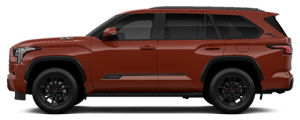
The Toyota TRD Pro edition focuses mostly on off-roading and sport driving features, all of which do plenty to produce a more comfortable and exciting ride. Some upgrades to the 2024 Sequoia TRD Pro are new shocks, exhausts, and a more powerful drivetrain. Other features of the TRD Pro package include:
- Black over-fenders, LED lighting, and TRD Pro badges
- 17-inch or 18-inch matte black or alloy wheels with all-terrain tires
- TRD-tuned suspension and FOX high-performance shocks
- TRD simulated leather upholstery, TRD Pro all-weather floor liners, and heated front seats
- Multi-terrain monitor with front, rear, and side camera views, panoramic view monitor, and Toyota Safety Sense suite of driver-assistance features
- Skid plate, TRD roof rack, power rear liftgate, rear privacy glass, and power tilt/slide moonroof
One other aspect of the 2024 Toyota Sequoia TRD Pro we like is the “Heritage Grille.” Where you usually see the traditional Toyota logo centered in the upper front grille, with the TRD Pro upgrade, the grille gets a textured surface with the Toyota nameplate running across the top. There’s not only one style of this grille, but it can also come in different shapes and shades, and it is the easiest way to make your new Sequoia look unique.
New Toyota Highlander
The Toyota Highlander, one of the car company’s most prominent family vehicles, comes with a few changes for 2024, but nothing too drastic (if it ain’t broke…). This year, Toyota has decided to discontinue the entry-level L trim, and it has added a hands-free power liftgate that comes in the mid-level trims. For the 2024 Highlander hybrid model, Toyota has swapped the previous Bronze edition for a new and improved Nightshade Edition.
The 2024 Highlander Hybrid Nightshade Edition comes with tons of stylistic changes, the most obvious, a blacked-out grille, mirror caps, wheels, and rear badging. Nightshade is available on the Highlander Hybrid LE and XLE trim levels. It’s certainly one of the sleekest-looking vehicles on Mount Airy Toyota’s lot! This added layer of style to the new Highlander provides captivating elements for both the exterior and interior–the black seats with silver accents on the interior really make the inside pop. Here are a few more new features of the 2024 Highlander Nightshade:
- Stylish 18-inch black wheels and accents
- Available on the LE or XLE editions along with a choice of front- or all-wheel-drive
- Either a hybrid or turbo-charged 4-cylinder
- Up to 36 combined miles per gallon
- Hands-free power Liftgate now standard on all XLE (gas, hybrid, nightshade) and XSE (Gas) editions
- Audio Multimedia System with a 12.3-inch touchscreen comes standard
The Highlander’s size makes it one of the most sought-after crossover SUVs on the market. One thing Mount Airy Toyota customers like best about the Highlander is that it’s not too big that it gets in the way, and it’s not too small so that it can’t stow, pull, or haul as a sport utility vehicle should. On the road, it conserves gas, maintains an incredibly quiet ride, and its many compartments and excess space allow for premium stowage.
2024 Toyota 4Runner
This year, Toyota has made major upgrades to the 2024 4Runner, most notably in terms of safety. 4Runners have always scored high in the safety department, but the newest iteration of the famed SUV is the most impressive yet. The all-new 4Runner has what Toyota calls, “Safety Sense,” a suite of safety systems designed to not only keep you safe during an accident but also to keep accidents from happening altogether. The 2024 4Runner’s safety ratings soar with forward collision warning, automatic emergency braking (in case your foot can’t make it to the brake pedal in time), lane-departure alert, adaptive cruise control, automatic high beams, and pedestrian pre-collision. There is also lane keep assist, blind-spot monitoring, and rear cross-traffic alert.
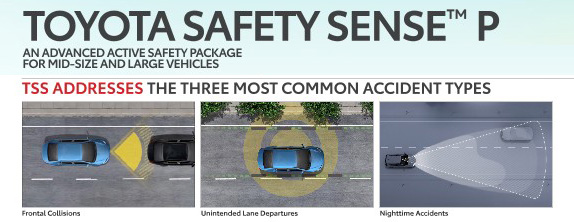
Our technicians at Mount Airy Toyota were most impressed with the 4Runner’s Pre-Collision System. Though the inner workings of this system are complex, using it couldn’t be easier. To help you avoid an accident, the Pre-Collision System uses advanced road-monitoring technologies to “see” the road ahead of you. Then it alerts you, the driver, in three phases:
- Phase 1–Alert. Once the system detects something (a vehicle, pedestrian, animal, etc.) in the direct path of the car, an audio and/or visual forward-collision warning will be triggered. This is simply to let you know there is something up ahead.
- Phase 2–Brake Assist. Once an object has been detected and an alert to the driver has been made, brake assist is applied to help the driver begin to slow the car.
- Phase 3–Automatic Braking. If the driver does not respond to phases 1-2, the 4Runner will use the Pre-Collision System to deploy automatic braking.
The Toyota 4Runner has quickly, in terms of years, created a Wrangler-like cult following, and with such a bevy of features and performance levels, it isn’t difficult to see why.
2024 Toyota Prius
Motortrend’s “car of the year,” the 2024 Toyota Prius is the new gold standard in hybrids. The 2024 Prius model is longer, lower, and wider and has updated headlights and taillights, giving it a sleek yet substantial look, one much sportier than ever before.
Though the new exterior look might be the most obvious difference of the new Prius, the most notable update is the 2.0-liter hybrid engine. Both the hybrid engine and the electric motors seamlessly work together to provide an incredibly smooth ride. While driving the 2024 Prius, the electric motors will run, but the 2.0-liter hybrid engine will take over when the charge runs low. There’s also a larger, more energized battery that offers 52 miles per gallon and up to a 44-mile range when driving all-electric. This means you can drive from Matthews to Huntersville and back without having to use the hybrid engine at all.
Hybrid and electric vehicles are being made at a rate higher than ever, and it’s no surprise, seeing how much money and energy is saved by those who choose to drive a car that you can plug in. At the top of the hybrid car list for 2024 is the all-new Toyota Prius. With its cool new exterior, and with a bit more pep in its step, the Prius is this year’s hottest energy-saving vehicle on the road.
2024 Toyota Sienna
One important aspect of the 2024 Toyota Sienna minivan, one setting it apart from all others in its class, is that every Sienna model now comes as hybrid. Since there has been so much success with hybrid vehicles–especially Toyota hybrids–they figured why not? It’s doubtful anyone will disagree with them on this, especially since Toyota has also expanded its hybrid warranty. Now, any Sienna model from 2020 forward will receive a 10-year battery warranty from first use or 150,000 miles, whichever comes first. Going from an 8-year warranty or 100,000 miles to this is a bold move, and a sign of confidence in the power, performance, and longevity of Toyota’s hybrid battery.
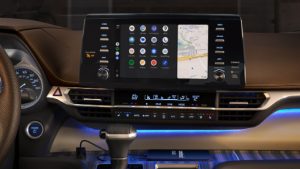
Another aspect of the 2024 Sienna that sets it apart from its predecessors is its new XSE Premium Package, one that provides increased levels of luxury and comfort. Here is what’s included in the all-new XSE trim level:
- Quality SofTex synthetic leather seats that can handle heavy-duty traffic
- Second-row captain’s chairs which provide more room to move around and easier access to the back row (the back row seats fold, giving even more room)
- Premium audio and a 9-inch touchscreen
- Four-zone climate control so everyone from front to back in the Sienna is happy
- Illuminated remote entry so you can lock and unlock, even start and stop your car even when you are in the dark
Other features include, six USB ports, the Driver Easy Speak feature, and the Rear Seat Reminder feature, so whether you and your family are driving the hills of the Blue Ridge Parkway, or if you find yourself caught in traffic on US 74 in Charlotte, comfort levels should remain the same.
The XSE Premium Package, a top-of-the-line hybrid battery, and all-wheel drive (an optional upgrade) turn the 2024 Toyota Sienna minivan into more of a luxury SUV–but without the hefty price tag.
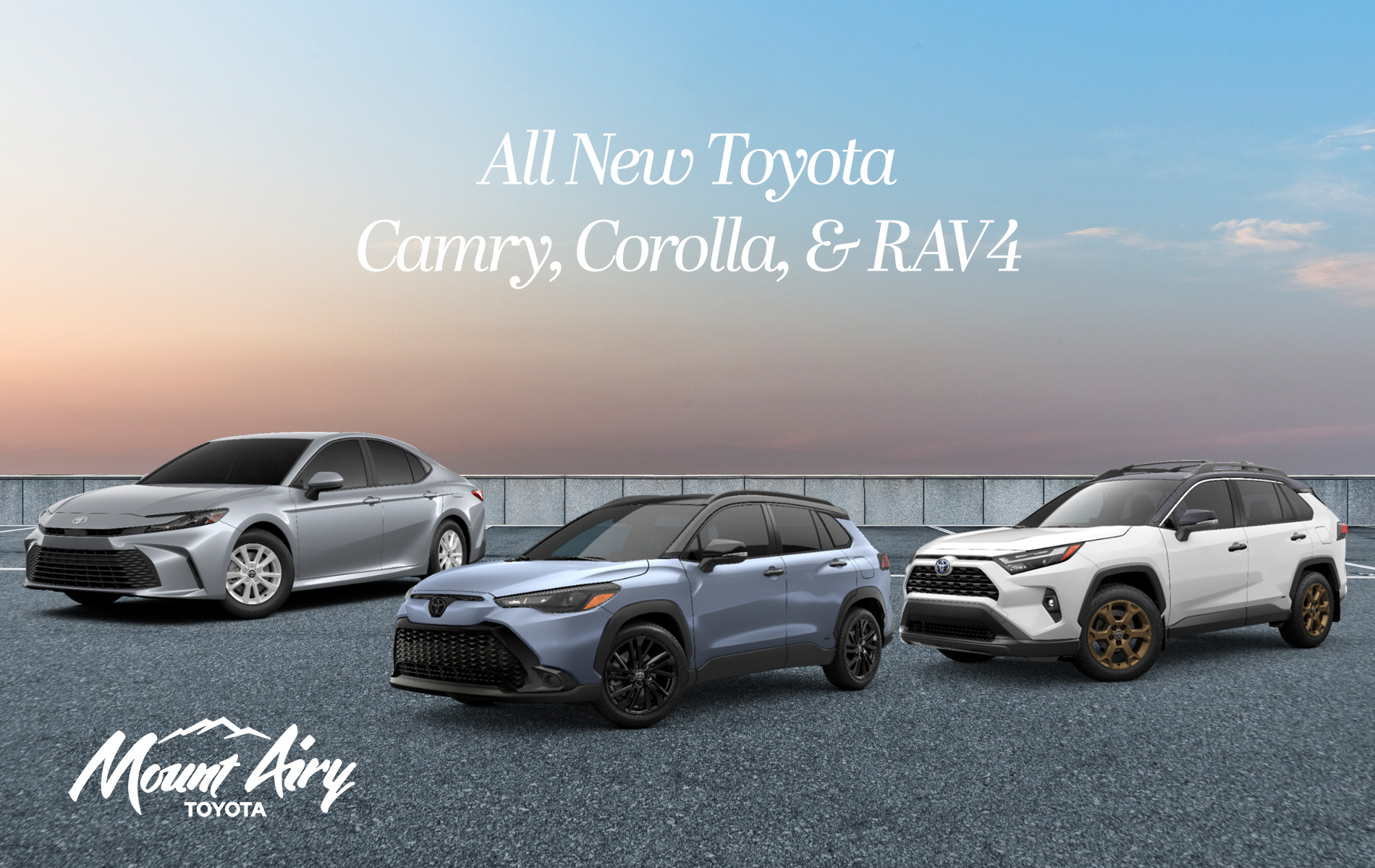
2024 Toyota RAV4
Every trim level of Toyota’s 2024 RAV4 comes with a free trial of Remote Connect, a feature that keeps you in direct contact with your car through an app on your phone. Through this app you can start and stop the engine, lock and unlock doors, find your vehicle, and access your RAV 4’s health status.
And that’s not all. Recently, a Mount Airy Toyota customer shared that she was able to use her Remote Connect for emergency roadside assistance, and she was able to make her monthly car payment all by using the app. This got us thinking, what else can one do with Toyota’s Remote Connect? Here is what we found:
- Remote Connect gives you 24/7 access to response for emergencies, so no matter where you are and no matter what time it is, you will be helped.
- You also get 24-hour access to a live agent who can help you with directions, addresses, points of interest, you name it.
- It is true, you can even pay bills through the app!
- You can schedule maintenance, car pick-up or drop-off, even track the progress of the service being performed and make a payment on the work being done to your RAV4.
The best thing about both the 2024 Toyota RAV4 is its unmatched reliability. Through the years, this compact SUV has won plenty of awards and has even been rated by U.S. News & World Report as one of the most reliable SUVs on the market today.
2024 Toyota Camry
New this year, the 2024 Camry comes in eight different trim levels, so there are plenty of options to fit your particular lifestyle. There’s the LE, SE, SE Nightshade, XLE, XSE, TRD, XLE V6, and the XSE V6, and all provide the power and reliability we have come to expect from the Toyota Camry.
Any Camry with a trim level that has an L in it offers a soft ride with easy, accurate steering. These are the cruiser cars that roll into curves and float down the road. Trim levels with an S and/or XSE tend to have a stiffer suspension and shorter ride height. They also have a bit more heft in the steering than an S. Though they are not considered sports cars, these are the more entertaining drivers, at least more so than most modern sedans. Though this is not true with all other car brands, Camry hybrids generally perform just as well as their non-hybrid siblings, due to their expert design and powerful batteries. The THS-II is a dynamic hybrid system that saves you money on fuel and still packs a punch like the others, so if you regularly travel longer distances, for example going back and forth from Mount Airy and Charlotte, the Camry THS-II could be a better choice.
The 2024 Camry is just as reliable as it has always been. It drives like a dream and feels like luxury, so it’s the perfect driver for family vacations and quick trips to the grocery store. The 2024 Toyota Camry is for the frugal driver who wants a little something more in a sedan.
2024 Toyota Corolla
The 2024 Toyota Corolla offers several hybrid trims that combine an electric motor with a gasoline engine for improved fuel efficiency. These include the LE, SE, Nightshade Edition, XSE, Hybrid LE, Hybrid SE, Hybrid Nightshade Edition, and the Hybrid XLE.
When Toyota makes a reliable car that gets good reviews, and at a good price point, they stick to the formula. Fortunately, this is the case for the 2024 Toyota Corolla. The engineers did not make many changes to 2024. The most notable difference is the return of the Nightshade Edition. This trim features a sporty blacked-out exterior with bronze wheels and black accents inside. Both the 2023 and the 2024 offer feature favorites like a touchscreen display with Apple CarPlay and Android Auto, automatic climate control, and a suite of safety features.
If you are pondering a switch to electric but aren’t ready to make the full commitment to a total electric vehicle, the 2024 Toyota Corolla Hybrid is the right choice. Several of our staff members have hybrids that they charge in their garages. Some were worried about the additional electric bills, or alterations to their garages, but after a couple of years, they reported cost savings, and all are happy with the convenience of charging at home. For more information on hybrid vehicles at Mount Airy Toyota check out this blog article.
When car shopping, there is only one thing in mind: get the right car. This begins by looking for vehicles that have been around a while and are known for their superior performance and longevity. You know, something like the Toyota Corolla, which has been around since 1974 and has been noted as the best-selling car worldwide.
If you’ve been on the road lately, chances are you’ve seen a Toyota RAV4 zipping past or parked in every other driveway. Have you ever wondered why this compact SUV is everywhere? It’s not just a coincidence—the Toyota RAV4 has become America’s best-selling SUV for many reasons. From its sleek design and impressive fuel efficiency to its reliable performance and family-friendly features, the RAV4 has something for everyone. Below, Mount Airy Toyota explains why this powerhouse on wheels has captured the hearts (and garages) of so many drivers nationwide.

History Rundown of the Toyota RAV4
The Toyota RAV4, short for “Recreational Activity Vehicle: 4-Wheel Drive,” debuted in 1994 and revolutionized the automotive market by pioneering the compact crossover SUV segment. The innovative vehicle was designed to combine the benefits of an SUV (e.g., higher visibility, increased cargo capacity, off-road capability) with a car’s fuel efficiency and handling.
The first-generation RAV4 launched in Japan and Europe before making its way to North America in 1996; it was an instant hit. It featured a unibody construction, a front-wheel-drive layout (with optional all-wheel drive), and a modest yet efficient 2.0-liter engine. This combination appealed to a wide range of consumers, from urban dwellers looking for practicality to outdoor enthusiasts needing a versatile ride.
As the RAV4 evolved, Toyota continued to innovate. The second generation came out in 2000 with a larger body and more powerful engine options. By the time the third generation emerged in 2005, the RAV4 had grown in size and offered a third-row seat option, which made it even more family-friendly.
The fourth generation, which appeared in 2013, marked a significant shift in design and technology. It showcased a sleeker aesthetic, better safety features, and enhanced fuel efficiency. The introduction of the RAV4 Hybrid in 2016 catered to the growing demand for eco-friendly vehicles, solidifying its position as a market leader.
The fifth and current generation, launched in 2018, takes the RAV4’s legacy to new heights. It boasts a rugged design inspired by Toyota’s off-road heritage, advanced tech features, and a suite of driver-assistance systems. The RAV4 Prime is a plug-in hybrid variant demonstrating Toyota’s commitment to sustainability and innovation. From its inception to its current status as a best-seller, the Toyota RAV4 has relentlessly adapted to consumer needs and market trends. By all appearances, it will remain a beloved choice for drivers across the globe—for many years to come.
Flawless Design, Features for Days
The Toyota RAV4 perfectly blends style, comfort, and technology, making it a top choice for a wide range of drivers. Let’s break down what makes the RAV4’s design and features so compelling:
Exterior Design
- Sleek and Modern: The RAV4’s exterior design harmonizes ruggedness and sophistication. Its bold front grille, sharp LED headlights, and sculpted body lines give it a dynamic, unmistakable presence on the road.
- Rugged Appeal: The RAV4 Adventure and TRD Off-Road models offer higher ground clearance, all-terrain tires, and unique styling cues that distinguish them from the rest of the lineup.
- Versatility: The RAV4’s design is not just about looks. Features like roof rails and an available hands-free power liftgate make it easy to load up for a family trip, a weekend getaway, or any other journey.
Interior Comfort
- Spacious Cabin: Inside, the RAV4 offers ample space for passengers and cargo. Generous legroom and headroom allow five to sit comfortably, so it’s ideal for families and carpoolers.
- Premium Materials: Toyota has upped the ante with high-quality materials and finishes. Options like SofTex-trimmed seats and a panoramic moonroof add a touch of luxury.
- User-Friendly Technology: The RAV4 is packed with tech features that enhance the overall driving experience. Among other things, the standard Entune 3.0 system includes a 7-inch touchscreen, Apple CarPlay, Android Auto, and Amazon Alexa compatibility.
Safety Features
- Toyota Safety Sense 2.0: Standard across all trims, this suite of advanced safety features includes the Pre-Collision System with Pedestrian Detection, Lane Departure Alert with Steering Assist, and Dynamic Radar Cruise Control.
- Blind Spot Monitoring: This feature is available on higher trims and helps drivers stay aware of their surroundings; it reduces the risk of collisions when changing lanes.
- Rear Cross-Traffic Alert: This handy feature enhances overall safety by alerting drivers to approaching vehicles when backing out of parking spaces.
The RAV4’s design and features transcend aesthetics and comfort—they yield a versatile, safe, and enjoyable driving experience. The SUV is designed to meet needs and exceed expectations, whether you’re navigating city streets or exploring off-the-beaten-path trails. Check out our inventory of new RAV4 models at Mount Airy Toyota!
A Reliable Performer
Performance and reliability are two areas where the RAV4 genuinely shines. Here’s why:
Engine Options and Performance Specs
The RAV4 offers a variety of engine choices to suit different driving preferences. The standard gas engine is a 2.5-liter 4-cylinder that delivers a solid 203 horsepower, providing plenty of get-up-and-go for everyday driving. It’s responsive and smooth, making your daily commute or weekend road trips a breeze.
For those looking to go green, the RAV4 Hybrid matches the same 2.5-liter engine with an electric motor for a combined 219 horsepower. It’s not just about power, though—the hybrid offers impressive fuel efficiency, which means fewer stops at the gas station. The plug-in hybrid variant (RAV4 Prime) is a game-changer; a whopping 302 horsepower makes it the most powerful RAV4 ever. Plus, it offers up to 42 miles of electric-only driving range and is ideal for short commutes and errands around town.
Fuel Economy
Fuel efficiency is one of the most important factors for drivers these days, and the RAV4 doesn’t disappoint. The standard RAV4 gets an EPA-estimated 28 mpg in the city and 35 mpg on the highway, while the hybrid model kicks it up a notch with an EPA-estimated 41 mpg in the city and 38 mpg on the highway. You’ll save money and reduce your carbon footprint!
Toyota’s Reputation for Reliability
To buy a Toyota is to buy peace of mind. These vehicles are known for their durability and longevity. In fact, seeing a RAV4 with well over 200,000 miles still running strong is quite common. Thanks to Toyota’s reliable engineering and expert service centers like Mount Airy Toyota, maintenance costs for the RAV4 are typically lower than average. And Toyota gives you a fantastic warranty to keep you covered.
Driving Experience
The RAV4 isn’t just reliable—it’s fun to drive. The suspension system is tuned for comfort and smooths out bumps to make every ride enjoyable. If you regularly navigate challenging weather or seek off-road adventures, the RAV4 offers several all-wheel drive options that enhance traction and stability.
In a nutshell, the RAV4’s performance and reliability make it a standout choice in the crowded SUV market. Power, efficiency, and peace of mind will have you feeling really good about your purchase!
3 Ways the RAV4 Appeals to Drivers
The Toyota RAV4 has captured a broad spectrum of the market, appealing to various demographics with its versatile offerings. Here’s a look at what makes it so attractive:
1. Affordability and Value for Money
One key reason the RAV4 is so popular is its competitive pricing. It arguably balances cost and features better than any other vehicle, which makes it accessible to a wide range of buyers. Starting at a reasonable price, it provides excellent value with standard features like advanced safety systems, a user-friendly infotainment setup, and a comfortable interior. Toyota’s renowned reliability and affordable maintenance further enhance its appeal.
2. Target Demographics
The RAV4’s versatility means it appeals to a diverse group of drivers. The spacious interior and ample cargo space make it a practical choice for families. Toyota Safety Sense provides peace of mind for parents, while the Adventure and TRD Off-Road models offer rugged capabilities and all-terrain performance for outdoor enthusiasts. Meanwhile, eco-conscious drivers are drawn to the Hybrid and Prime models for their excellent fuel efficiency and reduced environmental impact. Daily commuters also appreciate the RAV4’s comfortable ride, fuel efficiency, and tech-savvy features.
3. Comparison with Competitors
The RAV4 shines in the convoluted compact SUV segment; the Honda CR-V, Mazda CX-5, Ford Escape, and other rivals don’t hold a candle. It combines reliability, fuel efficiency, and a comprehensive suite of standard safety features to keep an edge year after year. The availability of hybrid and plug-in hybrid variants also sets it apart, catering to the growing demand for eco-friendly vehicles. Moreover, the RAV4’s resale value remains strong, so it’s a stellar long-term investment.
The RAV4’s Future Is Bright
Despite its consistent success, the Toyota RAV4 isn’t resting on its laurels. Toyota is constantly looking ahead to keep the compact SUV at the forefront of the game. Here’s a glimpse into what the future holds for this popular model:
Upcoming Models and Features
- New Trims and Editions: Toyota is always adding fresh trims and special editions—such as the RAV4 Woodland Edition with a trail-tuned suspension—to keep things exciting. You can expect other new variations with unique features and design elements to cater to evolving tastes and preferences.
- Enhanced Technology: Future RAV4 models will likely boast tech upgrades, including even more advanced driver-assistance systems and infotainment options. Think upgraded navigation systems, better connectivity, and more intuitive interfaces.
- Improved Hybrid Options: Toyota is expected to refine its hybrid offerings to meet the growing demand for green vehicles. In the next few years, we might see battery enhancements that yield better performance and longer electric ranges for the RAV4 Hybrid and Prime models.
Toyota’s Plans for Innovation and Sustainability
- Advanced Safety Features: Toyota has always been committed to pushing the envelope on safety. Future RAV4s will likely provide new, cutting-edge technologies via the Safety Sense suite to make driving safer and more secure.
- Sustainability Initiatives: As part of its broader sustainability goals, Toyota plans to introduce more eco-friendly features. This could mean further improving fuel efficiency and releasing new hybrid or electric variants.
- Off-Road Capabilities: Expect Toyota to continue improving the RAV4’s off-road prowess through the Adventure and TRD Off-Road models; they’ll be even more capable of tackling rough terrain.
Final Thoughts
The Toyota RAV4 has become America’s favorite SUV for many good reasons. Its stylish looks and fantastic features achieve form and function like no other in its class. You can always count on its solid performance and unmatched reliability, making it a top pick for families, adventurers, and eco-friendly drivers.
Toyota’s dedication to innovation and sustainability means the RAV4 will get even better over the years. Whether you need a dependable ride for your daily commute or an adventure-ready vehicle for your weekend getaways, this compact SUV has your back. See for yourself why the RAV4 is so popular—head over to Mount Airy Toyota for a test drive!
What You Need to Know About Advanced Driver Assistance Systems & Distracted Driving
What You Need to Know About Advanced Driver Assistance Systems
Though advanced driver assistance systems are considered a modern marvel when it comes to driving, there are some concerns being raised about them. These newer hands-free vehicle systems do provide a higher level of safety, there’s no question about that, but some believe they can cause additional distractions as well. Hands-free calling, texting, GPS, and other modern, high-tech features take our minds off traffic, especially in the evening hours, which heightens the possibility of drivers losing focus.

Winston-Salem, NC made the news recently, as both television and print outlets all over the state (including Charlotte) have reported on the dangers of distracted driving, citing specific accidents in areas around town. Though some of the information provided in these reports was a bit cherry-picked, much of what was reported is insightful information. For instance, did you know that from 9 pm to 11:59 pm on Friday and Saturday nights is the most dangerous time to be on the road? Whether you are driving through a small or big town, a congested or seemingly open road, there are plenty of ways to become distracted while driving, and this report points to the fact that advancements in the way we drive are not necessarily eliminating distractions–conversely, they may be enhancing them.
What Are Driver Assistance Systems?
Advanced Driver Assistance Systems, or ADAS, are various technologies created to improve the driving experience, namely, to promote vehicle safety. This process involves the implementation of automated assistance to the driver to help reduce the possibility of human error. This is done by using sensors, cameras, radar, and other advanced tech features to monitor the vehicle’s surroundings at all times and to assist in various driving tasks–such as adaptive cruise control, lane-departure assistance, automatic emergency braking, and parking assistance. But are these systems doing too much for us? Are they causing us to pay less attention to the technicalities of driving and spending more time letting our minds wander?
For some car companies, like Toyota, these advanced systems are nothing new, though they are often updated. The availability of specific assistance features can depend on the trim level and options chosen for each vehicle, but a variety of them can be found in most versions of Toyota’s Camry, RAV4, Corolla, Highlander, Tacoma, Prius, Avalon, and Sienna.
Before we get into some details on how these systems work, and how we can keep from letting our minds wander while they are in use, let’s have a look into how incorporating ADAS provides clear benefits both drivers and passengers:
- Improved Safety: we can already see how ADAS helps prevent car accidents by providing safety assistance to drivers through the use of emergency braking, lane departure warning, and adaptive cruise control.
- Enhanced Convenience: ADAS can make the driving experience more comfortable and less stressful by assisting with tasks such as maintaining a safe distance behind other vehicles, keeping your vehicle centered in its lane, and aiding in parking maneuvers, such as the dreaded parallel parking.
- Reduced Driver Fatigue: by incorporating ADAS, drivers can get alerts and assistance when necessary if experiencing fatigue. These technologies can keep drivers from falling asleep and/or get them to pay attention to certain aspects of driving–for instance, if there is flooding, icy conditions, animals crossing, etc.
- Potential Insurance Discounts: some insurance companies offer discounts for vehicles equipped with ADAS, as these technologies have already proven their ability to reduce the likelihood of accidents and even minimize potential damage in the case of an actual collision.
- Environmental Benefits: certain features of ADAS, such as adaptive cruise control, can help with fuel efficiency by maintaining a consistent speed and following distance. Over time, this can lead to a drastic reduction in fuel consumption. Lower emissions means your car is better for the environment, and you are able to save money by visiting the gas station less often.
- Assistance for Drivers with Disabilities: ADAS can provide helpful assistance to drivers with disabilities by helping them operate aspects of the vehicle through automated prompting, the use of warning lights, etc. It can also assist those with limited mobility by setting itself to take care of things like the usage of blinkers and headlights without the prompting of the driver.
Clearly, ADAS plays a crucial role in improving road safety and enhancing the driving experience, and this process of technological integration is only starting–who knows what the future holds! But how do we keep from losing focus since ADAS does so much of the work for us? To be honest, it doesn’t take special training or working through a series of steps. Focused driving simply requires a change in the way we communicate with our vehicle: though your car can now do more for you than ever before, it’s necessary to watch the processes take place. For instance, rather than constantly looking around your car as you drive alongside other vehicles on the highway, keep your attention on the dash and on your side mirrors, and let the ADAS system communicate to you what is going on through the sounds and images it shouts out to you. Always keep in mind that Advanced Driver Assistance Programs are meant to make driving easier, but they are not meant to take over completely. The same amount of attention is needed while driving, but now a lot of that attention can be directed to listening to what your car is telling you. You and your vehicle should be working in tandem to create a safe, enjoyable drive.
How ADAS Works
Integrated systems such as ADAS are quite complicated, but gaining a basic understanding of how they work can better inform drivers on how and when to use them. On the most basic level, ADAS uses a combination of sensors, cameras, radar, lidar, and software algorithms to monitor the vehicle’s surroundings. All of these technologies are used to assist the driver. Here is a general overview of how it all works:
- Sensors and Cameras–
Small sensors and cameras are strategically placed around the vehicle so that they can continuously collect data on the car’s surroundings, including nearby vehicles, pedestrians, road markings, traffic signs, and obstacles.
- Data Processing–
The data collected by sensors and cameras are processed in real time through the use of onboard computers. These computers use special algorithms to analyze the data received in order to identify objects on or around the road, detect potential hazardous situations, and assess the vehicle’s position in relation to the road and other vehicles.
- Decision Making–
Once incoming data has been processed, ADAS makes decisions about the appropriate actions to take so that the driver is assisted, and safety mechanisms are enhanced. For example, if it is detected that the vehicle is drifting in and out of its lane without signaling, lane departure warnings and/or the steering assistant may be employed to alert the driver and to keep the vehicle in its proper placement on the road.
- Driver Feeback and Intervention–
One of the great aspects of this sort of enhanced driving system is that ADAS provides feedback to the driver through visual, auditory, and haptic alerts in order to inform them of potential hazards in the moment. Not only that, but in some cases ADAS can also intervene directly by applying the brakes, adjusting steering, and even controlling the vehicle’s speed.
- Integration with Vehicle Controls–
Most often, Advanced Driver Assistance is integrated with the vehicle’s existing control systems–like braking, steering, and throttle–so that there is active vehicle control when necessary without the prompting of the driver. Essentially, this means that ADAS does not have to wait for human interaction for it to kick in. This makes sense if you are heading towards danger without knowing it, you want your vehicle to know to apply the brakes whether your foot hits the brake pad or not.
- Continuous Monitoring and Improvement–
What’s so great about ADAS is that it is continuously working. It is always monitoring the vehicle’s surroundings and performance–even if you are not–and it knows how to adapt and change driving conditions, and this effectiveness has actually improved over time. Manufacturers regularly update ADAS software to enhance performance, address potential issues, and introduce new safety features.
One other feature we like about the incorporation of ADAS is that if repairs or calibration are needed for the ADAS system in Toyota vehicles, a quick trip to the dealership is all that is required. Once on site, a certified technician can calibrate and/or repair any necessary areas. And there is no guesswork here, as your ADAS will let you know if there are necessary repairs or adjustments needed so that there is no compromise in the effectiveness of the system.
Driving is still about having fun and enjoying the open road but be careful driving your new Toyota Camry or Tundra. The hands-free features are terrific, but your mind still needs to be on the road. Take advantage of ADAS by letting your car communicate with you!
Mount Airy Toyota’s Comprehensive Guide to Advanced Driver Assistance Systems (ADAS)
Toyota continues to lead the way with its commitment to safety and innovation in the ever-evolving automotive technology landscape. One essential advancement in the modern era is the implementation of Advanced Driver Assistance Systems (ADAS) — a suite of cutting-edge technologies designed to enhance vehicle safety, improve driving experience, and pave the way for a more connected and autonomous future. Below, Mount Airy Toyota explains ADAS more thoroughly, delves into which Toyota vehicles boast these systems in 2024, and more.

Understanding ADAS
Advanced Driver Assistance Systems, commonly known as ADAS, refers to a set of technologies integrated into vehicles to assist drivers and boost overall safety. These systems leverage sensors, cameras, radar, and other advanced technologies to monitor the vehicle’s surroundings, detect potential hazards, and provide timely alerts or interventions to prevent accidents.
ADAS features many functionalities, including adaptive cruise control, lane departure warning, automatic emergency braking, blind-spot monitoring, and more. It employs a sophisticated blend of hardware and computer algorithms to enhance vehicle safety and help drivers in various aspects of their journeys. The primary goal of ADAS is to prevent accidents by providing real-time information about the vehicle’s surroundings and potential hazards. Here’s the gist of how it works:
Sensors and Cameras: ADAS relies on an array of sensors strategically placed around the vehicle. These sensors include radar, ultrasonic sensors, and cameras. Cameras are crucial for visually recognizing the environment and detecting objects, lane markings, and traffic signs.
Data Collection and Processing: The sensors continuously collect data from the vehicle’s surroundings to capture information about the position of nearby vehicles, pedestrians, lane markings, and potential obstacles. Onboard computers then process this raw data in real-time.
lgorithms and Decision-Making: Advanced algorithms analyze the processed data to make sense of the environment. These algorithms are designed to recognize patterns, identify objects, and assess potential risks. The system then makes decisions based on this analysis, determining whether intervention is necessary to avoid a collision or improve overall driving safety.
Alerts and Interventions: ADAS can provide various notifications or interventions depending on the detected risks. For instance, if the system senses an imminent collision with a vehicle ahead, it might trigger automatic emergency braking to reduce the severity of impact. Lane departure warning systems can alert the driver if they detect unintentional lane drifting, and some systems can even assist steering to keep the vehicle within its lane.
Adaptive Functionality: ADAS features often adapt to different driving conditions. Adaptive Cruise Control (ACC), for example, can automatically adjust the vehicle’s speed to maintain a safe following distance from the car ahead, facilitating a more relaxed driving experience on highways.
ADAS combines input from various sensors, cameras, and radar systems with sophisticated algorithms to enhance driver awareness and intervene when necessary. It ultimately makes driving safer and more enjoyable.
ADAS vs. Toyota Safety Sense (TSS)
ADAS is a general term encompassing various safety technologies, and Toyota Safety Sense is Toyota’s specialized implementation of ADAS that brings a specific set of safety features to enhance the driving experience for Toyota owners. ADAS often includes automatic emergency braking, blind-spot monitoring, parking assistance, and more. Other automakers may have their own variations of ADAS with unique features and branding that reflect their commitment to safety and innovation.
Toyota Safety Sense (TSS)
Toyota Safety Sense is a comprehensive suite of safety features developed by Toyota to provide extra protection for drivers, passengers, and pedestrians. TSS integrates various ADAS technologies to address different safety aspects; it primarily focuses on collision prevention and mitigation. The TSS package typically includes a combination of the following features:
- Pre-Collision System (PCS): This feature uses sensors and cameras to detect potential collisions with vehicles or pedestrians ahead. It can then initiate automatic braking or warn the driver to avoid or mitigate the impact.
- Lane Departure Alert (LDA): LDA alerts the driver if the vehicle unintentionally drifts out of its lane. In some models, it can provide steering assistance to keep the vehicle centered in its lane.
- Dynamic Radar Cruise Control (DRCC): This technology maintains a set following distance from the vehicle in front by automatically adjusting the vehicle’s speed. It offers a more relaxed driving experience, especially in highway traffic.
- Automatic High Beams (AHB): AHB enhances visibility during nighttime driving by automatically switching between high and low beams based on the presence of oncoming traffic.
- Blind Spot Monitor (BSM): This feature alerts the driver if there’s a vehicle in the blind spot during lane changes, which does wonders for overall awareness and safety.
- Road Sign Assist (RSA): RSA recognizes traffic sign information and displays it on the vehicle’s multi-information display; it essentially informs drivers of speed limits and other important road signs.
TSS focuses on a core set of safety features integrated into the vehicle to prevent and mitigate collisions. Whether you’re driving a compact sedan, a versatile SUV, or a powerful truck, there’s a good chance your Toyota is equipped with some level of ADAS.
Which Toyota Models Incorporate ADAS?
As of 2024, Toyota has made significant strides in integrating ADAS across its diverse lineup of vehicles. These systems are designed to enhance safety, improve overall driving experience, and pave the way for a future of connected and autonomous driving. Let’s take a closer look at some of the Toyota models that feature ADAS:
Toyota Camry
The Toyota Camry, a staple in the sedan segment, is equipped with an array of ADAS features. Drivers can benefit from technologies like Pre-Collision System (PCS), Lane Departure Alert (LDA), Adaptive Cruise Control (ACC), and more. It’s widely recognized as one of the safest cars for daily commutes and longer journeys.
Toyota RAV4
The popular Toyota RAV4 is a versatile and stylish SUV that includes a lot of ADAS features in a compact form. Automatic High Beams (AHB), Road Sign Assist (RSA), Blind Spot Monitor (BSM), and many other technologies contribute to an elevated driving experience.
Toyota Corolla
Similar to the RAV4, the Toyota Corolla is a compact vehicle that embraces many ADAS technologies. Features like Lane Tracing Assist (LTA) — which helps keep the vehicle centered in its lane — and Dynamic Radar Cruise Control (DRCC) are integrated into the Corolla’s safety suite. High reliability and efficiency ratings also make this car one of the best overall purchases for consumers.
Toyota Highlander
The Toyota Highlander is a midsize SUV designed for families and boasts a comprehensive suite of ADAS features. With technologies like Rear Cross-Traffic Alert (RCTA) and Bird’s Eye View Camera, the Highlander prioritizes safety and convenience for both the driver and passengers. And it looks beautiful on the road!
Toyota Tacoma
Toyota’s durable and capable pickup truck, the Tacoma, is most known for its fantastic blend of ruggedness and style. It also happens to incorporate ADAS to enhance safety on and off the road. Technologies like Pre-Collision System with Pedestrian Detection (PCS w/ PD) and Lane Departure Alert with Sway Warning System (LDA w/ SWS) contribute to a secure driving experience. The modern “Taco” is as safe as it is attractive and functional.
Toyota Prius
As a pioneer in hybrid technology, the Toyota Prius also embraces ADAS to complement its fuel efficiency. The Prius features Lane Departure Alert with Steering Assist (LDA w/ SA) and Intelligent Clearance Sonar (ICS) for added safety during city driving and parking. Save money on gas while keeping yourself and your passengers secure on the road.
Toyota Avalon
The Toyota Avalon is a full-size sedan known for its comfort and sophistication. Full-Speed Range Dynamic Radar Cruise Control (DRCC), Automatic High Beams, and a slew of other features contribute to a refined and secure driving experience. This car is classy, safe, and smooth to drive.
Toyota Sienna
Redesigned as a hybrid minivan, the Toyota Sienna prioritizes safety for families. It includes ADAS features like Front and Rear Parking Assist with Automatic Braking (PA w/ AB) and Road Sign Assist (RSA), which make it a reliable choice for anyone seeking a spacious and secure family vehicle.
These are just a few examples of the Toyota models equipped with ADAS in 2024. It’s important to note that Toyota continues to innovate and update its lineup, and additional models may feature advanced safety technologies to meet evolving industry standards. Toyota remains committed to integrating ADAS into its vehicles so that drivers across various segments benefit from these sophisticated safety features. TSS technologies contribute to a safer and more enjoyable driving experience whether you’re navigating city streets, highways, or off-road terrain.
Repairing and Calibrating ADAS
As technology continues to play a crucial role in enhancing vehicle safety, your vehicle’s ADAS is integral to your driving experience. These systems are designed for durability and reliability, but there may be instances when repairs or calibrations are necessary. Here are seven things to do if your car’s ADAS requires attention.
- Be attentive to warning signs. Pay close attention to any signs of issues with your ADAS. Unusual error messages on your dashboard, malfunctioning safety features, or minor collisions can trigger the need for repairs or calibration. Ignoring these warnings can compromise your safety on the road.
- Refer to your owner’s manual. Your Toyota’s owner’s manual is a valuable resource for understanding the intricacies of your vehicle’s ADAS. Familiarize yourself with the manual’s TSS section to grasp the functions of each system and learn potential troubleshooting steps. A well-informed owner is better equipped to address issues promptly.
- Contact Mount Airy Toyota Service Center. In the event of ADAS concerns, promptly contact our authorized Mount Airy Toyota Service Center. Our skilled technicians have the expertise and specialized tools required to accurately diagnose and effective resolve ADAS issues. Early intervention can prevent minor problems from escalating.
- Provide detailed information. When communicating with our service center, provide clear and detailed information about the symptoms or incidents that led to the ADAS malfunction. A precise account helps our technicians assess the situation accurately and expedite the repair or calibration process. In other words, accurate information streamlines the diagnostic process!
- Trust certified technicians. ADAS repairs and calibrations demand precision and technical knowledge. Trust our certified technicians at Mount Airy Toyota to handle these tasks. They have access to genuine Toyota parts and cutting-edge equipment to ensure your ADAS functions optimally post-repair. Certified technicians guarantee the quality of service that other mechanics cannot.
- Consider regular maintenance checks. Take a proactive approach by incorporating regular maintenance checks for your ADAS during routine service appointments. These checks can help identify potential issues early on, prevent more significant problems, and keep your ADAS features working reliably. Regular checks contribute to long-term system health.
- Be patient and stay informed. Depending on the issue’s complexity, ADAS repairs or calibrations may take some time. Exercise patience, and feel free to ask our technicians about the progress. We strive to keep you informed every step of the way to ensure your satisfaction. Anyone driver can tell you that patience and communication contribute to a positive service experience!
The Bottom Line
Toyota continues to push the boundaries of automotive technology with the widespread integration of ADAS in 2024. These cutting-edge features ultimately contribute to safer roads and redefine the driving experience for car owners. As you embark on your journey with a Toyota vehicle equipped with TSS, remember to stay informed about these systems’ capabilities and proactively address any repair or calibration needs.
With Toyota’s unwavering commitment to safety and innovation, the road ahead promises to be exciting and secure. Connect with Mount Airy Toyota today to learn about the vehicles on our lot or schedule a service for your existing model!
Minivans are the sexy new car of 2024, and the Toyota Sienna is the one to buy!
Minivans are the sexy new car of 2024, and the Toyota Sienna is the one to buy!
With the emergence of the SUV, many thought the days of the minivan were numbered. But the family van has proven itself true in the midst of the continual surge of sport utility vehicles and crossovers and has done so by finding the perks that make life easier when toting around children and friends (automatic sliding doors for one!) Toyota is all about making driving easier and more enjoyable. Among the many options of minivans out there today, Toyota has taken big strides in creating a modern, sexy driver…and it happens to be a minivan.

One important aspect of the new Toyota Sienna minivan, one that sets it apart from the others in its class, is that all new models come as hybrid only. Since there has been so much success with hybrid vehicles–especially Toyota hybrids–they figured why not? And it’s doubtful anyone will disagree with them for this, especially since Toyota has also expanded its hybrid warranty. Now, any Sienna model from 2020 forward will receive a 10-year battery warranty from first use or 150,000 miles, whichever comes first. Going from an 8-year warranty or 100,000 miles to this is a bold move. A sign of confidence in the power, performance, and longevity of Toyota’s hybrid battery.
The Sienna is also one of the only minivans to come in all-wheel-drive, which is a pretty distinguishing factor if you think about it. Why wouldn’t you want the option for an all-wheel-drive minivan? Imagine getting stuck on an icy driveway or a muddy, washed-out road—with kids in tow! The Toyota Sienna is truly a game-changer for minivan drivers mostly because it doesn’t feel or drive, or even look, like a traditional family van. The Sienna is sporty, cool, and futuristic. Something fun everyone.
Impressive Features
The all-new, 2024 Toyota Sienna comes packed with all the modern, useful features. This gallery of goods is best experienced, but you can get the gist of how impressive these are in the descriptions that follow:
- Hands-Free Power Sliding Side Doors and Liftgate. Whether it’s a kid or a pet or groceries, there always seems to be someone or something keeping you from being able to open or shut a sliding door to the van. Automatic sliding doors have been around for a little while now, so not too impressive there–but, did you know the Sienna has motion-activated auto doors? Simply wave your foot or give a low air-kick and the door will open. You can even close it the same way. Now, that’s impressive.
- Front and Rear Parking Assist with Automatic Braking. When parking is tight and you need a little assistance, allow the Sienna’s Parking Assistant to help by providing you with both audio and visual notifications. Don’t let the pressure of parking keep you from perfect symmetry. Let the Sienna do its thing (it also uses auto braking in case there is something behind you that you can’t see. They thought of everything.)
- Blind Spot Monitor with Rear Cross-Traffic Alert. The 2024 Sienna comes with blind spot monitoring, a standard among newer vehicles these days, as it alerts you to when a car is approaching from the next lane. What the new Sienna has in addition to this safety feature is a rear cross-traffic alert, which alerts you of any vehicles approaching when you are in reverse.
- Four-Zone Climate Control. When inside a van full of people, some like it hot while others like it cool–then there’s that one in the back who can never be satisfied. Using the Sienna’s four-zone climate control allows passengers to control their own air by setting a temp to his or her liking. Toyota knows how to keep everyone happy, even grumpy pants in the back seat.
- Remote Connect. Using your phone, you can control certain aspects of your new Sienna. Start and stop the engine; lock or unlock the doors; you can even monitor the vehicle’s overall status through a free app. This is a great way to keep up with the health of the van so you never have to worry about an unwanted surprise.
- WI-FI Connect. Your vehicle can now easily turn into an internet hotspot. By enabling WI-FI Connect, 4G internet pops up, ready to use. A total of 5 devices can use the internet while you drive down the road without any lag time. On longer road trips, this is a great way to save phone plan data and battery power, and all it takes is the flip of a switch.
- Android Auto Compatibility. Every new Sienna comes with the Android Auto suite, which allows you to display your phone’s apps on the touchscreen display. This means you can play your favorite songs, receive driving directions, and make calls and texts all with simple voice commands so you never have to take your eyes off the road.
As far as driving performance goes, the new Sienna wins again. No matter the trim level you choose, each is powered by the same 245-horsepower 2.5-liter 4-cylinder engine—in conjunction with a 5-speed automatic transmission and electronic power steering. And though the new Sienna does come with a powerful V-4, its gas mileage is still at an impressive 36mpg city and 36mpg highway. This is thanks to that hefty hybrid battery.
Besides the all-wheel-drive capability and high-level driving performance, the Sienna has something else to offer: extra space. Inside the cabin, there is plenty of storage with a double glove box, a wide tailgate (for easy loading of bulky or awkwardly shaped objects), and a flat and low floor, which makes it easy for children to enter and exit. Most impressive, and most beneficial to those scenic road trips, is the quality of the interior. The new Sienna contains larger display screens, making navigation and interaction with the vehicle even easier than before. The wide sweeping dash allows for optimal room for all passengers—including the driver. And there are three rows of seating and separate climate controls ensuring comfort for even the most difficult to please. There is even the option for fine leather upholstery throughout, making this van as luxurious as possible.
The key to enjoying the open road begins with the vehicle. It must keep everyone comfortable and happy for sometimes hours on end—especially if you get turned around and a bit lost.
The Sienna is one of the best and innovative minivans out today. The 2024 lineup has a sharp look with LED lights and a modern front grille design. It sits atop a finely tuned suspension made for hauling and pulling, and easy riding. There is a newer, sexier generation of minivans on the market these days, and the 2024 Sienna is leading the charge. Don’t waste your time looking at anything else when the best is right here. Come visit us at Mount Airy Toyota today and see the impressive features of America’s favorite minivan firsthand.
The Toyota RAV4 is the best-selling SUV in America, and it’s the fourth best-selling vehicle overall, beaten only by the Ford F-150, Chevrolet Silverado, and the Ram 1500. Note that these three ahead of the RAV4 are high-performing, luxury trucks, which leaves Toyota’s midsize SUV alone and untouchable as one of the most famous cars in America. Learn about the key features that keep customers coming back year after year to the celebrated RAV4.

When RAV4s began showing up on the roads in the early 1990s, they were compact and zippy little SUVs. They were built to last and perform well and you could, and still can, find a Toyota RAV4 clucking along with over 300,000 miles under its belt. Breaks, tires, and maybe a timing belt had to be changed, but that’s to be expected–the mechanics still intact and operating as they should, which is something you just don’t see in many vehicles made today. Over the years, new Toyota RAV4s have kept the respected stamina and have added a tougher-looking exterior, more comfortable interior, and showcase some impressive performance. Toyota’s iteration of the RAV4 has only gotten better with time, and in its more modern version, we find a bit more pluck and intuitive design than ever seen before in this vehicle.
Performance & Variety
The RAV4 was one of the first to try something that just about no other compact SUV maker dared to attempt at the time: the RAV4 came (and still does) with a hybrid version. When shopping for a RAV4, there are two big choices to make before you go through all the features and add-ons. Do you want a hybrid or gas? The answer to this question mostly depends on the level of performance you need, though you will be surprised by the power and performance both offer.
Let’s begin with the non-hybrid. The 2024 RAV4 TRD comes with a 2.5-liter, inline-4 engine that has up to 203 horsepower. It gets great gas mileage (40 mpg combined). It offers an all-wheel-drive system, which has electric controls that tell the rear wheels when to kick in, so that they are not needlessly running every time you go for a spin. On the road, the RAV4 is as smooth as ever and fun to drive. And with the inline-4, you get a little extra boost. The RAV4 hugs sharp turns and scoots in and around town like a pro.
Now for the hybrid. Believe it or not, this version actually has more power than the base, gas model. This electric-gas-powered machine operates with a 2.5-liter, 4-cylinder engine, and it has up to 219 net combined horsepower! The engine is paired with a Hybrid Synergy Drive System, which helps the vehicle to know when and when not to use gas. The RAV4 hybrid also comes with all-wheel-drive and gives the same smooth, sweet ride as its gas-only counterpart.
Safety
In terms of safety, Toyota has made many improvements to the RAV4. And not that they were bad before. RAV4s have always scored high in this department, but the newest version seems to get it perfect. The 2024 model has what Toyota calls, “Toyota Safety Sense.” This combination of safety mechanisms makes the RAV4’s safety ratings soar with forward collision warning, automatic emergency braking (just in case your foot can’t make it to the brake pedal in time), lane-departure alert, adaptive cruise control, automatic high beams, and pedestrian pre-collision. What’s more, the NHTSA has already given the 2024 Toyota RAV4 its highest safety rating, a 5 out of 5. With the inclusion of adaptive cruise control, lane keep assist, blind-spot monitoring, rear cross-traffic alert, and automatic high beams, how could it not? And there’s more!
The 2024 RAV4’s line of safety features include a total of eight airbags, a rearview camera, a surround-view camera, plus the impressive safety systems previously mentioned. And what better peace of mind to have this holiday season than knowing you are driving around with some of the most high-tech safety features ever made.
Comfort
RAV4s, even the old ones, have never lacked in the area of comfort, and this year it only gets better. At the Platinum trim level, you can opt for all the usual upgrades, plus a heated steering wheel. You can also get Toyota’s SofTex upholstery, which has the look and feel of leather but comes at a fraction of the cost. No matter which trim level of RAV4 you choose, you will be comfortable. The driver’s seat sits perfectly upright, but still manages to cradle and keep you comfy. You have a perfect view of the road, everything is at arm’s length, yet somehow you feel as though you are somewhat reclining. It’s nice. Really nice.
All entryways and exits are easily accessible, and it offers plenty of cargo space with a section below the floor, and a liftgate. Whereas the RAV4 of old could truly be considered a small, crossover vehicle, the 2024 model leans more towards the end of medium/large SUV, and this shift greatly helps in way of space and comfort. With a smooth, quiet ride, soft interior lighting, and soft-touch materials throughout, you can’t beat the new RAV4.
Features
Toyota has turned the RAV4 into one of those vehicles that can come with a seemingly unlimited number of features to add or alter. This is a good thing, as you can end up driving away with something truly tailored to you. But it does take some time to figure out exactly what you want. That’s why it’s a great idea to come down to Mount Airy Toyota where we can help you through the process of picking out your perfect RAV4, and you can even take one for a drive.
Here are a few of the best features offered with the 2024 RAV4:
- Interior LED Lighting
- Toyota’s Infotainment System
- Dual-Zone Automatic Climate Control
- Paddle Shifters
- A Unique Front Bumper and Grille Design
- Power Everything
- JBL Speakers
- Entune App Connectivity
And there are so many more. You can use hands-free calling and texting. Can even use the OpenTable app to make dinner reservations while on the way to the restaurant! The possibilities become endless the more car companies are able to connect our vehicles with our smartphones.
Fuel Economy
One of the greatest things about driving a crossover SUV is that they know how to conserve fuel without losing power in performance. The 2024 RAV4 gets around 41 miles per gallon in the city and 38 mpg on the highway, which is not bad at all. Especially with the power this thing has. What this equates to is a family-fun sport utility vehicle that requires less trips to the gas station. And, if you go for the RAV4 hybrid, there is even better fuel economy, obviously.
Toyota has thought of it all. Performance, safety, comfort, and fuel economy. Those are the big ones for any vehicle, and the RAV4 gets top marks on every single one. Don’t wait, come check out our lot of new and used RAV4s today.
Toyota’s Beyond Zero Vision
Understanding the leaps and bounds of progress the RAV4 hybrid represents, alongside other Toyota hybrids, requires you to understand Toyota’s commitment to its Beyond Zero Vision.
The RAV4 is just one model representing Toyota’s broader goals for carbon neutrality across its operations. By introducing a diverse array of electric and hybrid vehicles, Toyota hopes to encourage consumers and the automotive industry as a whole to strive for more efficient practices. They’ve started by bringing hybrid vehicles like the RAV4 to the front of the automotive industry.
Other key focus areas for carbon neutrality are as follows —
Carbon – The planet will benefit from lower emissions (or no emissions at all if you’re driving one of Toyota’s EVs). Making energy-efficient vehicles more widely available ensures a carbon reduction likely to make an impact.
Water – Toyota seeks to conserve water more effectively, acknowledging its importance as a key resource to our future. More sustainable practices and support for those restoring watersheds and cleaning up waterways are key pillars of Toyota’s Zero Vision.
Materials – Toyota is helping curb the “throwaway” mentality by reducing waste in packaging and re-examining its internal operations.
Biodiversity – Through the protection of natural spaces and habitats, Toyota hopes to protect areas that allow for biodiversity and contribute to the areas around them.
So, rest easy, knowing that when you purchase a RAV4 or any other Toyota hybrid, you’re not only reducing your own carbon footprint, you’re contributing to a larger mission for a more sustainable planet.
Don’t just take this report from Toyota as a testament; the numbers themselves point to this commitment.
“The company is doing well in terms of lowering CO2 emissions, and it has also reduced the weight of plastic packaging purchased by 19% between 2018 and 2022, with 93% of all waste recycled.” – Impakter Index, a Sustainability Organization.

Hybrids are growing in popularity and make up a large chunk of the modern automotive industry.
“Market predictions by S&P Global Mobility suggest that hybrids will constitute 24% of U.S. new vehicle sales by 2028” – Yahoo Finance.
The demand for hybrids is expected to triple over the next five years. And, with new models that successfully turn heads, it’s easy to understand why car buyers increasingly consider hybrids in their car buying process.
Flexibility, high fuel economy, and more environmentally friendly are major benefits of a hybrid vehicle. However, not all hybrid vehicles are created equal. Some hybrid options stand out as excellent hybrids and revolutionary vehicles. When one thinks of revolutionary, it’s hard not to picture the 2024 Toyota RAV4 Hybrid.
This generation of Toyota RAV4 touts an impressive redesign that carries on the RAV4’s legacy of success.
“With a boldly chiseled design inspired by Toyota’s tough trucks, the latest RAV4 amplifies the desirable crossover traits that made the first RAV4 an instant success over a quarter-century ago.” – Paul Hoggard, Toyota.
The 2024 Toyota RAV4 Hybrid is just that – an instant success. The vehicle stands out as the preeminent hybrid option, with power and fuel efficiency meeting in one design. Those interested in test driving a Toyota RAV4 or some of Toyota’s other new hybrid models should visit Mount Airy Toyota. Much like the RAV4, they offer the best of both worlds as a car dealership. Top-rated customer service alongside competitive inventories.
The Toyota RAV4
The RAV4 has long stood out as a trailblazer among off-roading vehicles. Some argue that the RAV4 is responsible for bridging the massive (at the time) gap between traditional off-roading vehicles and regular passenger vehicles — and they’d be right.
The world first got a glimpse of the RAV4 when it came to the Japanese market in 1994 and then later to the U.S. From that moment on it has pushed the envelope as an SUV.
“In the past two and a half decades, the RAV4 has helped create a whole new category of vehicles, and it’s also become one of Toyota’s top sellers.” – Amy Chao, Toyota.
With multiple generations, versions of the RAV vary wildly, but they are all improvements along the path to closing the hybrid gap in the modern marketplace. Now, RAV4 drivers can have confidence in a vehicle that does everything: off-road, family transportation, and now, energy efficiency.
RAV4 Features
The RAV4’s accomplishments aren’t just locked to history. The 2024 RAV4 has several features that make it one of the best vehicles on the market. Performance that’s competitive, impressive utility, and technology that’s fitting of this current automotive generation.
Utility – Part of being an impressive off-roading vehicle involves having options for tough situations. A high ground clearance, hands-free powerlift, and accessory power outlets make the RAV4 the perfect vehicle for camping or outdoor outings.
Technology – The RAV4 has multi-information displays, which have sizes that vary on the trim, allowing you to stay in touch while on the road. The media includes an impressive front and rear parking assistance display and offers a panoramic view, making parking and navigating in tough areas much easier.
Interior – The interior of any vehicle is important. The RAV4 is built with thoughtful attention to storage and space, resulting in a comfortable ride. The panoramic glass roof allows you to feel the spacious sky above you. The front and rear seats have individual vents, allowing for comfort tailored to your situation.
Toyota Safety Sense 2.5 – Toyota Safety Sense is something that Mount Airy Toyota has touched on a bit in our previous blogs. The RAV4 continues the tradition of offering an amazing set of safety features that protect you and your passengers. Automatic braking, automatic high beams, advanced cruise control, road sign assist, and lane departure notifications are just a few ways the RAV4 keeps you safe.
Benefits of a New Hybrid
What makes a powerful hybrid possible is a capable battery. Powered by a 245 V lithium-ion battery, the RAV4 can hold a substantial charge. That and its ability to utilize gasoline create an SUV ready for the long haul.
This combination results in a fuel efficiency of 41/38 miles per gallon. Using a powerful battery in tandem with a traditional gasoline engine allows the RAV4 to use the battery efficiently switching to gasoline when necessary. The RAV4 shows that performance off with a 7.3-second 60-mph time, and the torque offered by a high-performance battery will be felt in and around town. The prime goes the extra mile, with a 5.6 second 0-60!
Hybrids are often touted as the best of both worlds because they offer competitive energy efficiency and the convenience of gasoline. Hybrids also don’t require a plug-in, as they capture the kinetic energy generated while driving, which charges your battery without needing additional energy.
RAV4s and other hybrids are available for test drives at Mount Airy Toyota.
Mount Airy Toyota – The Perfect Partner in Your RAV4 Search
For readers excited about the chance of getting a 2024 RAV4 Hybrid, it may be tough to know exactly where to start. Thankfully, Mount Airy Toyota is there to help. They’ve got decades of experience, and much like the RAV4, they continue to improve and create lasting relationships with everyone who gives them a chance.
The 2024 RAV4 Hybrid starts at $31,475, a competitive rate for a brand-new vehicle. That coupled with Mount Airy Toyota’s specials, professional sales reps, and flexible finance department, you can get your hands on the vehicle you’ve been dreaming of.
Hundreds of positive reviews position Mount Airy Toyota as the best dealership in your RAV4 search. Reviews like this one are overjoyed with their new vehicle purchase.

Join those who’ve been connected to their dream vehicles through Mount Airy Toyota and get your hands on the RAV4 today by connecting with the talented team at Mount Airy Toyota.
The world is changing, and so is the weather. Severe weather events are becoming more frequent and intense, posing significant challenges for drivers on the road. Whether it’s heavy rain, floods, lightning, hailstorms, or wind events, understanding how to respond can mean the difference between a safe and perilous journey.

Mount Airy Toyota has put together this guide to equip you with the most critical information and strategies for staying safe when Mother Nature unleashes her fury on the road. Let’s start with some practical tips before getting into more details:
Heavy Rain and Flooding
Driving in heavy rain reduces visibility and causes slippery roads, a treacherous combination that increases the risk of accidents. Here’s what you should do:
- Slow down: Reduce your speed to match road conditions. Hydroplaning becomes a risk when driving too fast on wet roads.
- Increase your following distance. Maintain a safe distance from the vehicle in front of you; stopping distances increase on wet roads.
- Use headlights. Turn on your headlights, even during the day, to improve your visibility and help others see you.
- Avoid puddles. Don’t drive through standing water or flooded areas; it’s hard to judge the depth, and your car can get stuck or swept away.
- Stay informed. Keep an eye on weather reports and road closures. Consider delaying your trip if conditions worsen.
Lightning and Thunderstorms
There’s nothing fun about driving in a thunderstorm, but following these tips can help you stay safe:
- Pull over. If possible, find a safe place to pull over and wait for the storm to pass. Avoid parking under trees or tall structures.
- Stay in the vehicle. Your car provides some protection from lightning strikes. Keep the windows up and avoid touching metal surfaces inside the vehicle.
- Turn on your hazards. Push that double-triangle to make your vehicle more visible to other drivers.
- Listen to weather updates. Tune into local radio or use a weather app to monitor the storm’s progress.
Hailstorms
Hail can cause significant damage to your vehicle. When you encounter a hailstorm, be sure to:
- Find shelter. Seek a sturdy shelter, like a gas station or parking garage.
- Protect your vehicle. If shelter isn’t available, cover your car with a blanket or car cover to minimize hail damage.
- Reduce speed. Slow down to avoid losing control on slippery roads created by hail accumulation.
- Wait to drive. Listen to weather updates to know when it’s safe to resume your journey.
Wind Events
It’s not talked about as much as some other severe weather conditions, but high winds can make driving challenging, especially for high-profile vehicles like trucks and RVs. Follow these guidelines:
- Maintain control. Keep both hands on the wheel and maintain a firm grip to counteract gusts of wind.
- Reduce your speed. Slow down to reduce the impact of wind on your vehicle’s stability.
- Avoid overtaking. Don’t attempt to pass large vehicles because wind can make them less predictable.
- Beware of debris. Remain alert for flying debris on the road, and steer clear of it.
Severe weather season demands extra caution from drivers. Staying informed, adjusting your driving habits, and knowing when to seek shelter are crucial for staying safe. The takeaway is that your safety and the safety of others on the road should always be your top priority. Be prepared, stay vigilant, and drive responsibly.
Toyota Safety for the Win
Nothing is more important than safety when it comes to purchasing a new car. Fortunately, Toyota has a reputation for providing its drivers with cutting-edge safety features.
From built-in cameras that help you keep your car in the lane to industry-leading braking systems, the newest Toyota models are at the forefront of car safety. In fact, Toyota provides its Safety Sense package as standard across most of its lineup.
Pre-Collision System
This is one of the key features of Toyota Safety Sense. It’s an advanced system designed to detect and prevent potential collisions. Equipped with a Pedestrian Detection function, the pre-collision feature uses cameras and radar to identify pedestrians before alerting you if you’re about to hit someone.
Blind Spot Monitor
The newest Toyota models come with a Blind Spot Monitor that uses radars mounted on the rear bumper to detect other cars in your blind spot. The system issues visual and audio warnings when cars are in your blind spot, making it easier to change lanes safely.
Lane Departure Alert
The Lane Departure Alert helps you to stay in your lane by warning you if you start to veer out of it. The system sends signals to alert you when it detects you drifting out of your lane, helping you avoid dangerous collisions.
Full-Speed Dynamic Radar Cruise Control
Toyota’s Full-Speed Dynamic Radar Cruise Control automatically adjusts your speed to maintain a safe distance between you and the car in front of you. It’s particularly useful on highways where speeds can fluctuate suddenly and often.
Enhanced Vehicle Stability Control
Toyota’s Enhanced Vehicle Stability Control helps you maintain vehicle control in the event of sudden turns or other difficult driving situations. The system can automatically apply the brakes or reduce engine power to help keep your car on the road and out of danger.
The latest Toyota models come equipped with a range of advanced safety features that have been designed to keep you and your passengers safe on the road. The Toyota Safety Sense system is one of the most comprehensive and effective safety packages on the market today. If you’re looking for the ultimate in automotive safety, connect with Mount Airy Toyota to view our new and certified pre-owned options!
Is Your Vehicle Ready for Severe Weather?
Before hitting the road during severe weather, it’s crucial to ensure your car or truck is in optimal condition to handle the challenges that Mother Nature may throw your way. Here are 11 essential checks to determine if your vehicle is safe for severe weather:
- Use the “penny test” or a tread depth gauge to confirm your tires meet the minimum tread depth requirement (typically 2/32”). Adequate tire tread is essential for maintaining traction on wet and slippery roads. While you’re at it, check your vehicle’s recommended tire pressure and ensure all the tires are properly inflated.
- Make sure your brake pads and rotors are in good condition. Spongy or unresponsive brakes can be dangerous, especially in wet conditions.
- Confirm that all your lights are working correctly; proper lighting is crucial for visibility during heavy rain, fog, or storms.
- Have your vehicle’s battery tested to ensure it’s in good health, especially if it’s been a while since your last inspection. Cold weather and heavy electrical use during storms can strain it.
- Check for any cracks or damage to your windshield. A compromised windshield can shatter more easily during impacts. Also, make sure your wiper blades are in good condition and effectively clear rain or debris from your windshield. Replace them if they streak or leave streaks.
- Ensure that all the fluid levels (e.g., oil, transmission fluid, coolant, etc.) are within the recommended range. Adequate fluids help your engine run smoothly in extreme weather.
- Pack an emergency kit in your vehicle that includes a flashlight, first-aid supplies, blankets, non-perishable food, water, a tool kit, and other essentials.
- If your vehicle is equipped with four-wheel drive (4WD) or all-wheel drive (AWD), check that these systems are functioning correctly. They can be invaluable during slippery or challenging driving conditions.
- Make sure your traction and stability control systems are operational. They can assist in maintaining control during sudden maneuvers in adverse weather.
- Keep up with routine maintenance, such as oil changes and inspections, to catch and address potential issues before they become major problems.
- Take your vehicle for a test drive in a safe area to ensure everything feels and functions as it should. Listen for any unusual noises and pay attention to how your vehicle handles.
You’ll be better prepared to navigate severe weather with confidence by performing these checks and staying proactive about your vehicle’s maintenance. If you have any doubts about your vehicle’s readiness for severe weather, consult a trusted mechanic for a thorough inspection and necessary repairs.
How To Break Out of a Submerged Car
Imagine the unthinkable: Your car has veered off the road and plunged into deep water. In such a dire situation, it’s vital to remain calm, as panic can cloud your judgment and waste precious seconds. The first step to escaping a submerged vehicle is to unbuckle your seatbelt immediately to prepare for your escape.
Next, try to open a window as quickly as possible. If your car has electric windows, be aware that they may fail as the vehicle begins to sink, so act swiftly. If the windows won’t open, you must resort to using a specialized car window-breaking tool or any hard, pointed object (e.g., a screwdriver, a steel-tipped umbrella, metal prongs of a headrest, etc.) to break the glass. Aim for the corners or edges of the window since that’s where the glass is weakest.
Moreover, let a small amount of water into the car before attempting to open the door; doing so will equalize the pressure inside and outside so it’s easier to open the door. Once the pressure is balanced, open the door slowly and exit the vehicle. If you have passengers, help them exit before you. And swim to the surface as quickly as possible.
What To Do If Your Car Is Hit by a Tree
Encountering a falling tree while driving can be a terrifying experience. In such a situation, it’s imperative to stay calm, take a deep breath, and assess the scene. After confirming that neither you nor your passengers are harmed, activate your hazard lights to alert other drivers to the accident.
If it’s safe to do so, carefully exit your vehicle while being cautious of any fallen branches or debris that may pose additional risks. Once outside, inspect your car for damage. If the tree has fallen onto the vehicle but you can exit safely, it’s crucial to stay clear of it since it might have caused structural damage to the car.
Promptly contact the authorities to report the incident, especially if the fallen tree is blocking the road and needs to be removed. Try to take pictures of the scene for insurance purposes.
Keep in mind that you should seek medical attention even if you don’t immediately feel injured. Some injuries may not be immediately apparent but could manifest later.
Keeping the Right Emergency Equipment as Parents
Ensuring the safety and well-being of your children while on the road is a top priority. Storing specific safety and emergency equipment in your car can help you do just that. Some of the essentials include:
- A car seat or booster seat that meets your child’s age, height, and weight requirements.
- A well-stocked first-aid kit with bandages, antiseptic wipes, adhesive tape, scissors, and any necessary medications or medical supplies specific to your child’s needs.
- Non-perishable snacks and bottled water to ensure your child has access to food and hydration in case of unexpected delays or emergencies.
- Blankets and extra clothing that are suitable for the current weather conditions.
- A list of important emergency contacts, including pediatricians, family members, and friends who can be reached if needed.
- A dedicated window breaker and seatbelt cutter tool so you can quickly free your child from the vehicle.
- A flashlight with extra batteries for providing illumination in the dark or signaling for help.
- Reflective triangles or flares to alert other drivers to your presence in case of a breakdown or accident.
- Child comfort items such as blankets, stuffed animals, or toys to keep your child calm and distracted during stressful situations.
- Entertainment (e.g., books, coloring materials, or electronic devices with headphones, etc.) to occupy your child’s attention.
Remember to regularly check the expiration dates on items like car seats and first-aid supplies, and periodically review and update your emergency equipment to ensure it’s in good condition and suitable for your child’s evolving needs.
Being well-prepared can provide peace of mind and keep everyone safe while traveling. Don’t wait to grab the necessary equipment, and contact Mount Airy Toyota to schedule an inspection today!