


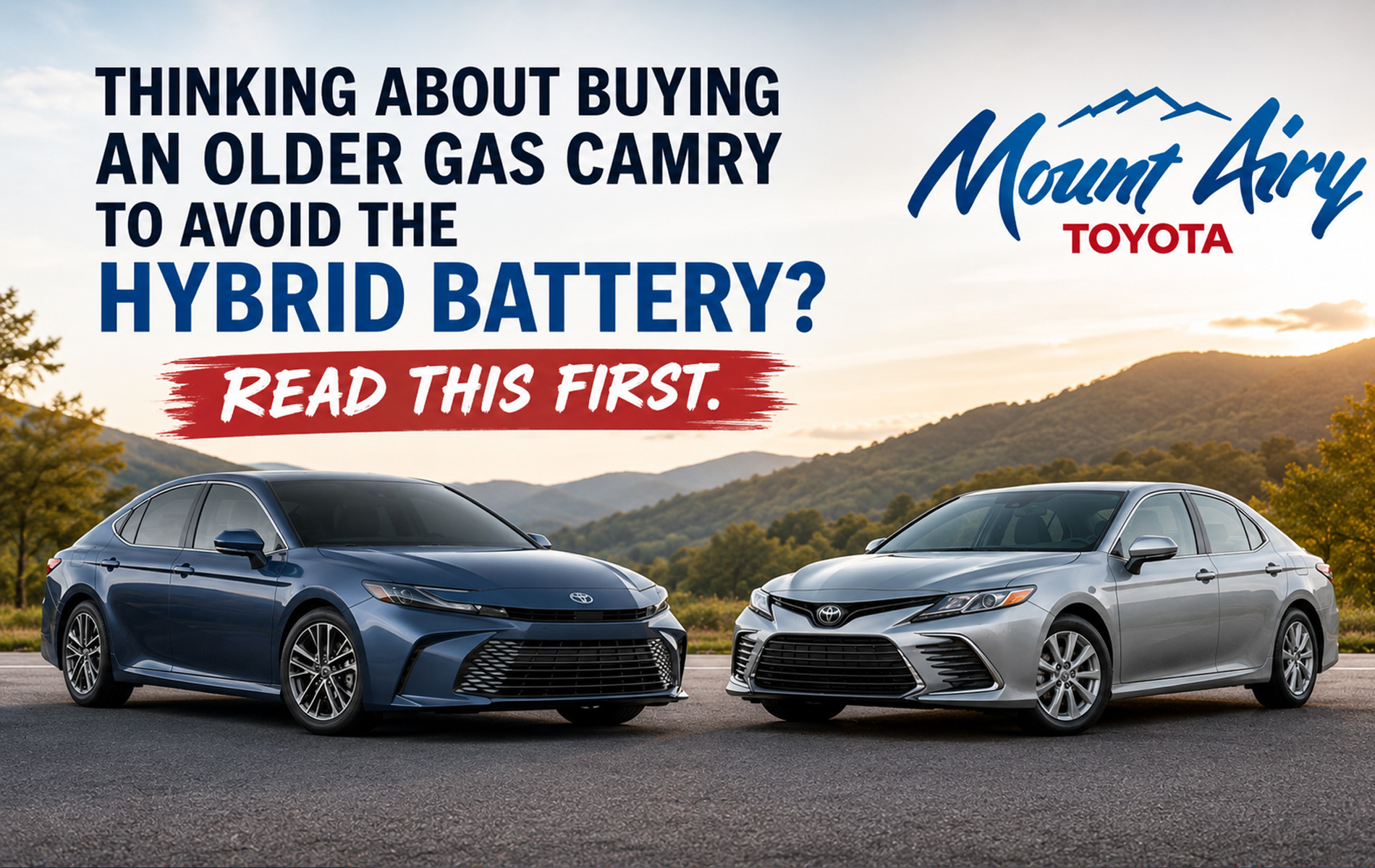
“Should You Buy a New Camry Hybrid or an Older Gas Camry? The Facts May Surprise You.”
For many Toyota shoppers, this is one of the biggest decisions they’ll make.
The good news is that today’s Toyota hybrid technology has been on the road for more than two decades and has earned one of the strongest reliability records in the automotive industry. Still, that doesn’t automatically make a new Camry Hybrid the right choice for every driver.
For many shoppers, the decision isn’t really about fuel economy.
It’s about the battery.
Questions like these come up every day:
- How long does the hybrid battery last?
- What if it fails after the warranty expires?
- Will I be able to find someone to repair it?
- Are hybrid batteries safe?
- Should I avoid a hybrid altogether and buy an older gas-powered Camry instead?
They’re fair questions.
The good news is that many of the stories you’ve heard probably refer to fully electric vehicles (EVs) rather than Toyota’s proven hybrid technology.
Before comparing ownership costs, let’s clear up one of the biggest misconceptions.
Hybrid vs. Electric Vehicle: They’re Not the Same Thing
Many people use the words hybrid and electric vehicle interchangeably. They shouldn’t. Although both use batteries, they work very differently.
A battery-electric vehicle (EV) relies entirely on a large battery pack that must be plugged into a charger. When the battery is depleted, you recharge before driving again.
A Toyota Camry Hybrid never needs to be plugged in. Instead, it combines a gasoline engine with a much smaller high-voltage battery and electric motor. The battery automatically recharges while you drive using the gasoline engine and regenerative braking system. From the driver’s seat, ownership feels exactly like a traditional gasoline vehicle. You simply stop at a gas station, fill the tank, and drive away.Because of this, many concerns commonly associated with electric vehicles simply don’t apply to the Camry Hybrid.
For example:
| Concern | EV | Camry Hybrid |
| Plug-in charging required | ✔ | ✘ |
| Range anxiety | ✔ | ✘ |
| Public charging stations | ✔ | ✘ |
| Gasoline engine backup | ✘ | ✔ |
| Regenerative braking | ✔ | ✔ |
Once shoppers understand this difference, many begin looking at hybrids very differently.
Which Camry Costs Less to Drive?
Let’s compare a realistic ownership scenario.
Assume a typical Mount Airy commuter drives:
- 15 miles each weekday (approximately 3,900 commuting miles annually)
- Plus shopping
- Weekend travel
- Family activities
- Vacations
Total annual driving: 12,000 miles
Using the average North Carolina gasoline price over the past several months (approximately $3.53 per gallon) and EPA combined fuel economy estimates:
| New Toyota Camry Hybrid vs 2022 Toyota Camry Gas | ||
| Annual Miles | 12,000 | 12,000 |
| Combined MPG | 51 MPG | 32 MPG |
| Fuel Used | 235 gallons | 375 gallons |
| Annual Fuel Cost | $830 | $1,324 |
Estimated Annual Fuel Savings: ~ $494 each year
Five-year Savings: $2,470
Unlike some hybrid comparisons where savings are relatively modest, the Camry Hybrid delivers meaningful fuel savings because of its excellent fuel economy.
Fuel savings alone probably won’t pay for the vehicle, but they’re certainly enough to become part of the buying decision.
Myth or Fact?
“The Hybrid Battery Won’t Last.”
The Concern
Many shoppers picture the battery wearing out after 75,000 or 100,000 miles.
The Facts
Toyota has been building hybrid vehicles for more than 25 years. Many original Prius and Camry Hybrid batteries remain on the road well beyond 200,000 miles, and some exceed 300,000 miles.
Toyota carefully manages battery charging levels to reduce wear and maximize longevity. Unlike your smartphone, the battery isn’t constantly charged to 100% and completely discharged. Instead, it operates within a carefully controlled range designed to extend its useful life.
Bottom Line – Mostly Myth
Battery failures can occur, but they are far less common than many shoppers expect.
“Replacing the Battery Will Cost a Fortune.”
The Concern
This is probably the number one reason buyers avoid hybrids.
The Facts
Yes. A hybrid battery replacement outside warranty can be expensive. Depending on the model and repair option selected, replacement costs can range from a few thousand dollars to several thousand dollars.
However… Many owners never replace the battery while they own the vehicle. In addition, today’s buyers have more choices than they did fifteen years ago.
Options now include:
- New Toyota batteries
- Factory remanufactured batteries
- Professionally rebuilt battery packs
- Independent hybrid repair specialists
Bottom Line
Partly Fact
Replacement is expensive. Replacement is also much less common than most shoppers believe.
“Hybrid Vehicles Are Dangerous.”
The Concern
News stories involving lithium batteries sometimes make shoppers nervous.
The Facts
Toyota hybrid systems include multiple safety features, including automatic high-voltage disconnects during many collision events and extensive crash testing. It’s also important to remember that a Camry Hybrid’s battery pack is much smaller than the battery found in a fully electric vehicle. Hybrid battery fires receive significant media attention because they’re unusual—not because they’re common.
Bottom Line
Mostly Myth
Toyota hybrids have earned an excellent safety record.
“North Carolina Summers Will Ruin the Battery.”
The Concern
Heat damages batteries. North Carolina gets hot. Does that shorten battery life?
The Facts
Extreme temperatures can temporarily reduce battery efficiency. However, Toyota designed its hybrid battery system with thermal management strategies intended to help protect long-term durability. Like any vehicle, routine maintenance and keeping cooling systems functioning properly contribute to long battery life.
Bottom Line
Mostly Myth
Hot weather may affect efficiency slightly on extremely hot days, but it typically does not significantly shorten battery life by itself.
“Nobody Around Here Can Repair a Hybrid.”
Twenty years ago, this concern carried more weight. Today, it’s much less of an issue. Toyota dealerships like Mount Airy Toyota service hybrid vehicles every day. In addition, many independent repair facilities employ ASE-certified technicians trained to diagnose and repair hybrid systems. Replacement parts are more widely available than ever before.
For most owners, finding qualified service is no longer difficult.
Bottom Line
Myth
“The Gas Camry Costs Less to Maintain.”
Many buyers assume hybrids are more expensive to maintain.
In reality, both vehicles require:
- Oil changes
- Tire rotations
- Cabin air filters
- Coolant service
- Inspections
However, the hybrid also benefits from regenerative braking, which often reduces brake wear. Because the electric motor assists during acceleration, some drivetrain components experience less stress during everyday driving. Routine maintenance costs are often surprisingly similar between the two vehicles.
Bottom Line
Mostly Myth
“Hybrid Batteries Are Bad for the Environment.”
This is a more complicated discussion. Hybrid batteries require materials such as lithium and nickel, and questions about mining and ethical sourcing are valid.
At the same time, hybrids consume substantially less gasoline over their lifetime, produce fewer tailpipe emissions, and Toyota has invested heavily in battery recycling and responsible end-of-life management.
Like nearly every modern technology, there are environmental trade-offs. The question isn’t whether hybrid batteries have an environmental impact—they do. The better question is whether the lifetime reduction in fuel consumption and emissions outweighs those impacts. Reasonable people can disagree, but it’s important to understand the complete picture rather than focusing on only one side of the equation.
Which Camry Is Right for You?
Choose the used gas-powered Camry if:
- You want the lowest purchase price.
- You drive relatively few miles each year.
- You’re comfortable buying a vehicle that’s several years old.
- You prefer traditional automotive technology.
Choose the new Camry Hybrid if:
- You commute regularly.
- You plan to keep the vehicle for many years.
- You want outstanding fuel economy.
- You value the latest Toyota Safety Sense technology.
- You appreciate lower operating costs over time.
- You want the peace of mind of a full factory warranty.
The Bottom Line
If you’re considering an older gas-powered Camry simply because you’re worried about hybrid batteries, today’s Toyota hybrid technology deserves a closer look.
Many of the concerns shoppers have—battery longevity, maintenance costs, safety, and repairability—were more understandable twenty years ago than they are today. Toyota has spent decades refining its hybrid system, and millions of owners have demonstrated that these vehicles can deliver outstanding reliability and low operating costs.
That doesn’t mean a new Camry Hybrid is automatically the right choice for everyone. An older gas-powered Camry remains one of the most dependable sedans on the road and may be the better fit for buyers focused on upfront affordability.
The smartest decision isn’t based on fear of a battery—it’s based on understanding the facts, comparing the long-term costs, and choosing the Camry that best fits your driving habits, budget, and plans for the years ahead.