
Blog / Toyota Safety

Blog

All Toyota Safety Toyota Camry Rav4 Tacoma Trucks Highlander Events Corolla Service 4Runner Tundra Electric Cars Auto News by Mount Airy Toyota Toyota History Toyota Technology Car Care Sienna Tires Avalon Mount Airy Toyota Dealer Toyotathon Trade- In Mount Airy Toyota Service Prius Supra Toyotacare Used Trucks Prius V Sequoia Used Cars C-HR Landcruiser SUV Crossover Employees End of the Year Savings Hatchback New Pickup Trucks Yaris ARB Safari Snorkel Explained Crown Difference between i-Force Max & i-Force Fox Internal Bypass QS3 Shocks Mount Airy Used Cars Old Man Emu Shocks Tacoma Onboard Air Compressor Toyota Hybrid Trucks & Cars Toyota Tundra Trailhunter vs TRD Pro TRD vs Trailhunter Suspension Venza What are Rock Sliders

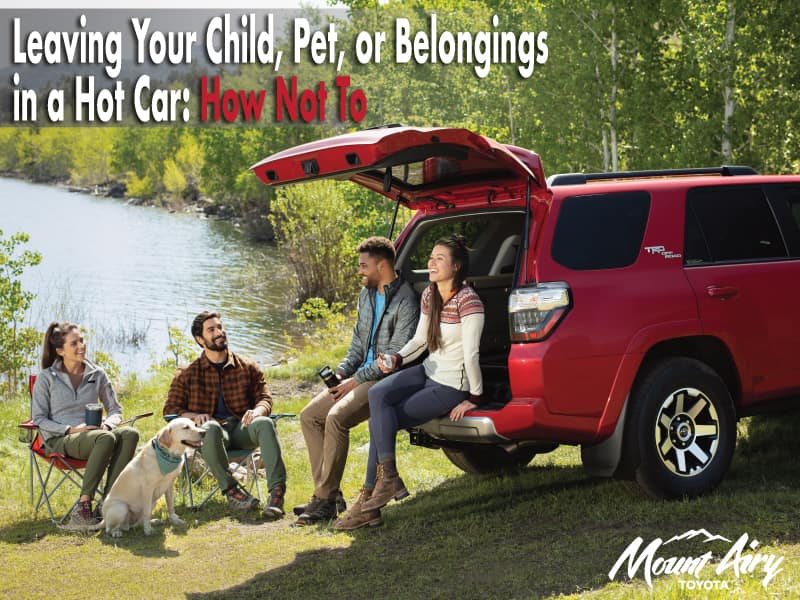
Leaving Your Child, Pet, or Belongings in a Hot Car: How Not To

Life moves fast these days, and chances are you’re just as busy as the next person. Between work, family, and other commitments, we all have a lot on our plate. And to expect ourselves to remember everything all the time would simply be unrealistic. That’s why most of us can say that we’ve forgotten something in our car before. Maybe it was a bottle of sunscreen or a laptop. Perhaps it was a pair of sunglasses or a container of medications. In many cases, even children or pets have been left in a car, leading to tragic consequences. The stresses of everyday life can cause memory lapses in the most diligent and responsible of us. And with the hottest days of the year approaching, we must all be extra conscious when we leave our vehicles. Mount Airy Toyota has different strategies for remembering who and what is in our cars, general car seat safety tips for the summer, and much more. Leaving Your Child in a Hot Car Most parents cannot imagine that they would ever leave their child in a hot car. Nonetheless, since 1998, almost 900 children have died of Pediatric Vehicular Heatstroke (PVH). And in more than half of these incidents, the caregivers had unknowingly left the children behind. While many would assume that only negligent or unfit parents would forget their child in a vehicle, the truth is it can happen to anyone. According to neuroscientist and UCF Tampa psychology professor David Diamond, Ph.D., forgetting a child in such a circumstance isn’t a negligence problem; it’s a memory problem. If you think about how much our routines change during summer, this makes sense. Whether it’s because of vacations, children being out of school, or any number of other reasons, many families drastically alter their regular routines. And in each of these tragic occurrences above, such disruptions were a common contributor. The first step of ensuring that your child stays safe this summer is to reject the mindset that it can’t happen to you. PVH has claimed the lives of children from five days old to 14 years old, and the caregivers involved have come from varying backgrounds: law enforcement officers, doctors, nurses, teachers, military officers, social workers, clergymen, and the list goes on. From an objective review of the data, it’s clear that education and socioeconomic status have had quite little to do with these tragedies. Prospective and Semantic Memories Prospective and semantic memories are parts of an individual’s working memory. In short, prospective memory enables us to prepare our minds for something in the future, and semantic memory allows us to fulfill tasks on autopilot, such as driving home from work without being able to remember details of the trip. In order to alter our routines, prospective and semantic memories must work in tandem. Take, for instance, a father who’s tasked with dropping his child off at daycare on the way to work when the mother usually does it. Or, imagine a mother who realizes that she needs to add an errand to her to-do list. Heightened stress or distraction can cause our working memories to fail. And this can lead to disastrous consequences, such as failing to take essential safety steps that would normally be a habit. Our brains multitask, and our brains are not perfect. This means that awareness of our surroundings can easily be lost, even if we are loving and attentive parents. Simple Strategies to Prevent PVH Finding ways to manage your stress, getting the sleep your mind and body need, and being aware of how a change in routine affects your brain is critical to avoiding tragic hot-car incidents. Here are some other strategies that you can implement: Use the front seat. While driving, keep an item of your child’s in the front passenger seat (e.g., hat, diaper bag, backpack, etc.) to remind you that your child is in the car. Make a habit of looking in the backseat. Every day, keep something in the backseat that you need for work, such as your briefcase or phone so that you will have to retrieve it every time. Use phone reminders. Set a reminder on your phone to confirm with your spouse or partner that they dropped off your child at daycare or school. Work with your childcare provider. Promise that you will always notify the childcare provider if your child is going to be absent or tardy, and have the childcare provider pledge to let you know if your child ever fails to arrive at their normal drop-off time. Other Summer Car Safety Tips Children are particularly susceptible to heatstroke. Not only can the inside of cars reach deadly temperatures within 30 minutes on a 72-degree day, but children’s bodies will heat up three to five times quicker than adults. Along with following the tips above, here are some other precautions you can take to ensure your child stays safe and healthy this summer: Buy a Car Seat Alarm There is no substitute for taking common-sense precautions, such as never leaving your child in a hot car or and always checking the backseat before leaving a vehicle. But as we’ve seen, even the most well-intentioned parents can have forgetful moments. For an extra layer of protection, consider investing in a car seat alarm or monitor. There are car seats that come with built-in sensors and notify caregivers when temperatures become alarming or when a child is left alone. For instance, the Cybex Eternis S SensorSafe Convertible Car Seat features a sensor clip that connects to your smartphone. If your child unbuckles their harness while the vehicle is moving, your child is left alone, or the ambient temperature in the vehicle gets too high or too low, then you will get an alert on your phone. You can also buy an independent car seat alarm that syncs with your phone. The Elepho eClip Car Seat Alarm will attach to your child’s car seat or safety belt and senses your child’s presence by monitoring their motion or weight. The alarm can either sync with your phone or with an accompanying key fob through Bluetooth. If you leave your vehicle and walk more than 15 feet away, the sensor will detect the difference in proximity and alert you immediately. If you don’t respond to the alarm (i.e., you don’t notice it), then the eClip will notify a spouse, a friend, or another person you trust. Moreover, the sensor is designed with a thermometer that monitors the vehicle’s cabin temperature. There’s one other type of product you can purchase that can help you prevent a nightmare scenario like PVH: a car tracker. While it’s typically used to stop car theft, the CarLock Advanced Real Time 3G Car Tracker & Alert System has a feature that will detect unusual vibrations in your vehicle. For example, if your child begins crying or thrashing around, the device will alert your phone. The system provides real-time tracking and updates every 30 seconds when your vehicle is parked. Use Car Seats Correctly This might sound obvious, but you should always ensure you’re using your child’s car seat the right way. Some parents may want to put a towel between their child’s swimsuit and the car seat, or underneath the car seat, after a day at the pool, for instance. But while that may help to keep your seats in good shape, it can hinder the car seat’s effectiveness during a crash. Instead, always bring along an extra set of dry clothes that you can put on your child. Never Use Someone Else’s Car Seat You never really know the condition of a car seat unless it’s yours. If you ever need to rent a car this summer, bring your own car seat with you. Even if the rental agency has the car seat or booster you need, you can’t be sure that the family that used it before you didn’t make any incorrect adjustments to the seat which would compromise its performance. Prevent Heat Rash Heat rashes are prevalent during summer. And if your child sweats while in their car seat, they can easily get a rash, especially if they’re more susceptible to heat rash in the first place due to excessive sweating or sensitive skin. Regularly monitor your child for heat rash from their car seat. If heat rash occurs, use diaper rash cream before long car rides, contact the car seat company about sending you a car seat cover with a different fabric, and frequently wash the car seat cover. Keep Items Secure If you’re like most families, you drive around with lots of supplies in your vehicle, particularly when taking a long trip. Always make sure that every item in your car is secured, including toys, snacks, drink bottles, and anything else that could fly around and injure someone if you stop suddenly or crash. Leaving Your Pet in a Hot Car There’s a common misconception that as long as you crack the windows, it’s safe to leave your dog in the car. But thinking like that can lead to catastrophic consequences. On a 70-degree day, the inside of a car can reach 100 degrees in 20 minutes. In the peak of summer, a car can reach 140 degrees in less than an hour. A study by the American Veterinary Medical Association (AVMA) found that cracking a window does not significantly lower the temperatures inside a vehicle. In fact, such a vehicle will heat up at almost the same rate as if the windows were completely rolled up. All dogs are prone to heatstroke by nature. Any time you drive with your dog in the car and you know that you will have to get out of the car along the way, bring another adult with you on the trip so that they can stay in the vehicle with the air conditioning running. Items You Should Never Leave in a Hot Car While not leaving children or pets in a hot car should definitely be at the top of your mind, there are also some inanimate objects that you should avoid leaving in your car during summer. Some products will melt, warp, or significantly change in composition in other ways. Not only can this lead to a major mess in your vehicle, but it can decrease the effectiveness of the product, if not destroy it altogether. Here are some things that you should never leave in a hot car: · DVDs or CDs · Electronic devices (e.g., laptops, tablets, smartphones, etc.) · Eyeglasses or Sunglasses · Medications · Sunscreen · Hairspray · Makeup · Food · Soda, wine, or beer · Crayons or markers · Ink pens or disposable lighters Conclusion The hottest season of the year is here, which means it’s time to take extra precautions. Along with finding ways to reduce stress and minimize distractions in your everyday life, remember the tips above for how you can remind yourself not to leave your children or pets in a hot car. And try to avoid leaving behind the other items mentioned as well. Most importantly, remember that none of us are above experiencing a tragic incident. Do everything you can to practice summer safety in the months ahead!
Summer Road Trip Playlist

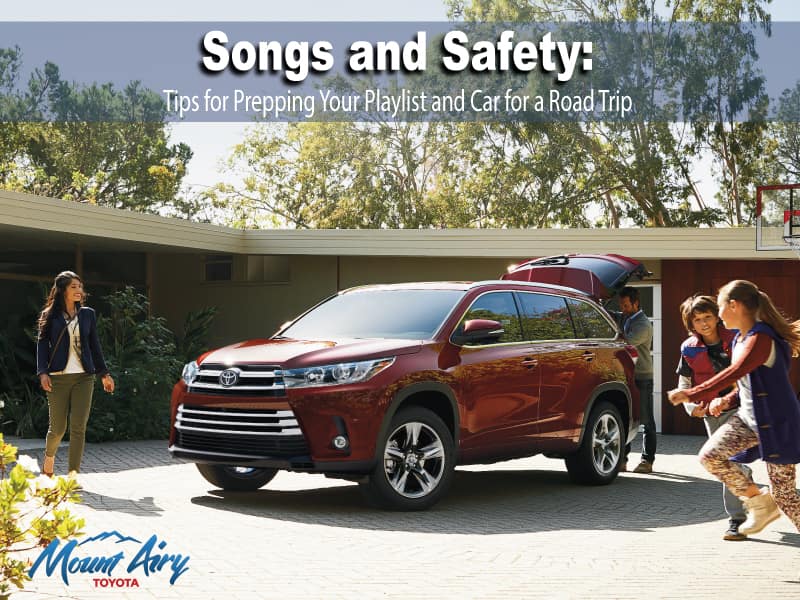
Songs and Safety: Tips for Prepping Your Playlist and Car for a Road Trip

So, you’ve decided to take a family road this summer. You’re excited to see wonderful sights, experience local foods and entertainment in different towns, and feel the breeze flowing through your car as you abandon the daily grind. While there’s nothing like going on a great road trip, ensuring your trip provides the fun and relaxation your family is hoping for will require you to make some preparations, and that includes choosing the right travel music and servicing your vehicle beforehand. Mount Airy Toyota wants to help your family knock out these tasks so that you can set the stage for the road trip of a lifetime: Get the Tunes Ready There are a lot of factors that go into planning a road trip, and the music often gets overlooked. But having the perfect playlist ready can help everyone enjoy the drive more, especially if the songs are easy to sing along to. One thing to keep in mind is that you’ll want all the songs on your playlist to be downloaded on your phone or iPod. That way, you won’t have to use data on your phone or risk not being able to play music in a dead cell zone. Now, to the goodies. Here are some of the best songs for a summer road trip (hint: there’s a little something for everybody!): All-American Songs · Born to Be Wild — Steppenwolf · Sweet Home Alabama — Lynyrd Skynyrd · Living on a Prayer — Bon Jovi · Born in the USA — Bruce Springsteen · My Life — Billy Joel · Nothin’ but a Good Time — Poison · Walk This Way — Aerosmith · One of These Nights — Eagles Classic Rock Songs · Nutbush City Limits — Ike & Tina Turner · Danger Zone — Kenny Loggins · Here I Go Again — Whitesnake · Don’t Stop Believing — Journey · Summer of ‘69 — Bryan Adams · Dude Looks Like a Lady — Aerosmith · Go Your Own Way — Fleetwood Mac · Back in Black — AC/DC Modern Songs · All the Small Things — Blink 182 · Happy — Pharell Williams · Can’t Stop The Feeling — Justin Timberlake · Shut Up & Dance — Walk the Moon · Stupid Love — Lady Gaga · California Gurls — Katy Perry · Set Fire to the Rain — Adele · Uptown Funk — Mark Ronson (feat. Bruno Mars) Songs About Driving · I Drove All Night — Roy Orbison · Paradise by the Dashboard Light — Meatloaf · Drive My Car — The Beatles · Keep the Car Running — Arcade Fire · Route 66 — Chuck Berry · Mustang Sally — The Commitments · Rhythm Made Me Do It — Shania Twain · Pink Cadillac — Bruce Springsteen Get Your Car Ready Now that you have some songs to consider for your playlist, let’s talk about how you can whip your vehicle into shape for the long drive! First of all, you need to make sure you’re secure where the rubber meets the road. Take your vehicle to a trusted mechanic, like the Mount Airy Toyota Service Center, to check your tires and replace them if necessary. If you still have plenty of tread, you may be able to get away with a rotation. Also, have your brakes checked, especially if you notice any grinding, screeching, or delayed functioning. Without having good tires and brakes, you increase your chances of an accident exponentially. Another essential step in preparing your car for the road is to replenish all of the fluids that need it. Along with changing your engine oil and filter, fill up on transmission fluid, brake fluid, power steering fluid, and engine coolant. If you’ve had your battery for at least two years, get it checked by your mechanic. Batteries typically give no warning before they quit, and that’s the last thing you want happening when you're driving in the middle of nowhere! Finally, you’ll want to check the hoses surrounding your radiator for cracks and damage, as well as the serpentine belt. And while you’re at it, throw on a new set of windshield wipers to ensure you’re well-prepared when it rains. Work it into your trip budget to replace any parts necessary for safe driving, and handle all of these tasks before leaving to avoid being thrown a curveball on your travels. Conclusion Making preparations before your road trip can help your entire experience go more smoothly. Remember to take time creating a killer playlist that the whole family will enjoy, and give your car a thorough evaluation. Mount Airy Toyota can handle all of your maintenance and repair needs! Just give us a call to schedule an appointment, and we’ll get your vehicle ready for the open road! (336) 786-2118

New Tech for Toyota

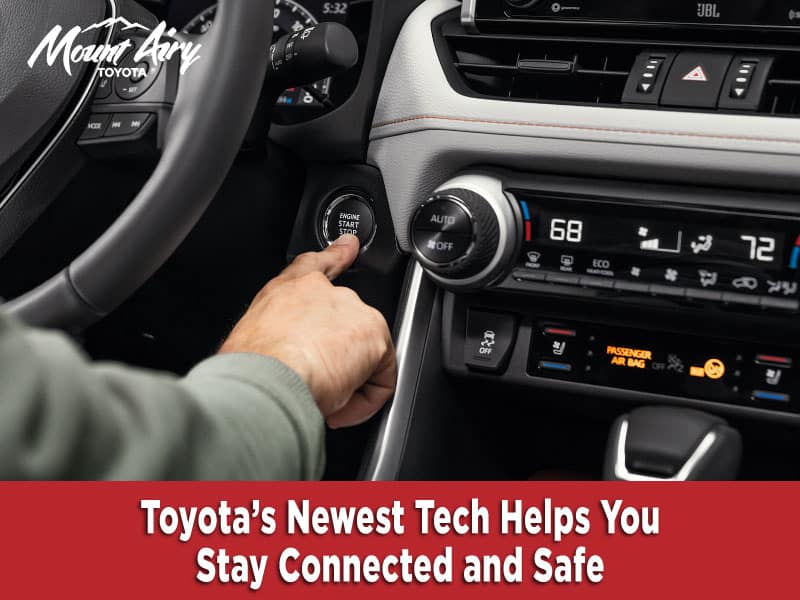
Toyota’s Newest Tech Helps You Stay Connected and Safe

From the moment it began disrupting the American automobile industry in 1937 to the creation of the first mass-produced hybrid-electric vehicle in 1997, Toyota has long been known to be a company of innovation. As of 2020, it leads all other carmakers in global sales. The innovation hasn’t stopped. Each year, Toyota offers significant upgrades to its models and consistently sets the industry standard for design, performance, safety, and comfort. And this year is no different. Among other developments, the 2021 model year brings with it cutting-edge technologies to help you stay connected to others on the road, as well as improvements on an already-groundbreaking suite of safety features. Below, we’ll discuss these upgrades in more detail and provide a brief rundown of available upgrades for a few of the leading Toyota models. ENTUNE INFOTAINMENT SYSTEM Every new Toyota model comes standard with the manufacturer’s Entune infotainment system. This system only adds to the functionality, safety, and comfort that has been provided by Toyota vehicles for decades. In terms of infotainment interfaces, it doesn’t get easier to use and navigate than Entune, and it’s perhaps the most efficient interface on the market. Entune 3.0 It was hard to imagine the previous version of Entune getting much better. But here are we are, and it is. The latest version of Toyota’s infotainment system comes with several notable upgrades. A remote connect feature allows you to view engine diagnostics, lock and unlock your doors, start your engine, and track down your vehicle in a parking lot—all on your smartphone, from wherever you may be. Entune 3.0 also comes with Verizon’s 4G LTA Wi-Fi connection, which means that you can stay connected pretty much anywhere you go without eating up your data plan. And navigation has been taken up a notch. When you opt for the Entune 3.0 Premium Audio Suite, you’ll get Dynamic Navigation, which shows you up-to-the-minute navigation and points of interest on your journey. Even better, the navigation system runs on a hard drive so that you don’t have to use your phone’s data. Unsurprisingly, the newest version of Entune still comes with Apple CarPlay, Android Auto, and Bluetooth capabilities, among a slew of other tech features. Entune Audio and Audio Plus Entune Audio comes on most Toyota models, and it includes a couple of notable features. For instance, it provides efficient Bluetooth connectivity, which allows you to talk on your phone, stream music and podcasts, and much more without using your hands. And if you have an iPhone, you can use Siri to perform a variety of functions, just like you would from your phone. The available Entune Audio Plus includes the features mentioned above and adds a few more. You’ll get access to Scout GPS Link, which is an app that provides simple, accurate turn-by-turn directions. It even shows real-time updates for traffic, cloud movement, and more! Entune Audio Plus also comes with the option for HD Radio—a feature that boosts the sound quality of any audio you play. Furthermore, a free three-month trial of SiriusXM radio is automatically included when you upgrade to Entune Audio Plus. Entune App Suite Last but not least, the Entune App Suite is your go-to platform for a wide array of helpful apps. Do you want to listen to your favorite station on Pandora or to a new album on Apple Music? What about that weekly podcast you’ve been waiting on? Or, perhaps you need to make dinner reservations or compare gas prices? Entune App Suite has everything you need. TOYOTA+ALEXA APP If you’re an Amazon Alexa customer, you likely know a little bit about what she can do. The latest version of Alexa can perform tens of thousands of functions, and with the Toyota+Alexa app, you get access to all of those services and skills right there in your vehicle. By using this app, you can do all kinds of things. You can order lunch, check the weather, assess traffic patterns, ask for directions, listen to the news, operate your smart home devices, and much more. Since Alexa is a cloud-based system, she automatically updates with new features and capabilities. And the best part is that Alexa is super simple to use, and you never have to lift a finger! SAFETY SENSE 2.5 PLUS Toyota Safety Sense (TSS) is just one example of how the manufacturer has proven to remain a pioneer in today’s auto industry. The innovative suite of standard safety technologies has garnered award after award, and the 2021 Camry is equipped with the latest version: Safety Sense 2.5 Plus. Other Toyota models are expected to receive the upgrade in the coming months and years. The focal point of the development of TSS 2.5+ was to mitigate frontal collisions, nighttime mishaps, and unwanted lane departures. As with previous versions of TSS, it’s all about using forward-thinking tech to prevent as many accidents as possible. TSS 2.5+ is by far the most advanced and sophisticated safety suite on the market, and it integrates cameras, radars, and an uber-powerful computer to get the job done. Carryover Features The Pre-Collision System with Pedestrian Detection and Full-Speed Dynamic Radar Cruise Control remain two of the primary technologies in the latest TSS suite. The former warns you of a potential collision with the vehicle in front of you, alerts you when there is a pedestrian within range, and implements automatic emergency braking when your vehicle is too close for comfort. The latter is Toyota’s adaptive cruise control, which adjusts your vehicle’s speed depending on surrounding vehicles (if you’re coming up hot on the car in front of you, it will automatically reduce your speed). Other technologies that carry over from previous TSS versions include automatic high beams, road sign assistance, lane-departure warning with lane-keeping assistance, and lane-centering assistance. Enhanced Features Though the forward collision warning and automatic braking of older TSS suites are remarkable in their ability to prevent accidents, TSS 2.5+ takes these technologies up a notch. In short, the system is more proactive and functional. Along with sensing vehicles ahead, it now detects preceding pedestrians and cyclists, whether it’s sunny or dark outside. If there is a vehicle, pedestrian, or cyclist making a left turn in front of you, the updated feature will alert you through sound and visuals. If necessary, the automatic braking will kick in. Moreover, the adaptive cruise control technology in TSS 2.5+ offers a brand-new function that makes passing slower vehicles easier and safer. After slowing down while using adaptive cruise control, there is typically a significant delay before the vehicle starts accelerating again. TSS 2.5+ gets rid of this problem. The revamped Full-Speed Dynamic Radar Cruise Control senses when you are coming up on a slower vehicle, and when you turn on your indicator and engage the steering wheel, the system automatically accelerates your vehicle. This puts you in a better position to pass the vehicle in front of you. The adaptive cruise control feature will then keep accelerating until you hit your established cruising speed. TECH UPGRADES BY MODEL We’ve covered some of the newest tech available from Toyota, but not every model will get all the same features. So, let’s touch on what you can expect from a few of the big hitters in the manufacturer’s 2021 lineup: Camry The 2021 Camry is one of Toyota’s most decked-out vehicles when it comes to technology. The Entune infotainment system is displayed on either a seven- or nine-inch touchscreen that floats gracefully on the dashboard. The Camry is also the first model to feature TSS 2.5+ (though others are soon to follow). Another notable feature is the Dynamic Torque Control AWD system, which comes in the North America-only Camry AWD. This system is matched with a high-efficiency 2.5-liter Dynamic Force engine (four-cylinder) and an eight-speed Direct-Shift automatic transmission. Corolla This year, buyers can opt for an eight-inch touchscreen for their Entune 3.0 system in the Corolla. There are several hard buttons around the large touchscreen, as well as rotary volume and tuning knobs, for easy and safe controlling while on the road. You can also opt for wireless charging and a premium JBL sound system. As of now, the 2021 Corolla comes with Safety Sense 2.0, including the pre-collision system, road sign assistance, and lane departure warning with steering assistance. Prius Anyone who has ever seen a Prius knows that it revolves around technology. It is, in fact, one of the vehicles that have strengthened Toyota’s reputation for being innovative. One hallmark feature that remains is the digital gauge panel mounted on the center of the dashboard, which includes two 4.2-inch full-color display screens and allows drivers to customize the wealth of content they see by using their steering wheel controls. On the Prius Prime, buyers will get a seven-inch touchscreen to facilitate Entune 3.0 unless they upgrade to the 11.6-inch vertical screen that comes in the XLE trim. The 2021 Prius Prime is available with Safety Sense 2.0. 4Runner Yes, even the rugged 4Runner comes with some impressive tech! All 2021 models feature Entune 3.0 and an eight-inch touchscreen. Of course, you get the physical buttons and rotary knobs to go with the infotainment interface, and you can opt for built-in navigation and a 15-speaker JBL sound system. Toyota Safety Sense P (TSS-P), which is a suite of active safety systems, comes on each 2021 4Runner. Also included is the Star Safety System, which provides traction control, vehicle stability control, Smart Stop Technologies (SST), and more. Rav4 The RAV4 is a little sibling to the 4Runner. And although it proves capable off the beaten path, it features more modern, polished styling and is more tech-focused. A seven-inch infotainment touchscreen is standard on the 2021 RAV4, and an eight-inch screen is available. As in the other Toyota models, the Entune 3.0 system provides a 4G LTE mobile hotspot and capabilities for Bluetooth, Apple CarPlay, Android Auto, and Amazon Alexa. The premium JBL sound system is available as well, as are enhanced navigation and a wireless charging pad. Even if you don’t choose a model with built-in navigation, you can use the Scout GPS Link app to display your smartphone’s map and directions on the touchscreen. TSS 2.0 comes standard on all 2021 RAV4 models, making it one of the safest compact SUVs on the road. CONCLUSION Toyota has long been known to produce vehicles that stand the test of time without shying away from technology. In fact, it remains a pioneer in innovative tech that helps drivers stay connected and improves performance, safety, and comfort. The model year 2021 sees a number of significant upgrades across the Toyota lineup, including the Entune infotainment system, Toyota+Alexa app, and Safety Sense technologies. Come by Mount Airy Toyota or browse our website to see the wide selection of Toyota models on our lot. We would love to talk with you about the tech that each model offers and schedule a test drive so that you can see what all the hype is about!

Your Holiday Service Guide: Keeping it Safe on the Roads this Winter

This holiday season give the gift that keeps on giving, winter service specials at Mount Airy Toyota! A gift for a loved one, a friend, or even for yourself, it doesn’t matter. What does matter is keeping your vehicles in shape and prepped for the cold weather ahead of us. Come check out some of the unbeatable service special Mount Airy Toyota is offering this season. The great thing about our vehicles, old or new, is that if you take the time to keep them maintained, they will last much much longer. Showing your car just a little love goes a long way, which is why we don’t just encourage you to come see us for your service needs, we also offer the best prices in town. Check out these deals: Oil and Filter Change. When the weather gets cold, so does the oil in your car. And if the oil is not fresh and pure, it becomes difficult for your engine to work with which, in turn, can cause some major damage in the long run. Right now we are offering $29.95 regular oil changes and $39.95 synthetic oil changes. Battery Replacement. Nobody wants to be left out in the cold due to a dead car battery. Extreme weather asks a lot of your car, and if your battery is old or corroded, it's simply not worth the risk of getting stuck out in the elements. This is why we are offering a battery replacement only at $95.95, which includes installation, a 60-month warranty, and an 18-month free replacement. Wiper Blade Replacement. With cold weather approaching, you can count on icy roads, which results in salt and sludge. Nothing makes your windshield wipers work harder than dirt and grime buildup. Stop in today and we'll even install them for you! Act now and get brand new blades for only $19.95. Brake Pad Inspection. Needless to say, your brakes are important. At Mount Airy Toyota, we can take a look at your existing brakes and let you know about how much longer you have until you will need new pads. And if you happen to need them right then, we can take care of that too. But act now to receive a FREE inspection! And if they are in need of changing, we have plenty of options to offer. And there are even more specials running: 15% Off Tundra & Tacoma Accessories. Touch-Up Paint  $9.95—ball-pen top for scratches requiring pin-point application and brush top for chips and scratches that need broader strokes. Free Check Engine Light Analysis—free scanning by one of our professionally trained Toyota Certified mechanics. We can test to check for codes and code interpretation. Free Tire Alignment! Tire rotation for $9.95—includes checking and setting tire pressures, along with a visual inspection of the brake pads and rotors for wear. As you can tell, we have amped our service specials for this year, and we’re pretty excited about it. Stay in Control: How to Drive in Winter Weather Winter snow can be beautiful and a lot of fun. But when it comes to driving in it there are many potential dangers that, if prepared for in advance, can be avoided. This being said, it is shocking how many drivers do not prepare themselves for these possibly treacherous conditions. Here are two basic rules that can keep you safe while driving this winter season: Anticipate what is ahead. Driving on ice and snow requires smooth, precise, and careful control of the steering wheel. Try and keep your wheels straight as much as possible, and when you do have to turn, slowly turn the wheel—this will require you to anticipate turns ahead of time so that you do not end up sliding into other lanes, or worse, off the road. Just remember, you want to avoid any sharp movements of your vehicle. Slow and steady gets you there safely. Know your stopping distances. Slowing down, for upcoming turns or otherwise, requires much more distance when driving on snow or ice. Be sure that you have clear visibility of road signs, stoplights, and other cars so that you can break well before you reach them. When you do apply the brakes, keep your heal on the floor and softly press the brake peddle with the ball of your foot. Again, try and keep your steering as straight as possible to avoid any skidding. If you do happen to hit a patch of ice and feel the vehicle begin to slip, start pumping the brakes by letting off the peddle and pressing (softly) it back down over and over until you regain control of the vehicle. If this does happen, be sure to remain calm and keep your movements soft and slow. With braking and steering under control, drivers can navigate through snow and ice in a controlled and safe way. A word to the wise though, beware of other drivers who do not know these two rules—you can recognize them by their jerky movements and inability to keep from skidding—and keep as much distance between you and them as possible. The Toyota RAV4 Recently, AMCI conducted certified tests to see which vehicles operated at the highest levels while driving in the ice and snow. Many vehicles were chosen for these tests, but only a few were tough enough to make it to the top of the list. So who made it? There were a variety of vehicles that did well, but performing best in acceleration, traction, and handling in these treacherous conditions was the all-wheel-drive Toyota Rav4. What really impressed the judges at AMCI was the Rav4’s ability to go from 0 to 50 mph quickly on snow, and with minimal slippage. It was also able to stop short on ice while going 30 mph. But that’s not all: the Rav4 continued to pique interest by showing top cornering performance on snow, as well as providing top of the line evasive-action performance. These top markings for the Rav4 are due to Toyota’s highly innovative AWD technology, which includes the intricately designed Dynamic Torque Control system. This system, along with the electric power steering mechanisms, helps enhance the driving experience by monitoring and controlling torque transfer between wheels—all four of the wheels—and uses input from a variety of sensors to keep the vehicle moving. Care for Your Car, Care for Yourself There’s no doubt about it, taking care of your car, especially during the winter months, is crucial. But, at Mount Airy Toyota, we realize it is just as important that we take care of ourselves. When you come to us for any service need, we take every measure to adhere to social distancing by conducting our operations with no-touch servicing. To encourage everyone to operate under these safe conditions, we are offering a 10% off social distancing coupon, which applies to ALL of our services offered. Here is the procedure for safely dropping off your car: Simply call us at 336-786-2118 and speak with Will or Russ (our service specialists) to schedule a time to drop off your vehicle. Once your time is set and arrives, all you have to do is drop off the car and wait for us to contact you when it’s finished. It’s that easy: no contact, no worries. Picking up your car is just as easy. Once you receive a text from us saying your vehicle is ready, head to the pickup lot to find your clean, serviced vehicle waiting for you—simply grab and go! At Mount Airy Toyota, we service all makes and all models of vehicles because we want everyone traveling safely this winter. Come see us, visit us online, or give Will or Russ a call today to get your car ready for the cold weather this season.

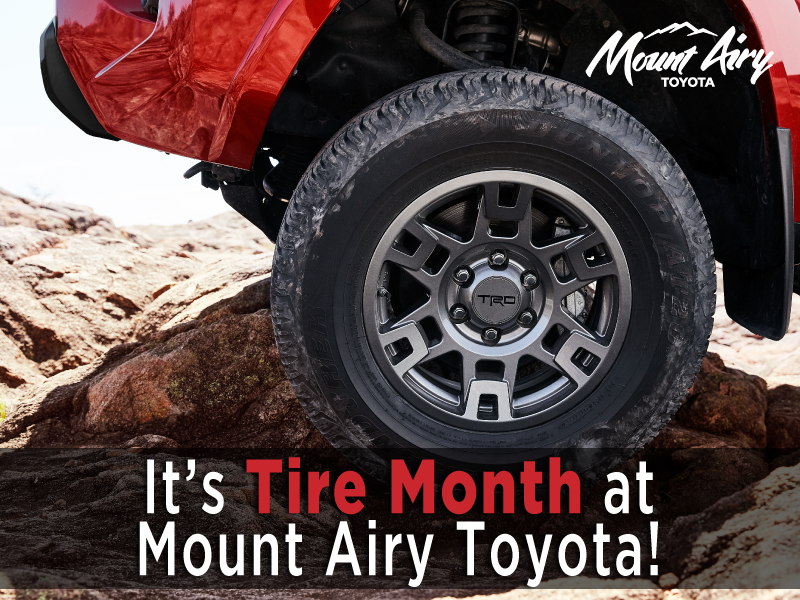
It’s Tire Month at Mount Airy Toyota!

Worn, old, or even cheaply-made tires can be hazardous to your vehicle’s handling and fuel efficiency, not to mention it is incredibly dangerous to drive with bad tires: a blow out while driving is sure to turn your knuckles white as you grip the steering wheel to try and navigate your vehicle to the side of the road. Luckily, Mount Airy Toyota’s Service Center can get you the exact replacements you need and at a very competitive price. Our factory-trained and certified Toyota technicians will ensure that your tires are mounted, balanced, and inflated to match your Toyota vehicle's specifications. What makes November tire month? With that hot summer behind us and a cold winter ahead of us, this is the most important time to check your tires. Drastic seasonal change means drivers need to be sure their tires can handle the cooling weather. During those hot spring and summer months, your car’s tires were worn and stretched from changes in air pressure, and extreme heat—like what we experience here in the South—tends to cause dry rot. Before your next car ride, complete the following steps to make sure you don’t end up stranded: Check the tire pressure and if any are low get them filled right away. If a tire, or tires, are extremely low we recommend not driving it unless there is a service station nearby. Otherwise, it’s a good idea to have someone come and fill your low tires. Have your tires rotated regularly. Our service department can keep your tires lasting as long as possible with regular rotations and check-ups. Have your tires professionally aligned. Anytime you get new tires or have been driving on the same ones for a year or so, it’s a good idea to have them checked and aligned. Keep an eye on the tread of each tire. (More on this in a minute.) Make sure your spare is in good repair. You hope to never need your spare, but if the time ever comes when you do need it, make sure it is full and ready for use. Do I Need New Tires? The Penny Test just got a lot more expensive; time for the Quarter Test. If you aren’t aware of the Penny Test, this was a method used to check the tread in tires to see if they need replacing. The test is taking a penny, turning it upside down so the top of Honest Abe’s head is pointed towards the car tire’s tread. Press the penny between the rows and see how much of his head is visible. The more of his head you can see, the better the chance you need new tires. This test is still a valid way to check your tires, but instead of using a penny, it has been found that a quarter is more accurate at finding the standard minimum depth of 4/32.” Winter Tires Not everyone needs snow tires, but anywhere there is a possibility of ice or snow—even the slightest chance—we advise looking into purchasing a set. They don't have to be incredibly expensive, and they can help keep you safe on the road this winter. With their intricate designs and soft rubber, they grip the ice and snow for better traction. This winter we like the Nokian Hakkapelitta. They start at around $120 per tire and are worth every penny. With Nokian, you get superior performance, especially on ice, but great traction through the snow as well. Nokian has a long history with winter tires, and creates a great one for a good price—$120 may seem a little high, but believe me, those prices can get much higher. If you want to pay a little less, you should look at either the Bridgestone Blizzak WS80 or the Michelin X-Ice X13. Both are noted as being equally effective in winter conditions and are highly recommended for anyone who lives in areas that drop in temperature to below 45 degrees. With a price of $85 they are more than affordable, and if taken care of, will last at least three to four seasons. Lastly, you can’t go wrong with a General Altimax Arctic. Though this suitable tire is not noted as being quite up to par with the Nokian Hakkapelitta, or the Blizzak and X-Ice, it still comes highly recommended by experts and owners alike. At around $50, it’s the best snow tire for the price, and a great option for those living in areas that don’t get a lot of snow, but do experience a little ice in the winter. Stay safe this winter by switching into snow tires. Take good care of them with routine check-ups and change them out when needed. You won’t regret it. Sure winter snow can be beautiful and a lot of fun. But when it comes to driving in it there are many potential dangers that, if prepared for in advance, can be avoided. This said, it is shocking how many drivers do not prepare themselves for these possibly treacherous conditions. Here are two basic rules that can keep you safe while driving this winter season: 1. Anticipate what is ahead. Driving on ice and snow requires smooth, precise, and careful control of the steering wheel. Try and keep your wheels straight as much as possible, and when you do have to turn, slowly turn the wheel—this will require you to anticipate turns ahead of time so that you do not end up sliding into other lanes, or worse, off the road. Just remember, you want to avoid any sharp movements of your vehicle. Slow and steady gets you there safely. 2. Know your stopping distances. Slowing down, for upcoming turns or otherwise, requires much more distance when driving on snow or ice. Be sure that you have clear visibility of road signs, stoplights, and other cars so that you can break well before you reach them. When you do apply the brakes, keep your heal on the floor and softly press the brake peddle with the ball of your foot. Again, try and keep your steering as straight as possible to avoid any skidding. If you do happen to hit a patch of ice and feel the vehicle begin to slip, start to pump the brakes by letting off the peddle and pressing (softly) it back down over and over until you regain control of the vehicle. If this does happen, be sure to remain calm and keep your movements soft and slow. With braking and steering under control, drivers can navigate through snow and ice in a controlled and safe way. A word to the wise though, beware of other drivers who do not know these two rules—you can recognize them by their jerky movements and inability to keep from skidding—and keep as much distance between you and them as possible. Time To Upgrade If you find your tires are out of shape, or even if you just aren’t sure if they need replacing, our certified technicians can help with tire alignment, tire rotation, tire installation, and tire patching. Our qualified tire installers and alignment specialists do not require an appointment, and we offer the 110% Price Guarantee—a program where Mount Airy Toyota will beat any price on any tire, no matter the make or brand. If you can show evidence of someone offering a tire at a lower price, we will beat it! Here’s how you can find your tires without leaving the comfort and safety of your own home: Access our service center website and scroll down to where you can fill in your vehicle’s specific information—year, make, model, trim and click “shop now” to immediately get a full list of tires and prices for your car. Once you find what you want, you can purchase or contact us to get more information on the tires, the process of having them put on, etc. We can also go over our COVID protocols so you can see how we take every precaution necessary to get you back to safely driving on the road. (Shop for tires now and take advantage of our sale: buy three tires and get the fourth for $1!) We love saving our customers money, and nothing makes us feel better than knowing you are driving on tires that grip the road and hug those turns.

Safe Carpooling

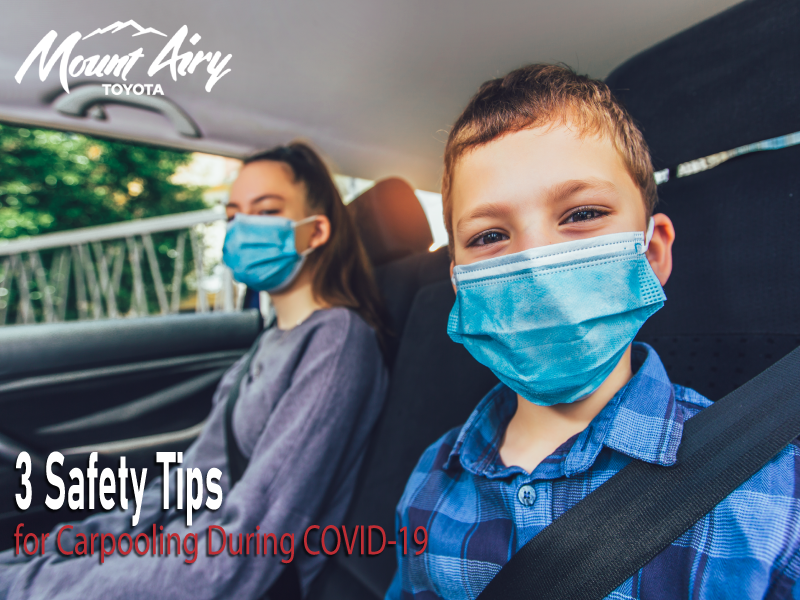
3 Safety Tips for Carpooling During COVID-19

It’s that time of year—time to load up the minivan and take your kids and their friends to school. Obviously, this year is much different than others because of the COVID-19 pandemic, and one result has been the disruption of everyday routines for millions of Americans. And that disruption has carried over to the beginning of the academic year. Even though many schools have already opened and others are soon to follow, there are a lot of questions as to how each school will operate. Some students will be attending classes in person full-time, some will be navigating online learning, and others will be doing a mixture of the two. And despite excruciating planning and strategizing, school systems across the country will be winging it to a degree since no one really knows how long the pandemic will last. But one thing is for sure: Kids who are attending school need to be able to get there. And for many families, carpooling is the preferred mode of transportation. Fortunately, there are safe ways to carpool with your kids and their friends, even during the pandemic. From taking extra precautions to enforcing basic rules of the road, here are three tips for keeping everyone in your vehicle safe when carpooling this school year: Follow Pandemic-Specific Guidelines The CDC recommends “avoiding pooled rides where multiple passengers are not in the same household.” But they have also recommended specific steps that you can take if walking, biking, or riding the bus is not feasible for your family and neighbors and carpooling is the only option. First of all, any child or parent who is sick or has had known contact with someone who has coronavirus should stay home. Also, every person riding in the vehicle should wear a face mask or face covering, and each person should have their own bottle of hand sanitizer. Furthermore, to improve your vehicle’s ventilation, lower the windows, and make sure the vehicle’s ventilation system is on non-recirculation. Another thing to consider is whether the little passengers outside of your household are in your children’s pandemic bubble. Schools are organizing students into classroom cohorts or pods in an attempt to prevent the spread of coronavirus, and it’s best to limit who rides in your vehicle to those who are already in your children’s groups. Moreover, whether or not you should add kids who are not family to your carpool will also depend on how many passengers you have. For example, if you have a minivan or large SUV, you could have one child ride in the second row and one in the third row. However, the more passengers you have, the harder it becomes to practice social distancing. So, consider how many kids you have riding with you before adding any others. Practice General Vehicle Safety for Kids Anytime you’re driving with children in the car, it’s essential that each child uses the proper seat. If your child is using a safety seat, make sure it’s in good condition and that it is installed and fastened correctly. And don’t rush to move your child up to the next car seat; it’s essential that they use the appropriate seat for their height and weight. If you are driving around kids who are in booster seats or using only a seat belt, make sure everyone has their seat belts fastened before you move the vehicle and that they keep them on until the trip is over. Also, never let any two children share a seatbelt. And remember that any child under 13-years-old should always sit in the backseat, which helps protect them from potential injuries caused by passenger airbags. Stay Focused on the Road Finally, the parent must always practice safe driving, especially when children are in the vehicle. No matter what, remain attentive, alert, and focused on the road and the vehicles around you. Make sure any kids who ride with you have a clear understanding of the safety rules and that they stay calm in the backseat so as to prevent distractions. And for your part, never text on your phone while driving. Not only will doing so put you and everyone with you at risk, but it will also teach dangerous habits to the children under your care. If you need to drive your kids and their friends to school this year, it’s essential to be mindful of the steps you should take. Remember to abide by the guidelines established by the CDC as closely as you can, enforce basic rules that help keep children safe on the road, and at all costs, remain focused while driving. At Mount Airy Toyota, we are care about the well-being of our customers, which is why we are committed to following all proper precautions necessary to keep a safe and healthy atmosphere. Following tips like these can help ensure a safe carpool experience, which means that everyone wins!

Vehicles of the Future: What Toyota’s Bringing to Mount Airy Toyota in 2019

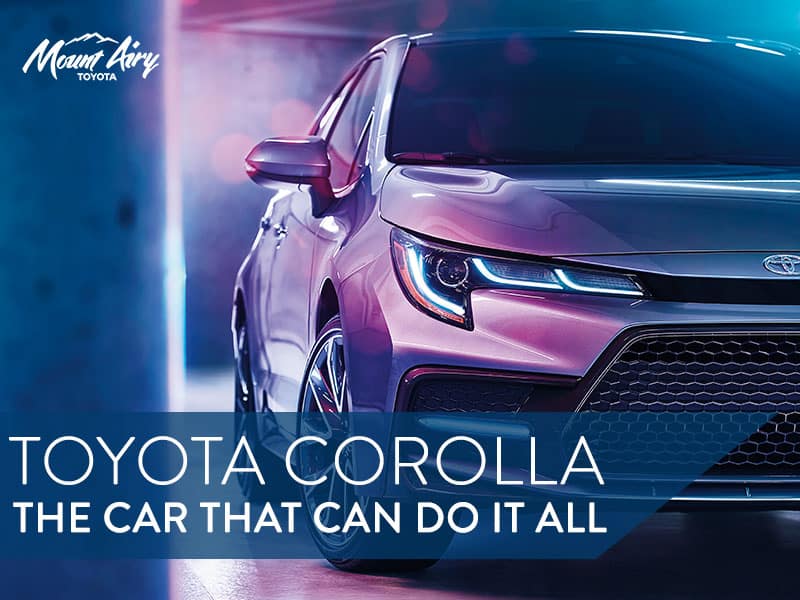
Here at Mount Airy Toyota, 2019 has been the year of delivering more reliable, interesting, and fun vehicles than ever before. We are more than excited over the latest technology, delivery, and design of Toyota’s innovative vehicles. With many of these new releases on the lot, there has never been a better time to visit Mount Airy Toyota to check out and test-drive your future vehicle. Speaking of future vehicles, you might remember the dream sports car of the 80’s—but the wait is over. Toyota’s design efforts have all lead up to the long anticipated return of the 2020 Supra in the U.S. this year. Check out some of Toyota’s latest and greatest advances, and learn about how Toyota is changing the face of dealerships like our own Mount Airy Toyota dealership, as well as, the American motor economy. The 2019 Toyota Corolla: Proof that you can have it all The Corolla is a reliable classic that comes in a sedan or hatchback, and has been revamped for 2019. Not only does it deliver a modern look and a composed ride, it also comes available with a rev-matching manual transmission. Check out some of the top new features worth noting about the 2019 Toyota Corolla. New TNGA Suspension The Toyota New Global Architecture, or TNGA is a modular unibody design found under a lot of Toyota’s new cars and SUVS. With the ability to easily accommodate different size vehicles and front, rear, and all-wheel drive powertrains, this suspension platform delivers. On the 2019 Corolla, the TNGA is configured with front wheel drive, with struts under the nose of the vehicle, and the multi-link independent suspension that supports the tail. The Future is Here with TNGA: According to Toyota, the Toyota New Global Architecture (TNGA) will build better-than-ever vehicles on common platforms with common parts, making the manufacturing plants more flexible and responsible to the marketplace, and leading to overall cost savings that can be reinvested into future technologies at Toyota. Quick facts on the TNGA: The first TNGA-inspired vehicle assembled in North America was the 2018 Camry at Toyota Motor Manufacturing in Kentucky. Toyota’s first North American manufacturing plant built with TNGA capabilities started production in 2019 at Toyota Motor Manufacturing de Guanajuato. By 2020, approximately half of all new Toyota vehicles worldwide will benefit from TNGA. With the 2019 Corolla, the TNGA makes the convention powertrain of the Corolla more powerful, fuel efficient, and reduces the overall weight of the vehicle from the adoption of materials like high strength steel and aluminum. Dynamic Shift-CVT The CVTs, or continuously variable transmissions, are paired with the new suspension system to really deliver a thrill of a ride. This means that the CVT has the advantage of being more fuel efficient, and making you feel more connected to drive. So if you are at an intersection and the light turns green, as your foot moves from the brake to the gas pedal, the fixed first gear will engage. This gives the engine a more direct connection to the front-drive wheels, making the pedal feel more responsive while improving acceleration and drivetrain durability. Refreshed Exterior Design From modern LED headlights, a sleek grille, and 16-inch steel wheels, the distinctive design of the Corolla is ready to go in any situation. Choose joy this 2019 While there are so many great sedans on the market, the 2019 Toyota Yaris is a highly competitive choice. Why not choose a driving experience that always delivers joy? Efficient, responsive performance The handling of this Yaris sedan is extremely responsive and fun, and truly delivers on its drivability. Whether you are cruising through the city, travelling on the highway, or taking a joy ride, the 1.5-liter engine with a 6-speed automatic transmission happily provides efficient performance with tons of pep. You will be getting an incredible 40-MPG on the highway and 32 MPT in the city. The MacPherson strut front suspension and torsion beam rear suspension offers a smooth ride, and agile handling for an exciting ride. When you are ready for a sportier trip, the Yaris lets you opt in to the 6-speed automatic Sport Mode with just the flip of a switch. Smart, stylish, and sporty Technology is more important than ever, and we expect seamless, integrated, and accessible features in our vehicles. The 2019 Toyota Yaris comes standard with a 7-in. touch-screen multimedia system. You can interact directly with the screen, use the control knob between the front seats, or speak to the system which features voice recognition and Bluetooth. The LE and XLE trims come standard with the Smart Key System, allowing you to lock and unlock your doors just by touching the handle, alongside the Push Button Start to engage the ignition just with the key fob close-by in your pocket or bag. Advanced technology One of the coolest features on the 2019 Yaris is the rain-sensing windshield wiper blades. These come standard on the Yaris XLE; the windshield wipers automatically adjust to match the intensity of the rain and speed of the car. Automatic LED headlights not only shine brighter, but also use less energy. You will be able to let the Yaris do the thinking, meaning turning the headlights to auto will save you the time of remembering to turn off and on your headlights. When it comes to safety, the 2019 Yaris comes standard with the Low-Speed Pre-Collision System, which scans the road for potential collisions, and if it detects a potential frontal collision, the vehicle provides an audio/visual alert and braking assistance is automatically activated. Move forward with clean power in 2019 The 2019 Toyota Mirai is a hydrogen-fueled, zero-emissions vehicle, and the first fuel-cell vehicle for sale. This vehicle runs solely on hydrogen and only emits water. You will feel better as a driver knowing you’re making life better for the environment and those around you. Here are five more reasons you should love the direction the Mirai takes Toyota: 1. Aspirational, aerodynamic design Mirai: In Japanese, the word “mirai” means “future.” The Toyota Mirai is definitely the future of eco-friendly, efficient vehicles. The interior of the vehicle is functional, practical, and comfortable. The speedometer and driving displays are further up on the dash, keeping your eyes on the critical vehicle functions instead. The Mirai also seats four. 2. Refueling will take no time at all Refueling the Mirai only takes 5 minutes! What is even more incredible is that the range of one tank is around 300 miles. Right now, fuel is completely included for the first three years of ownership. 3. Your drive will not disappoint This car is quiet, subdued, and provides a nicely tuned suspension for responsive steering. While perhaps not for the power enthusiast, the Mirai can keep up with the other cars on the highway. It can reach 60 MPH in 9.4 seconds and 80 MPH in a quarter-mile, and stop from 70 MPH in 194 feet. This is also impressive considering that it delivers 152 horsepower and weights less than two tons. 4. From California to across the world Currently, the Mirai is only sold or leased in California, where they have the infrastructure for hydrogen fueling. In 2018, there were only 35 public hydrogen-fueling stations in the United States, all of which were located in California. California announced their plan to boost this number by 50% by the end of 2019. So while you cannot get this vehicle in Mount Airy, it is still exciting to see the future of eco-friendly vehicles getting better and better each year in the U.S. 5. A milestone in vehicle development After 23 years of development and 5,680 patents, Toyota has invested a great deal into the Mirai and the future of fuel cell vehicles. The Toyota Mirai comes with an eight-year powertrain or 100,000 mile warranty. This also explains the price tag of such an innovative vehicle, starting with a base price of $58,325. Witness the return of a legendary sports car this summer The Toyota Supra is back. The revival of this 1980s and early 1990s classic, two decades after it was discontinued, was unveiled at the 2019 Detroit auto show. It will feature the classic long-hood, sleek, low-riding, two-door design, and short-deck proportion. Younger generations might be excited if they are fans of the Fast and Furious franchise, where the car was featured and gained a new reputation among the millennial audience. This powerhouse is being co-developed with BMW and will share its architecture with the upcoming Z4. This means the 3.0-liter turbocharged engine is shared with the Z4. It will boast a 3-liter, 6-cylinder engine with 335 horsepower, 365-lb-ft of torque, and an 8-speed automatic transmission. This means going from 0-60 miles per hour in an estimated 4.1 seconds, and a top speed of 155 with a curb weight of 3397 pounds. And this new model will, of course, come decked out with LED headlights, a 6.5” infotainment screen, forward-collision warning, automatic rain-sensing windshield wipers, and a sports mode. The Supra will be available in three trim levels: 3.0, 3.0 Premium, and the Launch Edition, which will only be made available in 1,500 units. The base price for this vehicle is $45,000; the 3.0 starts at $50,920, and the Launch Edition will start at $55,520. The higher trims up the infotainment screen to 8.8-inches, heated seats, and a 12-speaker JBL audio system. The Launch edition will include 19-inch wheels, and a red leather interior. The Supra plans to enter the market in mid-2019. Toyota: Supporting the American Economy Recently, Toyota announced its plan to invest an additional $3 billion in U.S. manufacturing plants, bolstering its North American production presence. According to USA Today, “…the company specific plans to invest $749 million and hire 568 new workers at existing operations in Alabama, Kentucky, Missouri, Tennessee an West Virginia. That includes adding the Toyota RAV4 Hybrid and Lexus E3 300H hybrid to its sprawling factory in Georgetown, Kentucky.” Toyota vehicles have always been some of America’s favorite cars, and knowing that you are supporting the American economy both nationwide from manufacturing and locally from supporting local dealerships, while reaping the benefits of Japanese design, makes buying Toyota all the better. In fact, did you know that Americans buy more Toyotas than in Japan? Toyota’s reach is pretty incredible! Innovation, Technology and Luxury: All Available at Mount Airy Toyota Whether you are interested in checking out one of the vehicles we talked about, are eager to chat with like-minded enthusiasts about the upcoming release of the Supra, or are searching for new 2019 Toyota cars, trucks, and SUVS for sale in the Mount Airy area, then look no further! Mount Airy Toyota offers a large selection of new Toyota models in Mount Airy. Our New Vehicle Inventory features all of the latest Toyota models, and allows you to browse our inventory online to see what we have in stock. If you find a Toyota vehicle that interests you, contact us to schedule a test drive or learn more about its features. Our friendly and knowledgeable team is here to assist you and help to answer any questions you might have. Visit Mount Airy Toyota today to experience our awe-inspiring lineup of new Toyota vehicles for sale in Mount

Indicator Lights: What to Know and Why it Matters

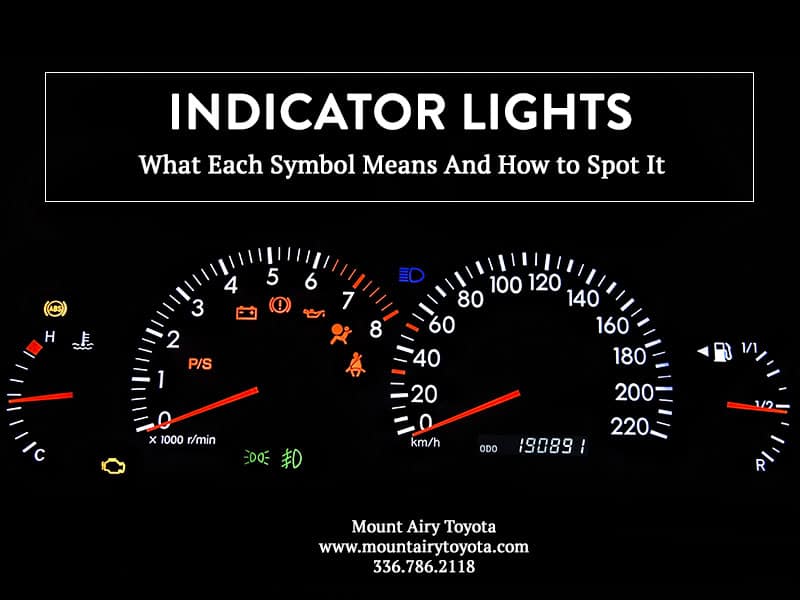
You’re driving down I-74, heading back from a weekend at the coast, when suddenly your dashboard lights start chiming at you and light up. What’s happening? Are they telling you of an impending disaster, or are they just gentle reminders and nudges for car maintenance? The trouble is, once you’ve been driving for years, you forget the importance of indicator lights, or what they could mean. Or you buy this car, then that, then another, and you forget that certain brands have different icons or symbols from the previous vehicles you owned. So, it seems a good idea to us, here at Mount Airy Toyota, to review some of the basics as well as look at a few indicator symbols that are unique to particular vehicles we have on our lot. Dashboard indicator lights—maybe not the most exciting things about your vehicle, but they are actually rather essential to the overall function of it. And the indicator lights aren’t just about functions your vehicle performs. They also help you make decisions about maintenance needs, they give you information so that you can make the best decisions (your speedometer and gas gauge both do this) and, of course, they also warn you of critical issues you need to deal with. Let’s look at some key indicator lights on Toyota’s line of vehicles, which uses many of the shared symbols across the industry, and consider their importance. Standard Indicator Lights ABS:  The anti-lock braking system’s indicator light tells you there is a malfunction with either the ABS system or with the Brake Assist system (if equipped). This should be considered an indication of a critical issue that needs to be attended to straight away. If your ABS indicator comes on, be sure you safely navigate it to the nearest mechanic or, better still, call a tow truck—you don’t want your braking system to give out, and end up causing an accident! Charging System: This indicator light will notify you of a malfunction in the vehicle’s charging system. But what does that mean? Obviously, since it looks like a battery, it can imply that your vehicle’s battery isn’t recharging properly, whilst you drive. It can also indicate an electrical issue with your car, which could mean a short in the wiring or could spell damage for things like your alternator or other system motors (windows, windshield wipers, etc.). Obviously check the battery charge, if you have a reader for that, but definitely take your vehicle in for service. Cruise Control Indicator: This one is straight forward: your cruise control is on. Though that seems a no-brainer, if you are ever out on the highway and have turned it on, then stepped on the gas to pass someone, it’s important to check your dashboard to see if the cruise control system is still engaged. Most, but not all vehicles (especially older ones), will disengage the cruise control features if you step on the brakes; but if you step on the gas, it may only let you speed up and then default the car’s speed to the cruise control settings previously established. It’s always safer to check and ensure whether or not the system is still engaged, after manually controlling the gas pedal. Electric Power Steering: This one certainly ranges among the most important indicators, because if you have a malfunction with your Electric Power Steering (EPS) system, you could quite obviously end up in a car accident. It’s so important to visit your dealer straight away if this indicator comes on. Headlight: This indicator informs you when you have the headlights, parking lights, taillights, license plate, or instrumental panel lights on. Pretty straight forward, right? Well, this is also the light you need to look for on the dashboard when shutting off your car and putting your keys away, because no one wants to come back to a car that has a dead battery as a result of leaving the headlights on. (Also, this light won’t illuminate if only the Daytime Running Lights are on.) High-beam Headlight Indicator: Driving from a woodsy, country house and getting on the main highway? Suddenly car after car flashes their high-beams at you, and you start to get annoyed until you look down at your dashboard. There’s that indicator light on, for your high beams, and you realize you had them on when navigating dark country roads—that’s fine, there. But turn them off in well-lit places or on highways, because those lights can be blinding at night (that’s part of the point, so that you can see in very dark areas). The other drivers will thank you. Malfunction Indicator (Engine): This is, of course, the big one! If this turns on, there is some malfunction in the engine control system, the throttle control system (for manual transmission vehicles), or the automatic transmission control system (for automatic transmission vehicles). Go directly to the dealer; do not pass “GO!” and do not collect $200. If you don’t go directly to your dealer when this light pops on, you might really damage your engine and pay far more than $200 to restore it. Low Fuel Level Warning Light (with buzzer): How many times do you look at the gas gauge and promise yourself as it hovers at half a tank, then slips just below, and then flirts with a quarter of a tank, that you will stop and get gas? And still you forget—until this light pops on and beeps at you. Now, you only have a range of 20-30 miles left (depending on the make and model of your vehicle) to locate a gas station and avert the walk of driver’s shame: gas can in hand, slogging it one mile to the next Citgo. Best advice: whenever you flirt with a one-quarter tank, just go and fill up. It’s all-around the smartest way to avoid a totally preventable, highly-irritating scenario! Tire Pressure Warning Light: How many times have you ignored this one? Following the same train of thought with the low fuel level light, we tend to keep telling ourselves that we will put air in the front right tire, the left rear tire, this upcoming Saturday morning when we have more time, or next Tuesday when we pop by Costco. But every time we drive on a tire with lowered pressure, we are making our tires work harder to keep us on the road (there’s a reason they have grooves in the tires—to create grip) and we are speeding up the time when they will finally go bald. These sort of lights seem easily dismissed, because they don’t strike panic like the “check engine” light can, but low tire pressure means replacing costly tires all the sooner and it means poor gas mileage performance. Just get yourself in the habit of filling up your tires when low (and checking their pressure regularly with a cheap pressure gauge, hung from a key fob). It’s just the smarter way to go! Brake System Warning Light (with buzzer): If this comes on, pull over safely, bring the vehicle to a complete stop, and call your dealer immediately. (Don’t forget you have a parking brake if you are in a situation where you’ve lost your brakes. If so, stop accelerating and try to drive off to the shoulder of the road and make use of your auxiliary braking systems.) Do not ignore this light, ever! This is a life or death light, and indicates either low brake fluid (more easily corrected by simply adding more) or a malfunction in the brake system (which your dealer needs to fix). “Smart” Indicator Lights (on newer vehicles): Lane Departure Alert (LDA) Indicator: As cars get smarter, we will see new indicator lights added to our dashboards, like the LDA indicator light. This is a good thing, such new additions, but it means we need to learn what they mean. So, the LDA indicator light tells the drive when she might depart from a lane. If you are on a highway or freeway, with white and yellow lines, the LDA system recognizes these lines with camera sensors; if you begin to float or stray from your lane, the system will beep at you. This sort of system, with its indicator light, is the wave of the future and promises us far smarter driving. That’s a good thing! BSM Outside Rearview Mirror Indicator: The Blind Sport Monitor (BSM) system provides two services to you, the driver: It can assist the driver in making a decision when to change lanes and, paired with the Rear Cross-Traffic Altert (RCTA) function, it can alert a driver when it’s safe (or not) to back up. This feature can be turned on and off in many of the vehicles that come equipped with it, and it uses the cameras positioned around the body of the vehicle to read and sense the other cars and objects around it. Safer driving, in future, will mean smarter driving, and the BSM and RCTA functions are part of the wave of future “smart” driving. Dynamic Radar Cruise Control: Using more cameras and sensors, this system will automatically adjust acceleration and deceleration, as well as, stop the vehicle, when you have the car in cruise control mode. That means your car will read and respond to the speeds and behaviors of cars around it, on the road. Such a feature means we have redundancy built into our driving: sure, we can manually adjust all of these things, but if we have a system that can act as a back up, so we have a safer buffer in our driving decisions, what’s not to like? Again, safer driving in the future will come from smarter features like the Dynamic Radar Cruise Control function. Smarter driving is safer driving, and at Mount Airy Toyota, safety is always our number one concern. Here at Mount Airy, we are excited about the future in driving. Prototypes and innovative designs in the car’s dashboard mean we will see more and more digital dashboards with numerous smart features. The infotainment screens we are getting used to will be child’s play, compared to the rich, digital LED screens that will be virtual cockpits in cars of the future. Your future dashboard will have apps, connect seamlessly to your smartphones, be attached to satellite GPS and interface with GPS systems like Waze, providing dynamic feedback and real-time adjustments—all on your digital dashboard. The more car companies can put into our dashboard, so that we aren’t relying on our phones’ little screens for navigation and information, the better! And it will the digital dashboard, enriched with numerous functions, that will be the future driver’s main interface for interacting with autonomous-driving vehicles. Sure, there will still be a steering wheel in the car, but the main way to master your car will be through touchscreens and voice commands. We are on the verge of a revolution in vehicles and driving habits, and Mount Airy will be there for you in future, as such cars roll off the line and onto salesfloors.

2019 Toyota Corolla Hatchback at Mount Airy Toyota

Discover the Sporty New 2019 Toyota Corolla Hatchback at Mount Airy Toyota

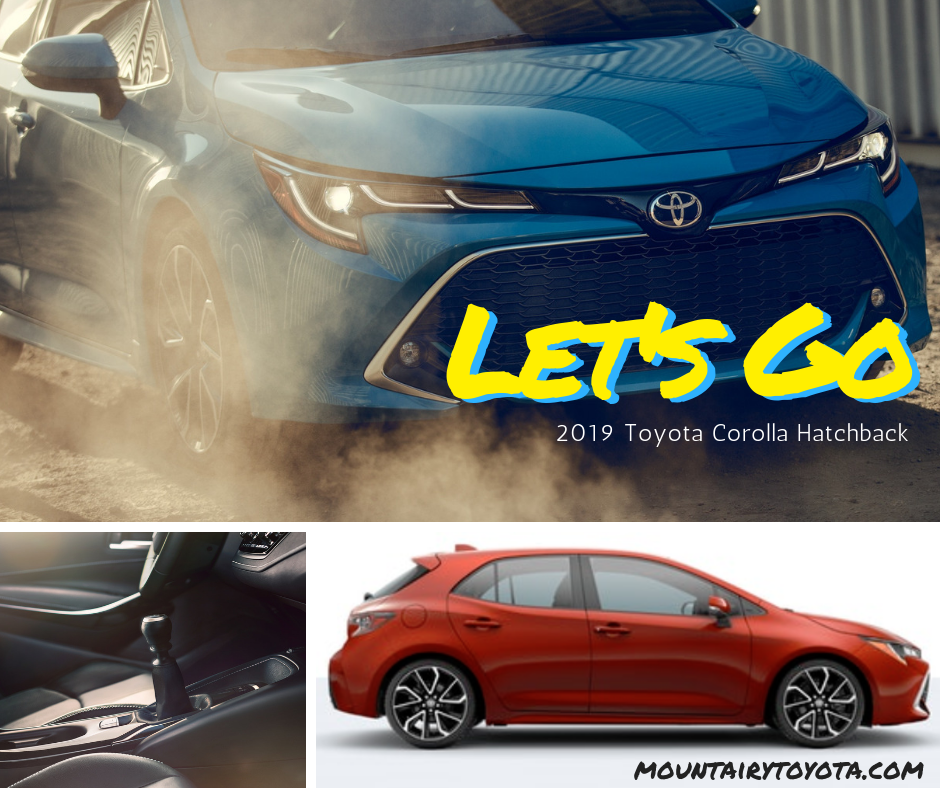
It’s not too often the case that someone hears the words “Toyota Corolla” and thinks, “Ohhh, exciting!” Long known as an entry-point to the car-maker’s reputation for reliability, the Corolla is the oldest name in Toyota’s current inventory, aside from the Land Cruiser. There have been close to 45 million Corollas sold worldwide — thus it is ubiquitous exactly because it is the most popular car line in history. But what was once a quiet, innocuous little sedan has gotten a tune up. “With the 2019 Toyota Corolla Hatchback, the carmaker fashions a substantial reminder that a small car with a rear hatch and a little attitude can be immensely appealing,” writes Kelly Blue Book. Once known as the iM, the brand new Corolla Hatchback is designed to be fun to drive. The 168 hp engine with 155 lb-ft of torque features 6-speed Intelligent Manual Transmission with close-ratio gears down low for acceleration and taller gears up top for better fuel economy. The ground-hugging body is mounted on MacPherson struts in front and a trailing-wishbone rear suspension for better control and less body roll. Disc brakes, all-season tires, and active cornering assist add punch to the overall stop and go. A hatchback in and of itself has greater capabilities than a sedan. It’s more flexible in terms of what it can carry, provided more vertical trunk space without the restrictive back window shelf of a sedan. The 2019 Corolla Hatchback has 17.8 cubic ft. of cargo volume — the standard 2018 and 2019 Corolla sedans offer only 13.0 cubic ft. and compared to SUVs on the market now the 2018 Mazda CX-3 has a cargo volume of only 12.4 cubic ft. Another Corolla Hatchback cool factor is its wearable connectivity. Got a smartwatch? Why not use it to locate your vehicle, lock or unlock the doors, or even start the engine — features perfect for warming up the engine before work on a cold, mountain day. Of course, there are also available heated seats and an available 8-speaker, 800-watt sound system to make the ride even more fun. “The main creature comforts of the Corolla have been admirably handled. The interior feels good, with no demerits or obviously cut corners. Road noise is commendably attenuated, and the Corolla is comfortable even for 6-foot adults with a little meat on their bones,” reports Digital Trends. Toyota doesn’t sacrifice fun for function. The 2019 Corolla Hatchback comes with Toyota Safety Sense 2.0, which includes a pre-collision system with pedestrian detection, lane-departure alert, and even road sign assist, which uses an intelligent camera to detect speed limit signs, stop signs, and yield signs and display feedback on the multimedia screen. “Overall, the 2019 hatchback model is a pleasantly surprising piece of work, roomy, premium and loaded with great features,” reports AutoGuide. The 2019 Toyota Corolla Hatchback is just rolling out to dealer lots now — late summer 2018 — but if you’re eager to build your own, Mount Airy Toyota can make that happen. Give us a call at 336.786.2118 to discuss available features and, if a new car isn’t quite what you’re looking for, we can find the right used vehicle for you.

Toyota C-HR Unveiled at LA Auto Show

Toyota’s C-HR Wins Top Safety Ratings as Eye-Catching New Addition to the Crossover Market

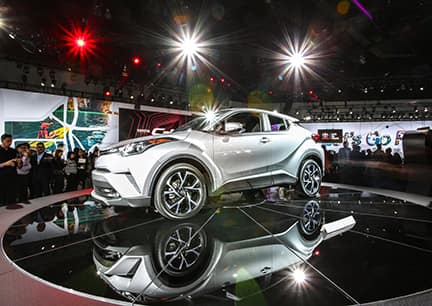
Need to tote around 1,500 venti Starbucks cups or 150 bowling balls? Have we got the compact SUV for you! Toyota C-HR Unveiled at LA Auto Show Some cars are more visually distinctive than others. At Mount Airy Toyota, we have the brand new 2018 Toyota C-HR on the lot, and we can’t stop looking at it. This coupe high rider (hence the C-HR name) is Toyota’s new entry to the crossover/small SUV category. It’s a vehicle that’s not a sedan, not a wagon, and not for heading off road. But when it comes to running around town with a little more height to your undercarriage, the C-HR is rated at 27 mpg in the city and 31 mpg on the highway, which beats the RAV-4, Ford Escape, and Mazda CX-3 while being on par with the Honda CR-V. There’s rumor of a hybrid C-HR engine in 2019. The C-HR seats five and has folding back seats with a 60/40 split. Folding down the seats gives 36.4 cubic feet of space – enough to hold more than 1,500 venti Starbucks cups or 150 bowling balls, if you’re in to that kind of thing. The C-HR was designed to fit a particular niche missing from the traditional Toyota lineup: something to bridge the gap between the SUVs, sedans, and compact cars. “The C-HR is smaller and more affordable than the RAV4. In fact, it was originally developed for Toyota's now-defunct Scion brand, which largely explains the C-HR's flamboyant styling and sporty handling. These two key attributes, along with the extensive list of standard safety features, are the main reasons to consider the C-HR in our opinion,” writes Cameron Rogers of Edmunds. Edmunds named the C-HR as one of the Best Small SUVs for 2018. The C-HR comes with Toyota Safety Sense suite, which includes integrated turn signal mirrors, pre-collision alert with pedestrian detection, lane departure warning, lane assist, automatic high beams, and adaptive cruise control plus a rearview camera as standard features. We love the standard hill start assist, which is great for mountain driveways. Rear cross traffic alert and blind spot monitoring are optional. The C-HR earned a five-star overall safety rating from the National Highway Transportation Safety Board and one of the highest predicted reliability ratings in its class: a 4.5 out of five from J.D. Power. Because the C-HR is, above all else, a Toyota, and Toyota’s are built to last. “It's taken for granted that a Toyota will work for decades without costing too much or breaking a lot,” writes Dan Roth of Forbes. Reliability is underappreciated until one is left standing on the side of the road in the middle of nowhere. Plus the C-HR, like all Toyotas, comes with Toyota Care – a free program that provides 24-hour roadside assistance for 2 years and unlimited miles as well as covers normal factory scheduled service for 2 years or 25,000 miles, whichever comes first. Like the Nissan Juke, Subaru Baja, and Pontiac Aztec before it, the C-HR is unique. Marketing materials call it: “Distinctive Diamond … matchless, sexy, muscular and edgy." The suspension system was designed for a sporty ride, according to Toyota deputy chief engineer Hiro Koba, a race car enthusiast; however, the C-HR takes 11 seconds to go 0 to 60 and 18.4 seconds to do the quarter-mile. It’s got a 2.0-liter four-cylinder engine with 144 horsepower and a continuously variable transmission (CVT). Note that a CVT technically doesn't have gears which is why drivers don't feel shifts like in a normal car. Instead RPMs run higher for acceleration, lower for cruising. So is the C-HR fun to drive? It depends on who you ask. “Driving the C-HR is a surprise,” Roth writes. “It’s stiff and solid, the steering is precise, and the ride is controlled. Careful suspension tuning included laps at the famous-to-car-people Nürburgring race track, where all the best Continental sports cars turn their wheels. Whatever secret sauce imparted by a racetrack in southwestern Germany and Deputy Chief Engineer Hiro Koba’s obsessive efforts has paid off.” All C-HRs come wearing 18-inch wheels inside 225/50R-18 all-season tires with "Vortex" styling. The C-HR engine may not have the most pull for passing – plus the car weighs 300 pounds more than an all-wheel drive Mazda CX-3 – but what it lacks in acceleration it makes up for in cornering. “It really does handle tight turns quite nicely, with little body roll and excellent control,” writes Scott Evans of MotorTrend. After all, a car with so much edge isn’t going to roll. How edgy? Toyota put the C-HR’s rear door handles at the top of the door – no little kiddos creeping into the backseat of this thing! That said, the backseat will indeed hold a baby’s car seat, if you decide to intentionally put one there. Those who remember the Toyota FJ Cruiser will recognize the signature white roof available on the C-HR with a Radiant Green Mica, Ruby Flare Pearl, or Blue Eclipse Metallic body. Full body colors selections include the blue and red plus Black Sand Pearl, Magnetic Grey Metallic, Silver Knockout Metallic, and Blizzard Pearl. Clear coat paint protection for the hood and doors is an option. On the lot right now at Mount Airy Toyota, we have three CH-Rs: one in Blizzard Pearl, one in Silver Knockout Metallic, and one with the special R-Code paint treatment in Blue Eclipse. Both XLE Premium models, the cars have smart key, push button start. There’s just something cool about push button start – it’s like launching a rocket into space. The C-HR’s other technology includes a 7-inch touch screen, 4.2-inch information display for the driver, auto-dimming rear view mirror, electric parking brake, and folding mirrors. Walk up to your C-HR with smart key technology and once you touch the door handle, the mirrors will unfold and display an illuminated logo on the ground. These lights complement the car’s halogen headlines, LED daytime running lights, and sculpted taillights. Inside the leather-trimmed steering wheel, dual zone climate control, and six-way adjustable, heated seats, enrich the C-HR’s environment. The C-HR does not offer leather seats. What the C-HR lacks in features – there’s no Apple CarPlay or Android Auto – it looks to make up for next year. A Toyota exec has said the 2019 C-HR will get Apple CarPlay when it arrives in a few months, according to The Torque Report. The connectivity is supposed to be added to other Toyota models – including the Avalon, Corolla, and RAV4 – as well. Come to Mount Airy Toyota to test drive this C-HR in Blue Eclipse Metallic. The C-HR comes in under $25,000. On our lot, the three premium models run $24,385, $23,885, and $23,275 with the savings specials currently offered including a financing offer and $500 bonus cash, which expires in early July. Schedule a test drive and calculate payments on our website to get started on bringing a brand new C-HR home with you. The C-HR is the kind of car that isn’t designed for everybody but may be designed just for you. “This hodgepodge of parts and pieces is a genre-bender that can warp your face into a smile,” writes Roth. If the C-HR turns out not to be the SUV for you, Mount Airy Toyota has plenty else from which to choose. We have new and used Highlanders, RAV4s, 4Runners, and more. Need a sedan, four wheel drive, or a truck? We’ve got that covered too. Call us today at 336.786.2118 or come by 508 N. Andy Griffith Parkway, Mount Airy, N.C. 27030.

Safety First

Back To School Driving Tips

Back To School Driving Tips Mount Airy Toyota offers back to school driving tips for first time drivers and experienced drivers as well. It is always necessary to be careful when driving, but once school is in session, it is especially important. No matter if you live in Wytheville, VA or Elkin, NC there seem to be more cars on the road this time of year. And younger drivers in them. That’s why we at Mount Airy Toyota have come up with a list of back to school driving tips. A good step towards safe driving is to get yourself a Toyota. Any model you buy comes with the Toyota Safety Sense (TSS). These are detailed measures the car company has taken to help keep drivers, passengers, and pedestrians as safe as possible. Safety is a high priority to Toyota and it shows. Slow Down. The first tip is to slow down when approaching a school, even if you are not attending or dropping someone off. Whether it’s early in the morning or in the afternoon, vehicles tend to quickly change lanes and traffic can abruptly stop. To drastically reduce the possibility of a collision, slow down, be alert, and utilize Toyota’s Pre-Collision System. (PCS) is a set of front-end sensors that detect oncoming objects and alert you to slow down or change lanes. Lane Departure Warning. Another tip is to use Toyota’s Lane Departure Alert (LDA). This high-tech feature detects when you are veering out of your lane so you can quickly correct yourself. This is especially usefully in that dreaded back-to-school-traffic. Bumper-to-bumper driving, especially with less experienced drivers, can be tough and full of distractions. Keep alert, and let Toyota’s LDA to help you. Watch Out for Pedestrians. One of the most important tips when driving around schools is to use Toyota’s Pre-Collision System with Pedestrian Detection Function (PCS w/PD). Students do not always wait for the stoplight to change before heading over the crosswalk. And early in the morning, when it is still dark, this can be dangerous. But with your new Toyota, and its PCS w/PD, you can detect any pedestrian movement in front of you. And most importantly, have time to slow down or stop. If you are heading back to school, dropping a loved one off, or just find yourself in school traffic, Toyota’s innovative safety features can keep you and others safe.

Driving in a Flood

How to Drive in a Flood

Recent rainfall and storms have caused flooding in and around the Mt. Airy area. Whether you believe in global warming or not, weather statistics are showing that 2015 is going to be the hottest year in recent history. Weather forecasters are claiming that a Godzilla El Nino will disrupt weather patterns and cause an above average amount of rainfall this fall and winter. This means possible flooding in many areas. Here are some tips to keep you safe during heavy rainfall and flash floods: Prepare for Floods Ahead of Time: Sometimes, we are driving and it begins to downpour. A flash flood can spring up out of nowhere. Consider keeping a safety kit packed in your car for emergencies. The kit should include maps, flares, a flashlight, a spare radio, canned food, and drinking water. Driving in a Flood Tips: Estimate how deep the water is before you try to drive through it. Look at road signs and other things along the road to estimate the level of the water. Did you know that just 6 inches of water can damage your engine and lead to stalling? A car can also start to float in as little as 12 inches of water. If you think the standing water is more than 6 inches, turn around and find another route. Slow Down when you are approaching standing water. If you must drive through water, do so cautiously. Turn off your A/C or heat to prevent the external fan sucking up water. If there are other cars around, let each car pass through the water one at a time. Look for Downed Power Lines. Do not attempt to drive through standing water if you see downed power lines. Respect Barricades. If you come to a road barricade- do not attempt to go around it. These barricades are there for your protection. Most likely the road that has been barricaded is a known flood zone or emergency workers have already had to rescue someone from that spot. There could be road damage that makes it unsafe to pass. Get Out of the Car if you get stuck in standing water. If you try to drive through water and get stuck, do not stay in your car. In as little as a foot of water, your vehicle can float away. Also, water can seep into your vehicle. It is best to seek higher ground and wait for emergency workers. At Mt. Airy Toyota and Scion, we want you to be safe this fall and winter. Remember you can always turn around and go a different way if you are unsure. Also, driving a vehicle that is higher can help during extreme weather. We recommend the Toyota Tacoma or Toyota Highlander- both have four-wheel drive and sit higher off the road than a sedan.

Contact Us

Fill out this form below and we'll contact you shortly
*Required Fields