Blog / Car Care

Blog

All Car Care Toyota Toyota Safety Camry Rav4 Tacoma Trucks Highlander Events Corolla Service 4Runner Tundra Electric Cars Auto News by Mount Airy Toyota Toyota History Toyota Technology Sienna Tires Avalon Mount Airy Toyota Dealer Toyotathon Trade- In Mount Airy Toyota Service Prius Supra Toyotacare Used Trucks Prius V Sequoia Used Cars C-HR Landcruiser SUV Crossover Employees End of the Year Savings Hatchback New Pickup Trucks Yaris ARB Safari Snorkel Explained Crown Difference between i-Force Max & i-Force Fox Internal Bypass QS3 Shocks Mount Airy Used Cars Old Man Emu Shocks Tacoma Onboard Air Compressor Toyota Hybrid Trucks & Cars Toyota Tundra Trailhunter vs TRD Pro TRD vs Trailhunter Suspension Venza What are Rock Sliders
Rodents are small, but the damage they leave behind inside a car engine can be surprisingly big.

Rodents and Brakes Are Squeaking in Your Car! How to Catch Damage Before It Costs You Big

The Problem of Waiting Too Long Tech Tips from Chris Pack at Mount Airy Toyota Many drivers treat auto inspections like an afterthought — “I’ll schedule it when something breaks.” But the reality is, by the time symptoms are obvious (squealing brakes, pulling, fluid leaks), damage is often deep enough to require expensive repair or replacement. A multi-point inspection catches small issues—worn pads, fluid level drops, loose components—before they evolve into bigger problems. The cost of treating early warning signs is negligible compared to full part replacement or safety failures. Set your service appointment today! RATS! RATS! RATS! Rodents are small, but the damage they leave behind inside a car engine can be surprisingly big. Warm engine bays attract rats and mice looking for shelter, and once they settle in, chewing becomes inevitable. Wiring harnesses, hoses, and insulation are prime targets because rodents use them to sharpen their teeth. What may look like a minor bite mark can quickly escalate into warning lights, electrical issues, or even a car that won’t start. The cost of replacing chewed wiring harnesses often shocks vehicle owners, since what seems like a small problem usually requires major repairs. Why the Air Filter Area Matters Most One of the first places rodents tend to show up is in the air filter box. It’s an easy entry point, and the filter material makes convenient nesting material. The bigger danger, however, comes from rodent droppings. Rat feces inside or around your air filter can contaminate the air moving into your cabin and circulate harmful bacteria and allergens into the vehicle. Beyond the health risk, droppings and debris can clog the filter, reducing airflow and hurting engine performance. This is why routine checks of the air filter are so important—they’re often the first line of defense against a bigger infestation. Catching the Problem Early The best way to avoid expensive repairs and potential health hazards is through regular vehicle service. Trained technicians know where to look for early signs of rodent activity, from chewed wiring to nests near the intake. If caught early, rodents can be deterred before they make it past the air filter and into critical components. Waiting too long can turn what could have been a simple cleaning into a costly replacement job. By keeping up with inspections, you not only protect your engine but also ensure the air you breathe inside your car stays safe and clean. Why Brakes & Pads Deserve Extra Attention Brakes and pads are among the most critical components for safe driving — and also among the ones that deteriorate gradually. Wear can be uneven, pads may degrade without you hearing or feeling it right away, and brake fluid leaks can sneak up. During a multi-point inspection, technicians closely examine rotor thickness, pad depth, fluid levels, and hardware integrity. They can spot unusual wear patterns, impending failures, and other red flags well before you ever need to hit the brakes hard in an emergency. The Hidden Benefits That Go Beyond Safety Of course, safety is paramount — but early detection brings a cascade of benefits. You’ll enjoy lower repair costs, improved fuel efficiency (no dragging or misaligned parts), and enhanced vehicle longevity. Regular inspections also build trust between you and your auto shop; you’re not paying for “surprises,” you’re paying for maintenance. In the long run, a proactive maintenance mindset means fewer breakdowns, fewer roadside emergencies, and more confidence behind the wheel.

Battery Information from Mount Airy Toyota

July Is the Month for Watermelon and Dead Batteries!

It happens every year about this time.  We get a rush of customers with battery issues because of the rapid rise in temperature.  It catches people off guard in Mount Airy because we're used to the extreme cold weather, but never quite as prepared for the heat of summer.  To help our customers be more prepared we've provided information, special cost savings on batter installation, and tips from our expert mechanics. Dead Battery? Here’s What You Need to Know (Before It Happens to You) We’ve all experienced that sinking feeling when you hop in your car, press the start button or turn the key, and nothing happens. No engine noise, no dashboard lights, no response at all. A dead battery can leave you stranded at the worst possible moment, whether you're heading to work, picking up the kids, or preparing for a road trip. Fortunately, a little knowledge goes a long way. Understanding how your car battery works, recognizing the warning signs, and knowing what to do in an emergency can help you avoid unnecessary stress. In this guide, we’ll break down everything you need to know about your vehicle’s battery so you can stay powered up and prepared for the road ahead. What Exactly Does Your Car Battery Do? Your car’s battery is much more than a simple power source. It plays a vital role in the operation of your vehicle from the moment you turn it on. At its core, the battery provides the jolt of electricity needed to start your engine. Without it, your car simply won’t run. Once the engine is started, the alternator takes over to generate electricity and recharge the battery—but that initial burst is critical. In addition to helping your vehicle start, the battery powers all of your electronic components when the engine is off. These components include: Interior and exterior lights Power windows and locks Infotainment systems and radios Climate control systems USB chargers and other accessories If your battery is weak or dying, any of these systems may become sluggish, glitchy, or stop working altogether. What To Do If Your Battery Dies If you find yourself with a car that won’t start, there’s a good chance your battery is to blame. But don’t panic, there are a couple of reliable methods to get back on the road.  If you're near Mount Airy Toyota, give us a call or schedule service.  We're ready to help! 1. Try a Jump Start Jump-starting is one of the most common and immediate solutions when dealing with a dead battery. You’ll need a pair of jumper cables and another vehicle with a fully charged battery. Step-by-Step Instructions: Position the vehicles: Park the working car close enough to the dead car so the cables can reach, but make sure the vehicles are not touching. Turn off both engines and remove the keys. Connect the cables in the following order: Red clamp to the positive terminal (+) on the dead battery. Red clamp to the positive terminal (+) on the working battery. Black clamp to the negative terminal (–) on the working battery. Black clamp to an unpainted metal surface on the engine block or chassis of the dead car (not the battery). Start the working car and let it run for a few minutes. Try starting the dead vehicle. Safety Tip: If you’re unsure of where the battery terminals are or how to properly connect the cables, consult your owner’s manual or call a professional. Incorrect connections can cause sparks, damage to the battery, or even injury. 2. Use a Portable Battery Jump Starter A more modern solution is the portable battery jump starter, often called a “jump box.” These compact, rechargeable devices are a must-have for emergency preparedness. Unlike jumper cables, a jump starter doesn’t require a second vehicle. Simply connect the clamps to your battery, turn it on, and start your car. Many models feature automatic polarity detection, spark-proof technology, and built-in safety alarms, making them very user-friendly. Some jump starters also double as: USB phone chargers Flashlights Tire inflators or air compressors If you travel frequently, live in a remote area, or simply want peace of mind, a jump starter is a smart investment. Why You Should Check Your Battery Regularly Like any other part of your vehicle, car batteries don’t last forever. On average, a battery will last between 3 to 5 years, depending on usage, weather conditions, and maintenance habits. Extreme heat and cold are especially hard on batteries. In hot weather, internal fluids evaporate faster, leading to corrosion and reduced performance. In freezing temperatures, a battery’s ability to hold a charge can drop significantly. That’s why routine battery checks should be part of your regular vehicle maintenance plan. At Mount Airy Toyota, our technicians can test your battery in just a few minutes during any scheduled service and, if the battery needs replacing, we can have it done in around 15-20 minutes. We check: Voltage – Is your battery fully charged? Cold Cranking Amps (CCA) – Can it deliver the power needed to start the car in cold conditions? Overall health – Is your battery near the end of its useful life? Pro Tip: Identifying a weak battery before it fails can save you the cost and inconvenience of a tow truck or emergency repair. What Happens If You Don’t Replace a Weak Battery? Ignoring the warning signs of a failing battery might seem harmless at first, until your car refuses to start when you need it most. A dying battery can cause a variety of problems beyond just an inconvenient breakdown. Here’s what you risk by waiting too long: Car won’t start – Often at the worst possible moment (late at night, in bad weather, far from home). Strain on the alternator – The alternator may work overtime to compensate, potentially shortening its lifespan. Malfunctioning electronics – Lights, radios, navigation systems, and other electronics may start acting erratically. Roadside assistance costs – Towing, jump-starts, or emergency service calls can get expensive fast. Prevention is always cheaper and easier than an emergency. Signs Your Battery Might Be Failing Car batteries usually don’t die suddenly. In most cases, they provide warning signs days or even weeks in advance. Recognizing these early symptoms can help you take action before you get stranded. Common Signs of Battery Trouble: Slow engine crank – The engine takes longer than usual to turn over. Dim headlights – Especially noticeable when idling or using multiple electronics. Clicking noise – A rapid clicking sound when you turn the key or press the start button. Dashboard warning lights – Battery or check engine lights may flash intermittently. Electrical issues – Infotainment system resets, malfunctioning power windows or locks. Corrosion – White or blue powder around the battery terminals is a sign of acid leakage. Swollen battery case – This can be caused by overcharging or extreme temperatures. If you notice any of these, it’s time to have your battery inspected by a professional. Pro Tips to Make Your Battery Last Longer While you can’t control everything, good maintenance habits can significantly extend your battery’s lifespan. Here are some tips to help you get the most out of your car battery: Drive regularly: Short trips or long periods of inactivity can drain your battery. Try to drive your car at least once a week. Turn off electronics: Before shutting off the engine, turn off lights, radio, and climate control to reduce drain. Clean battery terminals: Dirt and corrosion can prevent proper current flow. Use a wire brush and baking soda solution for cleaning. Tighten loose connections: Make sure the cables and terminals are snug and secure. Avoid extreme temperatures: Park in a garage or shaded area when possible. Extreme heat and cold are tough on battery cells. Disconnect when storing: If you're storing your vehicle for a long time, consider disconnecting the battery or using a trickle charger. Final Thoughts: Stay Charged, Stay Confident Your car’s battery might not be something you think about often—but when it fails, you’ll notice immediately. That’s why staying proactive is so important. A simple battery check today could prevent a major inconvenience tomorrow. Whether you're gearing up for a summer road trip or just commuting to work, take a few minutes to ensure your vehicle is ready to roll. Don't wait for warning signs or bad weather to catch you off guard. Need your battery checked or replaced? Come visit Mount Airy Toyota! Our expert technicians are here to help with quick, reliable battery inspections and replacements. We’ll make sure your Toyota stays powered up, safe, and ready for every mile ahead.

Distracted Driving and Advanced Driver Assistance Programs

What You Need to Know About Advanced Driver Assistance Systems & Distracted Driving

What You Need to Know About Advanced Driver Assistance Systems Though advanced driver assistance systems are considered a modern marvel when it comes to driving, there are some concerns being raised about them. These newer hands-free vehicle systems do provide a higher level of safety, there’s no question about that, but some believe they can cause additional distractions as well. Hands-free calling, texting, GPS, and other modern, high-tech features take our minds off traffic, especially in the evening hours, which heightens the possibility of drivers losing focus. Winston-Salem, NC made the news recently, as both television and print outlets all over the state (including Charlotte) have reported on the dangers of distracted driving, citing specific accidents in areas around town. Though some of the information provided in these reports was a bit cherry-picked, much of what was reported is insightful information. For instance, did you know that from 9 pm to 11:59 pm on Friday and Saturday nights is the most dangerous time to be on the road? Whether you are driving through a small or big town, a congested or seemingly open road, there are plenty of ways to become distracted while driving, and this report points to the fact that advancements in the way we drive are not necessarily eliminating distractions–conversely, they may be enhancing them. What Are Driver Assistance Systems? Advanced Driver Assistance Systems, or ADAS, are various technologies created to improve the driving experience, namely, to promote vehicle safety. This process involves the implementation of automated assistance to the driver to help reduce the possibility of human error. This is done by using sensors, cameras, radar, and other advanced tech features to monitor the vehicle’s surroundings at all times and to assist in various driving tasks–such as adaptive cruise control, lane-departure assistance, automatic emergency braking, and parking assistance. But are these systems doing too much for us? Are they causing us to pay less attention to the technicalities of driving and spending more time letting our minds wander?   For some car companies, like Toyota, these advanced systems are nothing new, though they are often updated. The availability of specific assistance features can depend on the trim level and options chosen for each vehicle, but a variety of them can be found in most versions of Toyota’s Camry, RAV4, Corolla, Highlander, Tacoma, Prius, Avalon, and Sienna.   Before we get into some details on how these systems work, and how we can keep from letting our minds wander while they are in use, let’s have a look into how incorporating ADAS provides clear benefits both drivers and passengers: Improved Safety: we can already see how ADAS helps prevent car accidents by providing safety assistance to drivers through the use of emergency braking, lane departure warning, and adaptive cruise control. Enhanced Convenience: ADAS can make the driving experience more comfortable and less stressful by assisting with tasks such as maintaining a safe distance behind other vehicles, keeping your vehicle centered in its lane, and aiding in parking maneuvers, such as the dreaded parallel parking. Reduced Driver Fatigue: by incorporating ADAS, drivers can get alerts and assistance when necessary if experiencing fatigue. These technologies can keep drivers from falling asleep and/or get them to pay attention to certain aspects of driving–for instance, if there is flooding, icy conditions, animals crossing, etc. Potential Insurance Discounts: some insurance companies offer discounts for vehicles equipped with ADAS, as these technologies have already proven their ability to reduce the likelihood of accidents and even minimize potential damage in the case of an actual collision. Environmental Benefits: certain features of ADAS, such as adaptive cruise control, can help with fuel efficiency by maintaining a consistent speed and following distance. Over time, this can lead to a drastic reduction in fuel consumption. Lower emissions means your car is better for the environment, and you are able to save money by visiting the gas station less often. Assistance for Drivers with Disabilities: ADAS can provide helpful assistance to drivers with disabilities by helping them operate aspects of the vehicle through automated prompting, the use of warning lights, etc. It can also assist those with limited mobility by setting itself to take care of things like the usage of blinkers and headlights without the prompting of the driver. Clearly, ADAS plays a crucial role in improving road safety and enhancing the driving experience, and this process of technological integration is only starting–who knows what the future holds! But how do we keep from losing focus since ADAS does so much of the work for us? To be honest, it doesn’t take special training or working through a series of steps. Focused driving simply requires a change in the way we communicate with our vehicle: though your car can now do more for you than ever before, it’s necessary to watch the processes take place. For instance, rather than constantly looking around your car as you drive alongside other vehicles on the highway, keep your attention on the dash and on your side mirrors, and let the ADAS system communicate to you what is going on through the sounds and images it shouts out to you. Always keep in mind that Advanced Driver Assistance Programs are meant to make driving easier, but they are not meant to take over completely. The same amount of attention is needed while driving, but now a lot of that attention can be directed to listening to what your car is telling you. You and your vehicle should be working in tandem to create a safe, enjoyable drive. How ADAS Works Integrated systems such as ADAS are quite complicated, but gaining a basic understanding of how they work can better inform drivers on how and when to use them. On the most basic level, ADAS uses a combination of sensors, cameras, radar, lidar, and software algorithms to monitor the vehicle’s surroundings. All of these technologies are used to assist the driver. Here is a general overview of how it all works: Sensors and Cameras – Small sensors and cameras are strategically placed around the vehicle so that they can continuously collect data on the car’s surroundings, including nearby vehicles, pedestrians, road markings, traffic signs, and obstacles. Data Processing – The data collected by sensors and cameras are processed in real time through the use of onboard computers. These computers use special algorithms to analyze the data received in order to identify objects on or around the road, detect potential hazardous situations, and assess the vehicle’s position in relation to the road and other vehicles. Decision Making – Once incoming data has been processed, ADAS makes decisions about the appropriate actions to take so that the driver is assisted, and safety mechanisms are enhanced. For example, if it is detected that the vehicle is drifting in and out of its lane without signaling, lane departure warnings and/or the steering assistant may be employed to alert the driver and to keep the vehicle in its proper placement on the road. Driver Feeback and Intervention – One of the great aspects of this sort of enhanced driving system is that ADAS provides feedback to the driver through visual, auditory, and haptic alerts in order to inform them of potential hazards in the moment. Not only that, but in some cases ADAS can also intervene directly by applying the brakes, adjusting steering, and even controlling the vehicle’s speed. Integration with Vehicle Controls – Most often, Advanced Driver Assistance is integrated with the vehicle’s existing control systems–like braking, steering, and throttle–so that there is active vehicle control when necessary without the prompting of the driver. Essentially, this means that ADAS does not have to wait for human interaction for it to kick in. This makes sense if you are heading towards danger without knowing it, you want your vehicle to know to apply the brakes whether your foot hits the brake pad or not. Continuous Monitoring and Improvement – What’s so great about ADAS is that it is continuously working. It is always monitoring the vehicle’s surroundings and performance–even if you are not–and it knows how to adapt and change driving conditions, and this effectiveness has actually improved over time. Manufacturers regularly update ADAS software to enhance performance, address potential issues, and introduce new safety features.   One other feature we like about the incorporation of ADAS is that if repairs or calibration are needed for the ADAS system in Toyota vehicles, a quick trip to the dealership is all that is required. Once on site, a certified technician can calibrate and/or repair any necessary areas. And there is no guesswork here, as your ADAS will let you know if there are necessary repairs or adjustments needed so that there is no compromise in the effectiveness of the system.   Driving is still about having fun and enjoying the open road but be careful driving your new Toyota Camry or Tundra. The hands-free features are terrific, but your mind still needs to be on the road. Take advantage of ADAS by letting your car communicate with you!

Understanding how to drive in severe weather could mean the difference between a safe and perilous journey.

Navigating Severe Weather Season: The Everyday Driver's Guide to Safety

The world is changing, and so is the weather. Severe weather events are becoming more frequent and intense, posing significant challenges for drivers on the road. Whether it's heavy rain, floods, lightning, hailstorms, or wind events, understanding how to respond can mean the difference between a safe and perilous journey. Mount Airy Toyota has put together this guide to equip you with the most critical information and strategies for staying safe when Mother Nature unleashes her fury on the road. Let’s start with some practical tips before getting into more details: Heavy Rain and Flooding Driving in heavy rain reduces visibility and causes slippery roads, a treacherous combination that increases the risk of accidents. Here's what you should do: Slow down: Reduce your speed to match road conditions. Hydroplaning becomes a risk when driving too fast on wet roads. Increase your following distance. Maintain a safe distance from the vehicle in front of you; stopping distances increase on wet roads. Use headlights. Turn on your headlights, even during the day, to improve your visibility and help others see you. Avoid puddles. Don't drive through standing water or flooded areas; it's hard to judge the depth, and your car can get stuck or swept away. Stay informed. Keep an eye on weather reports and road closures. Consider delaying your trip if conditions worsen. Lightning and Thunderstorms There’s nothing fun about driving in a thunderstorm, but following these tips can help you stay safe: Pull over. If possible, find a safe place to pull over and wait for the storm to pass. Avoid parking under trees or tall structures. Stay in the vehicle. Your car provides some protection from lightning strikes. Keep the windows up and avoid touching metal surfaces inside the vehicle. Turn on your hazards. Push that double-triangle to make your vehicle more visible to other drivers. Listen to weather updates. Tune into local radio or use a weather app to monitor the storm’s progress. Hailstorms Hail can cause significant damage to your vehicle. When you encounter a hailstorm, be sure to: Find shelter. Seek a sturdy shelter, like a gas station or parking garage. Protect your vehicle. If shelter isn't available, cover your car with a blanket or car cover to minimize hail damage. Reduce speed. Slow down to avoid losing control on slippery roads created by hail accumulation. Wait to drive. Listen to weather updates to know when it's safe to resume your journey. Wind Events It’s not talked about as much as some other severe weather conditions, but high winds can make driving challenging, especially for high-profile vehicles like trucks and RVs. Follow these guidelines: Maintain control. Keep both hands on the wheel and maintain a firm grip to counteract gusts of wind. Reduce your speed. Slow down to reduce the impact of wind on your vehicle's stability. Avoid overtaking. Don't attempt to pass large vehicles because wind can make them less predictable. Beware of debris. Remain alert for flying debris on the road, and steer clear of it. Severe weather season demands extra caution from drivers. Staying informed, adjusting your driving habits, and knowing when to seek shelter are crucial for staying safe. The takeaway is that your safety and the safety of others on the road should always be your top priority. Be prepared, stay vigilant, and drive responsibly. Toyota Safety for the Win Nothing is more important than safety when it comes to purchasing a new car. Fortunately, Toyota has a reputation for providing its drivers with cutting-edge safety features. From built-in cameras that help you keep your car in the lane to industry-leading braking systems, the newest Toyota models are at the forefront of car safety. In fact, Toyota provides its Safety Sense package as standard across most of its lineup. Pre-Collision System This is one of the key features of Toyota Safety Sense. It’s an advanced system designed to detect and prevent potential collisions. Equipped with a Pedestrian Detection function, the pre-collision feature uses cameras and radar to identify pedestrians before alerting you if you’re about to hit someone. Blind Spot Monitor The newest Toyota models come with a Blind Spot Monitor that uses radars mounted on the rear bumper to detect other cars in your blind spot. The system issues visual and audio warnings when cars are in your blind spot, making it easier to change lanes safely. Lane Departure Alert The Lane Departure Alert helps you to stay in your lane by warning you if you start to veer out of it. The system sends signals to alert you when it detects you drifting out of your lane, helping you avoid dangerous collisions. Full-Speed Dynamic Radar Cruise Control Toyota’s Full-Speed Dynamic Radar Cruise Control automatically adjusts your speed to maintain a safe distance between you and the car in front of you. It’s particularly useful on highways where speeds can fluctuate suddenly and often. Enhanced Vehicle Stability Control Toyota’s Enhanced Vehicle Stability Control helps you maintain vehicle control in the event of sudden turns or other difficult driving situations. The system can automatically apply the brakes or reduce engine power to help keep your car on the road and out of danger. The latest Toyota models come equipped with a range of advanced safety features that have been designed to keep you and your passengers safe on the road. The Toyota Safety Sense system is one of the most comprehensive and effective safety packages on the market today. If you’re looking for the ultimate in automotive safety, connect with Mount Airy Toyota to view our new and certified pre-owned options! Is Your Vehicle Ready for Severe Weather? Before hitting the road during severe weather, it's crucial to ensure your car or truck is in optimal condition to handle the challenges that Mother Nature may throw your way. Here are 11 essential checks to determine if your vehicle is safe for severe weather: Use the "penny test" or a tread depth gauge to confirm your tires meet the minimum tread depth requirement (typically 2/32”). Adequate tire tread is essential for maintaining traction on wet and slippery roads. While you’re at it, check your vehicle's recommended tire pressure and ensure all the tires are properly inflated. Make sure your brake pads and rotors are in good condition. Spongy or unresponsive brakes can be dangerous, especially in wet conditions. Confirm that all your lights are working correctly; proper lighting is crucial for visibility during heavy rain, fog, or storms. Have your vehicle’s battery tested to ensure it's in good health, especially if it's been a while since your last inspection. Cold weather and heavy electrical use during storms can strain it. Check for any cracks or damage to your windshield. A compromised windshield can shatter more easily during impacts. Also, make sure your wiper blades are in good condition and effectively clear rain or debris from your windshield. Replace them if they streak or leave streaks. Ensure that all the fluid levels (e.g., oil, transmission fluid, coolant, etc.) are within the recommended range. Adequate fluids help your engine run smoothly in extreme weather. Pack an emergency kit in your vehicle that includes a flashlight, first-aid supplies, blankets, non-perishable food, water, a tool kit, and other essentials. If your vehicle is equipped with four-wheel drive (4WD) or all-wheel drive (AWD), check that these systems are functioning correctly. They can be invaluable during slippery or challenging driving conditions. Make sure your traction and stability control systems are operational. They can assist in maintaining control during sudden maneuvers in adverse weather. Keep up with routine maintenance, such as oil changes and inspections, to catch and address potential issues before they become major problems. Take your vehicle for a test drive in a safe area to ensure everything feels and functions as it should. Listen for any unusual noises and pay attention to how your vehicle handles. You’ll be better prepared to navigate severe weather with confidence by performing these checks and staying proactive about your vehicle's maintenance. If you have any doubts about your vehicle's readiness for severe weather, consult a trusted mechanic for a thorough inspection and necessary repairs. How To Break Out of a Submerged Car Imagine the unthinkable: Your car has veered off the road and plunged into deep water. In such a dire situation, it's vital to remain calm, as panic can cloud your judgment and waste precious seconds. The first step to escaping a submerged vehicle is to unbuckle your seatbelt immediately to prepare for your escape. Next, try to open a window as quickly as possible. If your car has electric windows, be aware that they may fail as the vehicle begins to sink, so act swiftly. If the windows won't open, you must resort to using a specialized car window-breaking tool or any hard, pointed object (e.g., a screwdriver, a steel-tipped umbrella, metal prongs of a headrest, etc.) to break the glass. Aim for the corners or edges of the window since that’s where the glass is weakest. Moreover, let a small amount of water into the car before attempting to open the door; doing so will equalize the pressure inside and outside so it’s easier to open the door. Once the pressure is balanced, open the door slowly and exit the vehicle. If you have passengers, help them exit before you. And swim to the surface as quickly as possible. What To Do If Your Car Is Hit by a Tree Encountering a falling tree while driving can be a terrifying experience. In such a situation, it's imperative to stay calm, take a deep breath, and assess the scene. After confirming that neither you nor your passengers are harmed, activate your hazard lights to alert other drivers to the accident. If it's safe to do so, carefully exit your vehicle while being cautious of any fallen branches or debris that may pose additional risks. Once outside, inspect your car for damage. If the tree has fallen onto the vehicle but you can exit safely, it's crucial to stay clear of it since it might have caused structural damage to the car. Promptly contact the authorities to report the incident, especially if the fallen tree is blocking the road and needs to be removed. Try to take pictures of the scene for insurance purposes. Keep in mind that you should seek medical attention even if you don't immediately feel injured. Some injuries may not be immediately apparent but could manifest later. Keeping the Right Emergency Equipment as Parents Ensuring the safety and well-being of your children while on the road is a top priority. Storing specific safety and emergency equipment in your car can help you do just that. Some of the essentials include: A car seat or booster seat that meets your child’s age, height, and weight requirements. A well-stocked first-aid kit with bandages, antiseptic wipes, adhesive tape, scissors, and any necessary medications or medical supplies specific to your child's needs. Non-perishable snacks and bottled water to ensure your child has access to food and hydration in case of unexpected delays or emergencies. Blankets and extra clothing that are suitable for the current weather conditions. A list of important emergency contacts, including pediatricians, family members, and friends who can be reached if needed. A dedicated window breaker and seatbelt cutter tool so you can quickly free your child from the vehicle. A flashlight with extra batteries for providing illumination in the dark or signaling for help. Reflective triangles or flares to alert other drivers to your presence in case of a breakdown or accident. Child comfort items such as blankets, stuffed animals, or toys to keep your child calm and distracted during stressful situations. Entertainment (e.g., books, coloring materials, or electronic devices with headphones, etc.) to occupy your child’s attention. Remember to regularly check the expiration dates on items like car seats and first-aid supplies, and periodically review and update your emergency equipment to ensure it's in good condition and suitable for your child's evolving needs. Being well-prepared can provide peace of mind and keep everyone safe while traveling. Don’t wait to grab the necessary equipment, and contact Mount Airy Toyota to schedule an inspection today!

The Best Road Trip Playlists, Stations and Music-Streaming Platforms for 2020

Nothing beats cruising down the road with your windows down, blaring your favorite music as you let go of all your worries for just a moment. OK, so if your road trip is taking place during winter, the windows-down part might not be a thing. But the music can still happen! There are countless playlists and stations that span across various music platforms for streaming and listening, and it can be difficult to know which are the best ones. After all, analyzing all of them would take hours upon hours, and you probably have plenty of other things to focus on as you plan your road trip. That’s why we’ve done the heavy lifting for you. Below, we’ll discuss some of the best playlists and stations we’ve found and cover the benefits of using four of the most popular streaming/listening platforms—SiriusXM, Pandora, and Spotify. THE BEST PLAYLISTS AND STATIONS OF 2020 Before you determine which music platforms to use for your road trip, let’s see a little bit of what each has to offer: SiriusXM There are well over a thousand stations on SiriusXM, so the ones that you listen to will depend on the type of music and entertainment you enjoy most. If you like listening to modern Top 40 music, stations like The Pulse and SiriusXM Hits 1 might float your boat. You can also choose pop music stations by the decade, such as ‘50s on 5, ’60s on 6, ‘70s on 7, and so on. If rock music is more your speed for traveling, check out Classic Rewind, Lithium, or Alt Nation. For hip hop fans, stations like Hip Hop Nation and The Heat are very popular, as are The Highway and Willie’s Roadhouse for country listeners. There are also plenty of stations that cater to other types of genres like dance/electronica, talk, and sports. Pandora With Pandora, you can either stream current radio schedules or record shows for listening later. And there are a lot of great shows and stations for enjoying either of these functions. For instance, Family Road Trip Radio is perfect for those with children in tow, as it offers a mix of pop, rock, reggae, classic rock, children’s music, and other genres. Country Road Trip Radio plays songs from Thomas Rhett, Luke Bryan, Jason Aldean, and other top country artists. And if you’re looking for a great sing-along experience with others in the vehicle, try Lip Sync Road Trip Radio, which plays everything from Queen to The Fugees. Spotify Spotify is strictly a music-streaming service, which means that you listen to whatever song you like at any time, rather than having to wait for a song to come on or record a show. While there are millions of songs to choose from, maybe you would rather sit back and enjoy the work that curators have put into their playlists. Indie Rock Road Trip contains songs from Local Natives, Vampire Weekend, Freedom Fry, and other popular indie artists. The Road Trip playlist is tailored more for college-age drivers with the likes of Taylor Swift, Billie Eilish, and Charli XCX controlling the waves. And Rockin’ Road Trip will provide you with songs by artists like ZZ Top, Bloc Party, and The Wild Feathers. THE BEST MUSIC PLATFORMS Now that you have an idea of what each of these platforms has to offer in terms of music and entertainment, let’s briefly look at their benefits: SiriusXM The biggest advantage of using SiriusXM is that, unlike Pandora and Spotify, you don’t need to use data or download content. It works just like traditional radio except there are more options—like, a lot more options. Pandora Pandora offers both a free and premium option for users. The free service allows you to create playlists and curate your stations over time, though you will have to deal with ads and you can only skip six songs per hour. With Pandora Plus ($4.99/month), you don’t have to worry about ads and you can skip as many songs as you like, as well as rewind songs. And if you want to go all the way, choose Pandora Premium ($9.99/month), which allows for unlimited mobile playback and customizable playlists, among many other features. Spotify Spotify also allows users to create a free or premium account. When it comes to radio functions and discovering artists, Pandora has the upper hand. But Spotify generally offers more in every other category. For example, the free Spotify service allows you to listen to any song you want on-demand (though you’ll still have ads). If you upgrade to Spotify Premium ($9.99/month), you can listen to almost any song you can think of in top-notch sound quality, you don’t have to sit through ads, and you can listen offline. Conclusion When you’re in the midst of planning your road trip, don’t forget to prepare for your music and entertainment along the way. Look into SiriusXM, Pandora, and Spotify to determine which platform(s) will most enhance your travels, and consider the stations and playlists mentioned here. Finally, keep researching because there are a plethora of stations and playlists that might be the perfect fit for you and your family!

Why Regularly Servicing Your Vehicle Saves You Money

It’s the beginning of a new year, which means it’s the perfect time to begin scheduling your vehicle’s regular maintenance with us at Mount Airy Toyota. Sure, maintaining your car might not sound like the most exciting resolution, but once you realize how much money regular service saves you, it gets exciting. It doesn't take a car enthusiast or a professional mechanic to know that once you purchase a car, old or new, it will need to be regularly serviced—tires, brakes, radiator, etc. But despite this understanding, many people today drive their vehicles into the ground, forcing them into an early grave. The truth is, it takes minimal effort to keep your car maintained and it can save you thousands of dollars and many headaches. From tire rotation to a quick oil change, you should follow the factory guidelines that have been laid out for your vehicle. These complicated machines we so dearly rely on need care and attention to keep them running well, and often—if not always—this care and attention costs money. A new radiator can be upwards of $500; tires and brakes each the same amount or more. Yeah, it’s not cheap owning a car, but it doesn’t have to break the bank if you plan ahead. So where to begin? Start by grabbing the manual from the glove box and opening it up for once. Reading your manual won’t turn you into an expert technician, but it will provide you with basic information about your specific vehicle that you need to know. Getting acquainted with your car is step number one in establishing longevity. Six Reasons to Regularly Maintain Your Car Beyond saving you tons of money by servicing your vehicle on a regular basis, there are plenty of other benefits. Check out these five big ones: Increased Safety. Cars these days have incredible safety features. From Lane Assist to a constant 360-camera view of your surroundings, it’s easy to see why drivers today feel pretty safe on the road. But what about when a tire blows when you’re moving at 75 miles an hour? Or, out of nowhere, your car’s temperature gauge shoots up into the red and your engine begins to smoke? What do you do then? Regular maintenance can keep these, and other, things from happening unexpectedly. Top Performance At All Times. Keeping everything under the hood, beneath the car, and around the rear in check won’t only keep your car running. It will keep it running well—like it did when you first bought it. Lower Cost of Fuel. A well-maintained car savors every drop of fuel. A vehicle that is struggling down the road, however, tends to burn a bit more, as well as spill a little along the way. When everything’s in its right place, doing what it was built to do, your car will run like a gem for as long as its combined parts continue to work together. Your Time Saved. It takes time to open the hood and check the fluids; it takes time to drive to Mount Airy Toyota and have a technician check out your water pump. But no matter how long it takes you to figure out how to even open your trunk, or no matter how many miles you live from Mount Airy, the time lost during a breakdown is always worse. Stranded on the side of the road, trying to get your car started in your own driveway while you are late for work, these time wasters have added stress that makes them even worse. Higher Resale Value. How can you tell someone buying a used car knows what he’s doing? The first question he asks is, “So what maintenance has been done to this car?” And if all your paperwork is current—showing regular maintenance year after year—he will have no problem paying top dollar for it. Cold Weather And Your Car It is important to take extra precautions in order to make sure your car runs correctly this winter. Extreme temperatures of any kind can do major damage to integral parts of your car. And if these things are not checked regularly, you could end up stranded. Or worse, you could end up needing a new vehicle. Here are four ways to keep your car alive and well during the cold winter months: Have your battery checked. Cool air paired with the jolting vibration of a running vehicle can cause your battery harm if it’s not up to par. Likewise, a car that sits in the cold weather all day can cause sluggishness and poor performance. And taking a long trip during any season can cause your battery to wriggle free from its connections. Once extreme weather is upon us, the best bet is to bring your car into Mount Airy Toyota for a quick battery check in order to make sure it is operating as it should. Have your coolant flushed. Your vehicle’s coolant fluid keeps the engine from overheating. You might not think it, but this is something very important during the winter. After long periods of time, the coolant can become contaminated and much less effective, and if you are driving long distances there is always the chance of your thermostat going bad. Once this happens, your engine doesn’t know when to cool down, which can cause it to heat up enough to do some permanent damage. It’s a good idea to have this fluid flushed and replaced with fresh coolant that can keep your car running smoothly. Check all other important fluids. Your car runs the best when the oil, transmission fluid, power steering fluid, and brake fluid are all topped off. These are relatively easy to check and should be looked at about once a week. If you have trouble finding any of these, contact a service member at Mount Airy Toyota and he can tell you exactly what to do. Get your heating system checked by a certified professional. Driving without heat in the winter is not comfortable—or safe. Even if you’re heating system seems to be okay, it’s a great idea to have it checked anyway. You never know when it could break down. And you do not want to be in the middle of a winter road trip when this happens. Avoid being stranded this winter by scheduling a maintenance appointment at Mount Airy Toyota today. Mount Airy’s Service Specials As we have seen, if you keep your vehicle maintained, it will last longer—years longer. This simple act of keeping things current can save you money and frustration, which is why we at Mount Airy Toyota are always offering service discounts. This winter, we have some extra special discounts that can keep your vehicle ready to handle even the toughest driving situations. Check out these deals: Oil and Filter Change. When the weather gets cold, so does the oil in your car. And if the oil is not fresh and pure, it becomes difficult for your engine to work with which, in turn, can cause some major damage in the long run. Right now we are offering a $29.95 regular oil change and $39.95 synthetic oil changes. Battery Replacement. Nobody wants to be left out in the cold due to a dead car battery. Extreme weather asks a lot of your car, and if your battery is old or corroded, it's simply not worth the risk of getting stuck out in the elements. This is why we are offering a battery replacement only at $95.95, which includes installation, a 60-month warranty, and an 18-month free replacement. Wiper Blade Replacement. With cold weather approaching, you can count on icy roads, which results in salt and sludge. Nothing makes your windshield wipers work harder than dirt and grime buildup. Stop in today and we'll even install them for you! Act now and get brand new blades for only $19.95. Brake Pad Inspection. Needless to say, your brakes are important. At Mount Airy Toyota, we can take a look at your existing brakes and let you know about how much longer you have until you will need new pads. And if you happen to need them right then, we can take care of that too. But act now to receive a FREE inspection! And if they are in need of changing, we have plenty of options to offer. The service department at Mount Airy Toyota wants to keep your used vehicle running as it should. Whether you need a part, repair work, or just someone to find and fix that clunky noise that won’t go away, our team can take care of you.   At Mount Airy Toyota, a technician will run diagnostics on your vehicle to make sure everything is working and running properly. And if something is not, he can pinpoint the exact issue and fix it immediately. But what if the vehicle wasn’t purchased from Mount Airy Toyota, will they charge me more to work on it? Absolutely not. As a matter of fact, if your old ride still has a factory warranty, you could actually save even more. Setting up an appointment is easy. Simply go to the dealership’s website navigate to the service department link, and click on the “Schedule Service” tab. From there you will be asked a few questions about your vehicle and availability to stop in. It’s really that easy.   What sort of things will your service technician look for? Anything that is not performing properly. He or she will also look for things that could go wrong in the near future. Intricate pieces like engine belts, hoses, and plugs. These all need replacing every so often, and if you wait until they completely malfunction you could be left stranded. And even worse, they could cause damage to other parts of your engine. So don’t wait until something breaks. It’s time to head into Mount Airy Toyota’s service department now. Let a professional look over your vehicle so that you can keep it running for years to come. There are plenty more rebates and discounted services currently being offered at Mount Airy Toyota. Check out our service website and find the discounted services you need before they expire!

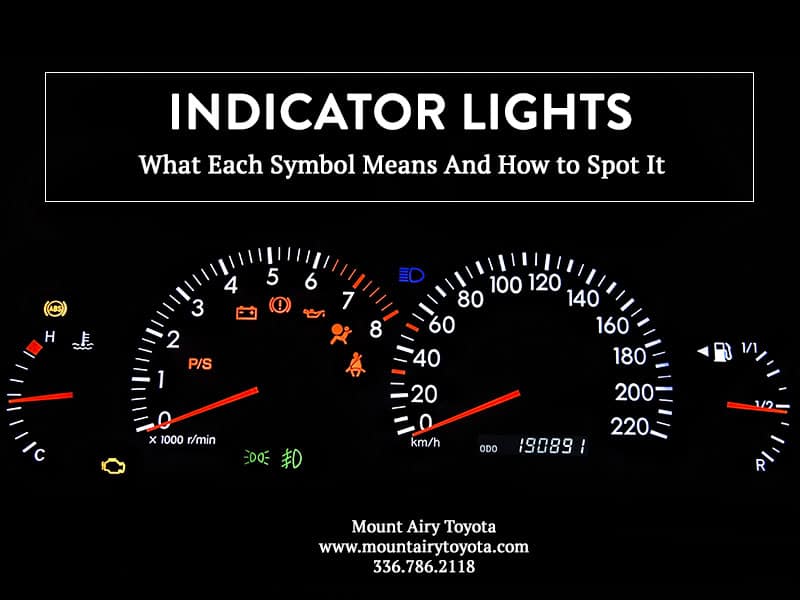
Indicator Lights: What to Know and Why it Matters

You’re driving down I-74, heading back from a weekend at the coast, when suddenly your dashboard lights start chiming at you and light up. What’s happening? Are they telling you of an impending disaster, or are they just gentle reminders and nudges for car maintenance? The trouble is, once you’ve been driving for years, you forget the importance of indicator lights, or what they could mean. Or you buy this car, then that, then another, and you forget that certain brands have different icons or symbols from the previous vehicles you owned. So, it seems a good idea to us, here at Mount Airy Toyota, to review some of the basics as well as look at a few indicator symbols that are unique to particular vehicles we have on our lot. Dashboard indicator lights—maybe not the most exciting things about your vehicle, but they are actually rather essential to the overall function of it. And the indicator lights aren’t just about functions your vehicle performs. They also help you make decisions about maintenance needs, they give you information so that you can make the best decisions (your speedometer and gas gauge both do this) and, of course, they also warn you of critical issues you need to deal with. Let’s look at some key indicator lights on Toyota’s line of vehicles, which uses many of the shared symbols across the industry, and consider their importance. Standard Indicator Lights ABS:  The anti-lock braking system’s indicator light tells you there is a malfunction with either the ABS system or with the Brake Assist system (if equipped). This should be considered an indication of a critical issue that needs to be attended to straight away. If your ABS indicator comes on, be sure you safely navigate it to the nearest mechanic or, better still, call a tow truck—you don’t want your braking system to give out, and end up causing an accident! Charging System: This indicator light will notify you of a malfunction in the vehicle’s charging system. But what does that mean? Obviously, since it looks like a battery, it can imply that your vehicle’s battery isn’t recharging properly, whilst you drive. It can also indicate an electrical issue with your car, which could mean a short in the wiring or could spell damage for things like your alternator or other system motors (windows, windshield wipers, etc.). Obviously check the battery charge, if you have a reader for that, but definitely take your vehicle in for service. Cruise Control Indicator: This one is straight forward: your cruise control is on. Though that seems a no-brainer, if you are ever out on the highway and have turned it on, then stepped on the gas to pass someone, it’s important to check your dashboard to see if the cruise control system is still engaged. Most, but not all vehicles (especially older ones), will disengage the cruise control features if you step on the brakes; but if you step on the gas, it may only let you speed up and then default the car’s speed to the cruise control settings previously established. It’s always safer to check and ensure whether or not the system is still engaged, after manually controlling the gas pedal. Electric Power Steering: This one certainly ranges among the most important indicators, because if you have a malfunction with your Electric Power Steering (EPS) system, you could quite obviously end up in a car accident. It’s so important to visit your dealer straight away if this indicator comes on. Headlight: This indicator informs you when you have the headlights, parking lights, taillights, license plate, or instrumental panel lights on. Pretty straight forward, right? Well, this is also the light you need to look for on the dashboard when shutting off your car and putting your keys away, because no one wants to come back to a car that has a dead battery as a result of leaving the headlights on. (Also, this light won’t illuminate if only the Daytime Running Lights are on.) High-beam Headlight Indicator: Driving from a woodsy, country house and getting on the main highway? Suddenly car after car flashes their high-beams at you, and you start to get annoyed until you look down at your dashboard. There’s that indicator light on, for your high beams, and you realize you had them on when navigating dark country roads—that’s fine, there. But turn them off in well-lit places or on highways, because those lights can be blinding at night (that’s part of the point, so that you can see in very dark areas). The other drivers will thank you. Malfunction Indicator (Engine): This is, of course, the big one! If this turns on, there is some malfunction in the engine control system, the throttle control system (for manual transmission vehicles), or the automatic transmission control system (for automatic transmission vehicles). Go directly to the dealer; do not pass “GO!” and do not collect $200. If you don’t go directly to your dealer when this light pops on, you might really damage your engine and pay far more than $200 to restore it. Low Fuel Level Warning Light (with buzzer): How many times do you look at the gas gauge and promise yourself as it hovers at half a tank, then slips just below, and then flirts with a quarter of a tank, that you will stop and get gas? And still you forget—until this light pops on and beeps at you. Now, you only have a range of 20-30 miles left (depending on the make and model of your vehicle) to locate a gas station and avert the walk of driver’s shame: gas can in hand, slogging it one mile to the next Citgo. Best advice: whenever you flirt with a one-quarter tank, just go and fill up. It’s all-around the smartest way to avoid a totally preventable, highly-irritating scenario! Tire Pressure Warning Light: How many times have you ignored this one? Following the same train of thought with the low fuel level light, we tend to keep telling ourselves that we will put air in the front right tire, the left rear tire, this upcoming Saturday morning when we have more time, or next Tuesday when we pop by Costco. But every time we drive on a tire with lowered pressure, we are making our tires work harder to keep us on the road (there’s a reason they have grooves in the tires—to create grip) and we are speeding up the time when they will finally go bald. These sort of lights seem easily dismissed, because they don’t strike panic like the “check engine” light can, but low tire pressure means replacing costly tires all the sooner and it means poor gas mileage performance. Just get yourself in the habit of filling up your tires when low (and checking their pressure regularly with a cheap pressure gauge, hung from a key fob). It’s just the smarter way to go! Brake System Warning Light (with buzzer): If this comes on, pull over safely, bring the vehicle to a complete stop, and call your dealer immediately. (Don’t forget you have a parking brake if you are in a situation where you’ve lost your brakes. If so, stop accelerating and try to drive off to the shoulder of the road and make use of your auxiliary braking systems.) Do not ignore this light, ever! This is a life or death light, and indicates either low brake fluid (more easily corrected by simply adding more) or a malfunction in the brake system (which your dealer needs to fix). “Smart” Indicator Lights (on newer vehicles): Lane Departure Alert (LDA) Indicator: As cars get smarter, we will see new indicator lights added to our dashboards, like the LDA indicator light. This is a good thing, such new additions, but it means we need to learn what they mean. So, the LDA indicator light tells the drive when she might depart from a lane. If you are on a highway or freeway, with white and yellow lines, the LDA system recognizes these lines with camera sensors; if you begin to float or stray from your lane, the system will beep at you. This sort of system, with its indicator light, is the wave of the future and promises us far smarter driving. That’s a good thing! BSM Outside Rearview Mirror Indicator: The Blind Sport Monitor (BSM) system provides two services to you, the driver: It can assist the driver in making a decision when to change lanes and, paired with the Rear Cross-Traffic Altert (RCTA) function, it can alert a driver when it’s safe (or not) to back up. This feature can be turned on and off in many of the vehicles that come equipped with it, and it uses the cameras positioned around the body of the vehicle to read and sense the other cars and objects around it. Safer driving, in future, will mean smarter driving, and the BSM and RCTA functions are part of the wave of future “smart” driving. Dynamic Radar Cruise Control: Using more cameras and sensors, this system will automatically adjust acceleration and deceleration, as well as, stop the vehicle, when you have the car in cruise control mode. That means your car will read and respond to the speeds and behaviors of cars around it, on the road. Such a feature means we have redundancy built into our driving: sure, we can manually adjust all of these things, but if we have a system that can act as a back up, so we have a safer buffer in our driving decisions, what’s not to like? Again, safer driving in the future will come from smarter features like the Dynamic Radar Cruise Control function. Smarter driving is safer driving, and at Mount Airy Toyota, safety is always our number one concern. Here at Mount Airy, we are excited about the future in driving. Prototypes and innovative designs in the car’s dashboard mean we will see more and more digital dashboards with numerous smart features. The infotainment screens we are getting used to will be child’s play, compared to the rich, digital LED screens that will be virtual cockpits in cars of the future. Your future dashboard will have apps, connect seamlessly to your smartphones, be attached to satellite GPS and interface with GPS systems like Waze, providing dynamic feedback and real-time adjustments—all on your digital dashboard. The more car companies can put into our dashboard, so that we aren’t relying on our phones’ little screens for navigation and information, the better! And it will the digital dashboard, enriched with numerous functions, that will be the future driver’s main interface for interacting with autonomous-driving vehicles. Sure, there will still be a steering wheel in the car, but the main way to master your car will be through touchscreens and voice commands. We are on the verge of a revolution in vehicles and driving habits, and Mount Airy will be there for you in future, as such cars roll off the line and onto salesfloors.


Summer Heat

Summer Heat Kills Your Car

Mount Airy Toyota Scion's service department wants to make sure your car is running at full capacity this summer. And this starts with identifying the problem and knowing where to take your car to get it fixed.   One of the first things to die on your car during the summer is the battery. The extreme heat causes the liquid inside the battery to evaporate. These low fluid levels will then damage the core of the battery and eventually kill it completely. This can be frustrating and expensive. But it does not have to be.   The worst-case scenario is that your car dies, right when you need it, and you have to get it towed. This can be pricey. A new battery can run a few hundred dollars, and towing can be even more depending on how far away you are from the service department. So what can you do? On those really hot days pay extra attention to the sound of your car as you start it. Does it seem to take a little longer to turn over? Does it seem sluggish? This could be your first warning sign that the battery liquid is low, and it would be a good idea to head straight over to Mount Airy Toyota Scion’s service department to have them give it a look.   One thing to keep in mind is that sometimes it is not the battery that is dying or dead. It could be the alternator. This device charges your battery as the car runs, and if it is damaged or ruined it can be even more expensive than a bad battery. Some warning signs your alternator is fading? Dim lights, trouble starting, strange smells, odd sounds, and warning lights. If any of these things occur it is time to head over to Mount Airy Toyota Scion. Whether you are in Jonesville, VA or Charlotte, NC, you know the summer heat is going to be intense. So don't take chances with your vehicle. You don't have to be a mechanic or crawl underneath your car. Just pay attention and heed the warning signs. Then head over to Mount Airy Toyota Scion and let the professionals take care of you.

Contact Us

Fill out this form below and we'll contact you shortly
*Required Fields