
Blog / Service

Blog

All Service Toyota Toyota Safety Camry Rav4 Tacoma Trucks Highlander Events Corolla 4Runner Tundra Electric Cars Auto News by Mount Airy Toyota Toyota History Toyota Technology Car Care Sienna Tires Avalon Mount Airy Toyota Dealer Toyotathon Trade- In Mount Airy Toyota Service Prius Supra Toyotacare Used Trucks Prius V Sequoia Used Cars C-HR Landcruiser SUV Crossover Employees End of the Year Savings Hatchback New Pickup Trucks Yaris ARB Safari Snorkel Explained Crown Difference between i-Force Max & i-Force Fox Internal Bypass QS3 Shocks Mount Airy Used Cars Old Man Emu Shocks Tacoma Onboard Air Compressor Toyota Hybrid Trucks & Cars Toyota Tundra Trailhunter vs TRD Pro TRD vs Trailhunter Suspension Venza What are Rock Sliders
Mount Airy Toyota Service

Brakes & Tires in Mountain Country - Oh My!!!!

Why Mount Airy Drivers Need to Pay Extra Attention – Insights from Top Service Manager Chris Pack Driving in the Blue Ridge Mountains is beautiful—but it’s also harder on your vehicle than most people realize. Our top service manager, Chris Pack, explains in two recent videos that mountain driving and dramatic temperature swings put extra strain on both brakes and tires. Long downhill grades, constant elevation changes, sharp curves, and hot-cold seasonal extremes all speed up wear that would be mild in flatter regions. His message is simple: Stay ahead on brake and tire maintenance, and you’ll save money—and stay much safer—than waiting until something goes wrong. Below is your complete guide to brake and tire care in mountain conditions, including answers to the most-searched questions drivers ask online. Why Are the Mountains Tough on Brakes? In the Mount Airy region, the steep, twisty mountain roads mean drivers brake more often and more aggressively than those in flat areas. Add temperature swings—from freezing winter mornings to hot summer afternoons—and brake components expand, contract, and wear out faster. This combination makes proactive brake maintenance essential, not optional. Is it safe to drive with bad brakes? Driving with worn or failing brakes is dangerous anywhere—but especially in the mountains. If you must drive, stopping distance will be much longer, and you’ll need to avoid sudden braking. On steep grades, failing brakes can overheat quickly, leading to brake fade and a loss of stopping power. Can you replace your own brakes? Yes, some drivers choose to replace their own brake pads— but only if they truly understand the process. Brake work requires precision and proper safety handling. Front brakes are usually more straightforward, but rear drum brakes or advanced braking systems can be tricky. If in doubt, it’s safer (and often cheaper long-term) to let a certified Toyota technician handle it. What are the signs of worn brakes? Look and listen for: Squealing, grinding, or scraping noises A soft, spongy, or vibrating brake pedal Visible thin brake pads (check through the wheel spokes) Dashboard brake warning lights Longer distances required to stop your vehicle If you notice these signs, schedule service right away—mountain braking only accelerates the problem. Should I replace all four brake pads at once? Ideally, yes. At the very least, brakes should be replaced in axle pairs (both fronts together or both rears together). Installing pads unevenly can lead to unbalanced braking, which may cause pulling, extra wear, or unsafe stopping behavior—especially on winding NC mountain roads. What’s included in a full brake job? A comprehensive brake service typically includes: A complete brake system inspection Replacement of worn pads Resurfacing or replacement of rotors Inspection or servicing of calipers, brake lines, and hydraulic components Brake fluid check or replacement This ensures your entire system—not just one component—is operating safely. How much do new brakes cost at a typical Toyota dealership? Pricing varies by model, but generally: Brake pad replacement: $150–$300 per axle Pads + rotors: $500–$800 for all four wheels Your exact total depends on the vehicle, parts used, and how much wear has occurred. Mount Airy Toyota always provides upfront pricing so you know exactly what to expect. How often should car brakes be replaced? Most vehicles need new brakes somewhere between 25,000 and 65,000 miles. However, here in the mountains of North Carolina, brakes tend to wear out sooner due to: Repeated downhill braking Sharp curves requiring frequent speed adjustments Frequent temperature swings For mountain driving, we recommend inspections every 10,000–12,000 miles or at every oil change. Does the quality of my tires affect my brake life? Absolutely. High-quality, properly inflated tires help the vehicle grip the road more effectively, reducing the amount of work your brakes must do. Poor-quality or worn tires make your braking system work harder and wear out faster. Why Mountain Driving Is Tough on Tires Like brakes, tires suffer more in our region. Curvy, hilly roads, temperature fluctuations, and rougher mountain surfaces all contribute to faster wear. According to Chris Pack, neglecting tires in the mountains can be as dangerous as neglecting your brakes. Here’s how tires directly impact braking performance: How Tire Quality Impacts Brake Life Better grip = less brake strain High-quality tires use stronger rubber compounds and smarter tread patterns. When grip improves, stopping distance gets shorter—and your brakes don’t have to work as hard. Improved stopping power and less ABS activation Good tires maintain traction longer, allowing brakes to apply force without slipping. This means your ABS doesn’t need to intervene as often, which reduces stress on brake components. Worn tires increase brake wear As tires lose tread, they struggle to grip the pavement—especially on wet or sloped mountain roads. This causes brakes to work harder and heat up more quickly, accelerating pad and rotor wear. Proper tire pressure is critical Both underinflated and overinflated tires reduce your braking efficiency. Maintaining the recommended tire pressure helps ensure optimal traction, stability, and braking performance. Final Thoughts from Mount Airy Toyota Mountain driving demands more from your brakes and tires than typical conditions. That’s why Chris Pack and our entire service team emphasize regular inspections, timely replacement, and investing in quality components. By keeping up with brake and tire maintenance, you’ll: ✔ Stay safer on the road ✔ Prevent costly repairs ✔ Enjoy smoother, more controlled driving ✔ Extend the life of your vehicle If you have questions or want a complimentary brake or tire inspection, the Mount Airy Toyota Service Center is here to help.
Mount Airy Toyota tire deals

Chris Pack’s Tire Tips | Mount Airy Toyota Expert Explains Tire Types & Maintenance

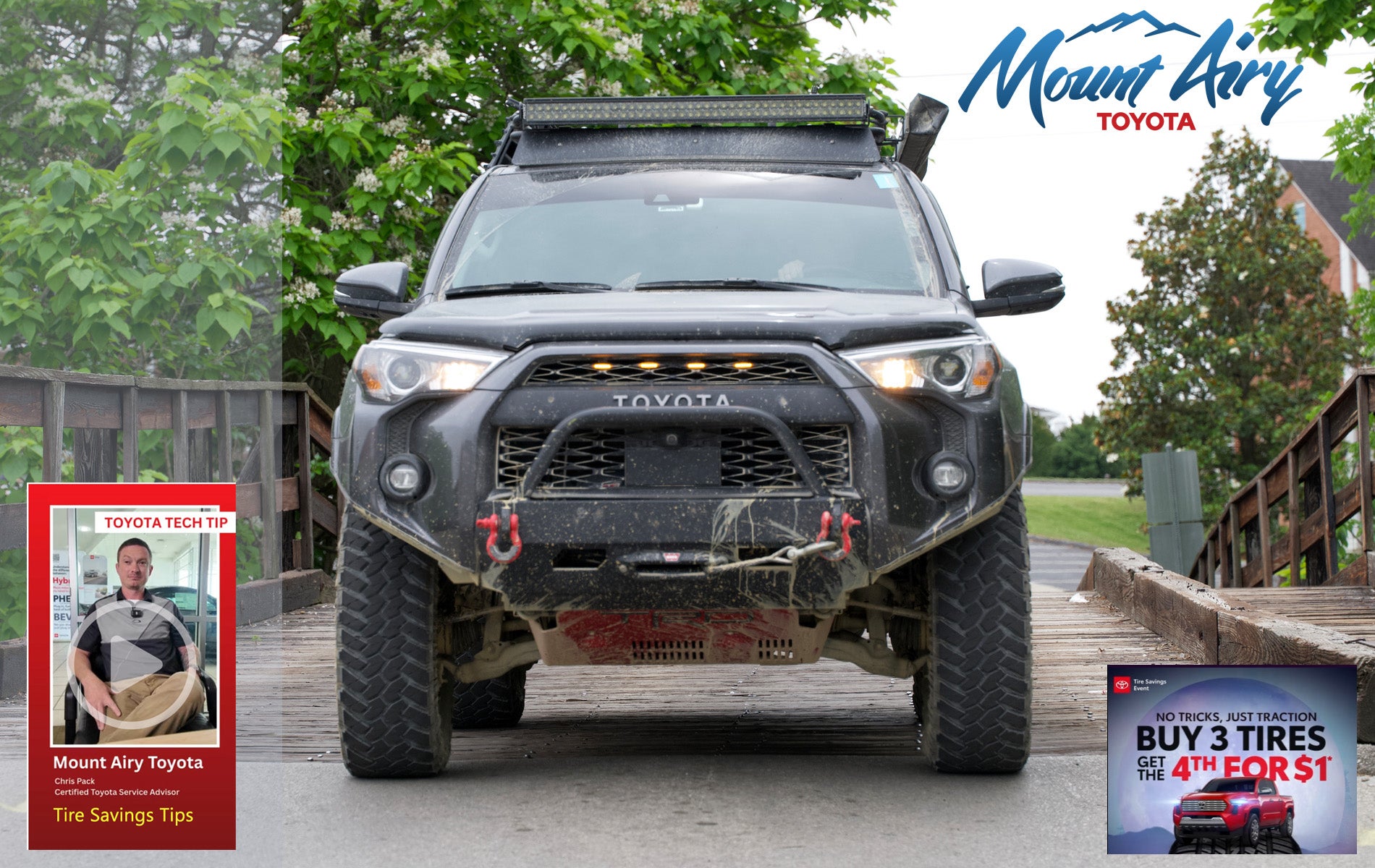
Choosing the Right Tires for Your Toyota in Mount Airy, NC When you live and drive in the foothills and mountains around Mount Airy, NC, your tires aren’t just rubber on the road—they’re your first line of defense against unpredictable mountain weather, icy roads, and rugged terrain. At Mount Airy Toyota, our service team knows that choosing the right tires can make all the difference in safety, performance, and comfort. In our recent YouTube Short, our Service Manager, Chris Pack, walks through how different vehicles, driving styles, and terrain demand different tires. You’ll learn of how tire treads vary and why one size doesn’t fit all. That visual short helps bring this tire education to life. Whether you drive a sedan, SUV, or truck, your tire needs are unique. Add in the challenges of snow, ice, rain, and gravel roads—and it’s easy to see why one-size-fits-all tires simply don’t work. Let’s explore how to choose the perfect tires for your Toyota—and why now is the perfect time to take advantage of Toyota’s Buy 3, Get the 4th for $1 Tire Sale! Why Tire Choice Matters in the Mountains Driving in Mount Airy means tackling steep inclines, winding roads, and seasonal snow or ice. Your tires must handle all of it while providing grip, comfort, and fuel efficiency. T he right tire for the right vehicle and terrain means safer driving. Elevation changes create more stress on tires, snow and ice require flexibility, rough terrain demands durability, and rain needs special tread channels. The right tires keep you safe and performing year-round. Types of Tires and Their Best Uses Different vehicles and driving styles call for different tire types. Here’s a breakdown of the most common categories—some of which you’ll see demonstrated in the video. Tire Type Best For Ideal Vehicles Terrain & Conditions Key Features All-Season Tires Everyday driving Sedans (Camry, Corolla), Crossovers (RAV4) Moderate climates, light snow Balanced tread for comfort & fuel economy All-Terrain Tires Mixed on/off-road use SUVs (Highlander, 4Runner), Trucks (Tacoma, Tundra) Dirt, gravel, mud, snow Deep treads & reinforced sidewalls Winter / Snow Tires Cold and icy conditions Any vehicle used in winter Snow, slush, ice Softer rubber and added siping Performance Tires Sporty handling Sport models (GR86, Camry XSE) Dry roads, high speeds Low tread depth for cornering & braking Mud-Terrain Tires Off-road adventure 4×4s and lifted trucks Mud, rocks, deep ruts Aggressive tread & self-cleaning Touring Tires Long-distance comfort Sedans, hybrids Highways & paved roads Quiet ride and even wear Tires for Sedans Toyota sedans like the Camry, Corolla, and Avalon need tires that balance comfort, fuel efficiency, and traction for changing weather. Recommended: All-Season or Touring tires. They offer a quiet ride and handle light snow well. If you compare all-season tire against a winter-rated tire on a frozen surface you will see that traction differences can be dramatic. For sportier handling, performance tires are great, but they’re not ideal for snow. Tires for SUVs SUVs like the RAV4, Highlander, and 4Runner face mixed terrain—from city pavement to gravel backroads and snow. Recommended: All-Terrain or All-Season tires. They provide traction on mountains while staying smooth on highways. Swap to winter tires if you drive in higher elevations. The difference between an SUV highway tire and a mixed-terrain tire is in the stiffer sidewalls and deeper grooves that improve control in the mountains. Tires for Trucks For trucks like the Tacoma and Tundra, tire choice depends on use. Daily drivers benefit from All-Season or Touring tires for comfort and fuel economy. Work and towing trucks do better with All-Terrain tires for durability. Off-roaders will want Mud-Terrain tires for maximum traction. Heavy-duty tires differ in construction. Those load ratings matter for mountain towing. Truck tires also feature reinforced sidewalls for steep, heavy hauls. Tires for Different Terrains Mount Airy roads can mean pavement one day and ice the next.  Here's how tread patterns perform across different conditions: Paved Roads: Smooth tread reduces road noise and improves efficiency. Snow & Ice: Winter tires stay flexible and grip cold surfaces. Look for the snowflake symbol. Gravel & Dirt: All-terrain tires have wider grooves that grip loose surfaces. Mud & Trails: Mud-terrain tires clean themselves to maintain traction. Rain: Deep circumferential grooves prevent hydroplaning by channeling water out from under the tire. How to Check Your Tires for Wear and Tear Keep your tires in top shape with these checks: Tread Depth: Use a penny—if you see all of Lincoln’s head, replace the tire. In the video, the manager uses a tread gauge to show this difference. Uneven Wear: Can signal alignment issues. The video shows how edge wear looks on a misaligned tire. Cracks or Bulges: These are signs of damage and need immediate replacement. Pressure: Cold weather and altitude changes can lower pressure quickly—check monthly. When to Replace or Rotate Tires Replace tires every 5–6 years or 40k–60k miles, depending on use. Rotate every 5k–7.5k miles to ensure even wear. Alignment should be checked yearly or if your car pulls to one side. R otation may not be optional for mountain drivers because curves and elevation make uneven wear happen faster. How Long Tires Last in the Mountains of NC Mountain driving wears tires faster. Expect: All-Season: 45k–60k miles All-Terrain: 40k–50k miles Winter: 3–4 winter seasons Keep them inflated, balanced, and rotated for maximum life. Take Advantage of Toyota’s Tire Sale Now’s the perfect time to get new tires for your Toyota! Mount Airy Toyota is proud to offer Toyota’s Buy 3, Get the 4th for $1 Sale, available for a limited time. Waiting to replace worn tires means risking your safety—so take advantage of this deal before the first snow hits. Our certified team will match the best tires to your Toyota, terrain, and driving style. Schedule Your Tire Service Today Don’t wait for the ice to find out your tires aren’t ready. Visit MountAiryToyota.com or call our Service Center to schedule your tire inspection or replacement today. Drive safer, smoother, and smarter—with the right tires for your Toyota and your mountain lifestyle.

Distracted Driving and Advanced Driver Assistance Programs

What You Need to Know About Advanced Driver Assistance Systems & Distracted Driving

What You Need to Know About Advanced Driver Assistance Systems Though advanced driver assistance systems are considered a modern marvel when it comes to driving, there are some concerns being raised about them. These newer hands-free vehicle systems do provide a higher level of safety, there’s no question about that, but some believe they can cause additional distractions as well. Hands-free calling, texting, GPS, and other modern, high-tech features take our minds off traffic, especially in the evening hours, which heightens the possibility of drivers losing focus. Winston-Salem, NC made the news recently, as both television and print outlets all over the state (including Charlotte) have reported on the dangers of distracted driving, citing specific accidents in areas around town. Though some of the information provided in these reports was a bit cherry-picked, much of what was reported is insightful information. For instance, did you know that from 9 pm to 11:59 pm on Friday and Saturday nights is the most dangerous time to be on the road? Whether you are driving through a small or big town, a congested or seemingly open road, there are plenty of ways to become distracted while driving, and this report points to the fact that advancements in the way we drive are not necessarily eliminating distractions–conversely, they may be enhancing them. What Are Driver Assistance Systems? Advanced Driver Assistance Systems, or ADAS, are various technologies created to improve the driving experience, namely, to promote vehicle safety. This process involves the implementation of automated assistance to the driver to help reduce the possibility of human error. This is done by using sensors, cameras, radar, and other advanced tech features to monitor the vehicle’s surroundings at all times and to assist in various driving tasks–such as adaptive cruise control, lane-departure assistance, automatic emergency braking, and parking assistance. But are these systems doing too much for us? Are they causing us to pay less attention to the technicalities of driving and spending more time letting our minds wander?   For some car companies, like Toyota, these advanced systems are nothing new, though they are often updated. The availability of specific assistance features can depend on the trim level and options chosen for each vehicle, but a variety of them can be found in most versions of Toyota’s Camry, RAV4, Corolla, Highlander, Tacoma, Prius, Avalon, and Sienna.   Before we get into some details on how these systems work, and how we can keep from letting our minds wander while they are in use, let’s have a look into how incorporating ADAS provides clear benefits both drivers and passengers: Improved Safety: we can already see how ADAS helps prevent car accidents by providing safety assistance to drivers through the use of emergency braking, lane departure warning, and adaptive cruise control. Enhanced Convenience: ADAS can make the driving experience more comfortable and less stressful by assisting with tasks such as maintaining a safe distance behind other vehicles, keeping your vehicle centered in its lane, and aiding in parking maneuvers, such as the dreaded parallel parking. Reduced Driver Fatigue: by incorporating ADAS, drivers can get alerts and assistance when necessary if experiencing fatigue. These technologies can keep drivers from falling asleep and/or get them to pay attention to certain aspects of driving–for instance, if there is flooding, icy conditions, animals crossing, etc. Potential Insurance Discounts: some insurance companies offer discounts for vehicles equipped with ADAS, as these technologies have already proven their ability to reduce the likelihood of accidents and even minimize potential damage in the case of an actual collision. Environmental Benefits: certain features of ADAS, such as adaptive cruise control, can help with fuel efficiency by maintaining a consistent speed and following distance. Over time, this can lead to a drastic reduction in fuel consumption. Lower emissions means your car is better for the environment, and you are able to save money by visiting the gas station less often. Assistance for Drivers with Disabilities: ADAS can provide helpful assistance to drivers with disabilities by helping them operate aspects of the vehicle through automated prompting, the use of warning lights, etc. It can also assist those with limited mobility by setting itself to take care of things like the usage of blinkers and headlights without the prompting of the driver. Clearly, ADAS plays a crucial role in improving road safety and enhancing the driving experience, and this process of technological integration is only starting–who knows what the future holds! But how do we keep from losing focus since ADAS does so much of the work for us? To be honest, it doesn’t take special training or working through a series of steps. Focused driving simply requires a change in the way we communicate with our vehicle: though your car can now do more for you than ever before, it’s necessary to watch the processes take place. For instance, rather than constantly looking around your car as you drive alongside other vehicles on the highway, keep your attention on the dash and on your side mirrors, and let the ADAS system communicate to you what is going on through the sounds and images it shouts out to you. Always keep in mind that Advanced Driver Assistance Programs are meant to make driving easier, but they are not meant to take over completely. The same amount of attention is needed while driving, but now a lot of that attention can be directed to listening to what your car is telling you. You and your vehicle should be working in tandem to create a safe, enjoyable drive. How ADAS Works Integrated systems such as ADAS are quite complicated, but gaining a basic understanding of how they work can better inform drivers on how and when to use them. On the most basic level, ADAS uses a combination of sensors, cameras, radar, lidar, and software algorithms to monitor the vehicle’s surroundings. All of these technologies are used to assist the driver. Here is a general overview of how it all works: Sensors and Cameras – Small sensors and cameras are strategically placed around the vehicle so that they can continuously collect data on the car’s surroundings, including nearby vehicles, pedestrians, road markings, traffic signs, and obstacles. Data Processing – The data collected by sensors and cameras are processed in real time through the use of onboard computers. These computers use special algorithms to analyze the data received in order to identify objects on or around the road, detect potential hazardous situations, and assess the vehicle’s position in relation to the road and other vehicles. Decision Making – Once incoming data has been processed, ADAS makes decisions about the appropriate actions to take so that the driver is assisted, and safety mechanisms are enhanced. For example, if it is detected that the vehicle is drifting in and out of its lane without signaling, lane departure warnings and/or the steering assistant may be employed to alert the driver and to keep the vehicle in its proper placement on the road. Driver Feeback and Intervention – One of the great aspects of this sort of enhanced driving system is that ADAS provides feedback to the driver through visual, auditory, and haptic alerts in order to inform them of potential hazards in the moment. Not only that, but in some cases ADAS can also intervene directly by applying the brakes, adjusting steering, and even controlling the vehicle’s speed. Integration with Vehicle Controls – Most often, Advanced Driver Assistance is integrated with the vehicle’s existing control systems–like braking, steering, and throttle–so that there is active vehicle control when necessary without the prompting of the driver. Essentially, this means that ADAS does not have to wait for human interaction for it to kick in. This makes sense if you are heading towards danger without knowing it, you want your vehicle to know to apply the brakes whether your foot hits the brake pad or not. Continuous Monitoring and Improvement – What’s so great about ADAS is that it is continuously working. It is always monitoring the vehicle’s surroundings and performance–even if you are not–and it knows how to adapt and change driving conditions, and this effectiveness has actually improved over time. Manufacturers regularly update ADAS software to enhance performance, address potential issues, and introduce new safety features.   One other feature we like about the incorporation of ADAS is that if repairs or calibration are needed for the ADAS system in Toyota vehicles, a quick trip to the dealership is all that is required. Once on site, a certified technician can calibrate and/or repair any necessary areas. And there is no guesswork here, as your ADAS will let you know if there are necessary repairs or adjustments needed so that there is no compromise in the effectiveness of the system.   Driving is still about having fun and enjoying the open road but be careful driving your new Toyota Camry or Tundra. The hands-free features are terrific, but your mind still needs to be on the road. Take advantage of ADAS by letting your car communicate with you!

Mount Airy Toyota’s Comprehensive Guide to Advanced Driver Assistance Systems (ADAS)

Mount Airy Toyota’s Comprehensive Guide to Advanced Driver Assistance Systems (ADAS)

Toyota continues to lead the way with its commitment to safety and innovation in the ever-evolving automotive technology landscape. One essential advancement in the modern era is the implementation of Advanced Driver Assistance Systems (ADAS) — a suite of cutting-edge technologies designed to enhance vehicle safety, improve driving experience, and pave the way for a more connected and autonomous future. Below, Mount Airy Toyota explains ADAS more thoroughly, delves into which Toyota vehicles boast these systems in 2024, and more. Understanding ADAS Advanced Driver Assistance Systems, commonly known as ADAS, refers to a set of technologies integrated into vehicles to assist drivers and boost overall safety. These systems leverage sensors, cameras, radar, and other advanced technologies to monitor the vehicle's surroundings, detect potential hazards, and provide timely alerts or interventions to prevent accidents.   ADAS features many functionalities, including adaptive cruise control, lane departure warning, automatic emergency braking, blind-spot monitoring, and more. It employs a sophisticated blend of hardware and computer algorithms to enhance vehicle safety and help drivers in various aspects of their journeys. The primary goal of ADAS is to prevent accidents by providing real-time information about the vehicle's surroundings and potential hazards. Here's the gist of how it works: Sensors and Cameras: ADAS relies on an array of sensors strategically placed around the vehicle. These sensors include radar, ultrasonic sensors, and cameras. Cameras are crucial for visually recognizing the environment and detecting objects, lane markings, and traffic signs. Data Collection and Processing: The sensors continuously collect data from the vehicle's surroundings to capture information about the position of nearby vehicles, pedestrians, lane markings, and potential obstacles. Onboard computers then process this raw data in real-time. lgorithms and Decision-Making: Advanced algorithms analyze the processed data to make sense of the environment. These algorithms are designed to recognize patterns, identify objects, and assess potential risks. The system then makes decisions based on this analysis, determining whether intervention is necessary to avoid a collision or improve overall driving safety. Alerts and Interventions: ADAS can provide various notifications or interventions depending on the detected risks. For instance, if the system senses an imminent collision with a vehicle ahead, it might trigger automatic emergency braking to reduce the severity of impact. Lane departure warning systems can alert the driver if they detect unintentional lane drifting, and some systems can even assist steering to keep the vehicle within its lane. Adaptive Functionality: ADAS features often adapt to different driving conditions. Adaptive Cruise Control (ACC), for example, can automatically adjust the vehicle's speed to maintain a safe following distance from the car ahead, facilitating a more relaxed driving experience on highways. ADAS combines input from various sensors, cameras, and radar systems with sophisticated algorithms to enhance driver awareness and intervene when necessary. It ultimately makes driving safer and more enjoyable. ADAS vs. Toyota Safety Sense (TSS) ADAS is a general term encompassing various safety technologies, and Toyota Safety Sense is Toyota's specialized implementation of ADAS that brings a specific set of safety features to enhance the driving experience for Toyota owners. ADAS often includes automatic emergency braking, blind-spot monitoring, parking assistance, and more. Other automakers may have their own variations of ADAS with unique features and branding that reflect their commitment to safety and innovation. Toyota Safety Sense (TSS) Toyota Safety Sense is a comprehensive suite of safety features developed by Toyota to provide extra protection for drivers, passengers, and pedestrians. TSS integrates various ADAS technologies to address different safety aspects; it primarily focuses on collision prevention and mitigation. The TSS package typically includes a combination of the following features: Pre-Collision System (PCS): This feature uses sensors and cameras to detect potential collisions with vehicles or pedestrians ahead. It can then initiate automatic braking or warn the driver to avoid or mitigate the impact. Lane Departure Alert (LDA): LDA alerts the driver if the vehicle unintentionally drifts out of its lane. In some models, it can provide steering assistance to keep the vehicle centered in its lane. Dynamic Radar Cruise Control (DRCC): This technology maintains a set following distance from the vehicle in front by automatically adjusting the vehicle's speed. It offers a more relaxed driving experience, especially in highway traffic. Automatic High Beams (AHB): AHB enhances visibility during nighttime driving by automatically switching between high and low beams based on the presence of oncoming traffic. Blind Spot Monitor (BSM): This feature alerts the driver if there's a vehicle in the blind spot during lane changes, which does wonders for overall awareness and safety. Road Sign Assist (RSA): RSA recognizes traffic sign information and displays it on the vehicle's multi-information display; it essentially informs drivers of speed limits and other important road signs. TSS focuses on a core set of safety features integrated into the vehicle to prevent and mitigate collisions. Whether you're driving a compact sedan, a versatile SUV, or a powerful truck, there's a good chance your Toyota is equipped with some level of ADAS. Which Toyota Models Incorporate ADAS? As of 2024, Toyota has made significant strides in integrating ADAS across its diverse lineup of vehicles. These systems are designed to enhance safety, improve overall driving experience, and pave the way for a future of connected and autonomous driving. Let's take a closer look at some of the Toyota models that feature ADAS: Toyota Camry The Toyota Camry, a staple in the sedan segment, is equipped with an array of ADAS features. Drivers can benefit from technologies like Pre-Collision System (PCS), Lane Departure Alert (LDA), Adaptive Cruise Control (ACC), and more. It’s widely recognized as one of the safest cars for daily commutes and longer journeys. Toyota RAV4 The popular Toyota RAV4 is a versatile and stylish SUV that includes a lot of ADAS features in  a compact form. Automatic High Beams (AHB), Road Sign Assist (RSA), Blind Spot Monitor (BSM), and many other technologies contribute to an elevated driving experience. Toyota Corolla Similar to the RAV4, the Toyota Corolla is a compact vehicle that embraces many ADAS technologies. Features like Lane Tracing Assist (LTA) — which helps keep the vehicle centered in its lane — and Dynamic Radar Cruise Control (DRCC) are integrated into the Corolla's safety suite. High reliability and efficiency ratings also make this car one of the best overall purchases for consumers. Toyota Highlander The Toyota Highlander is a midsize SUV designed for families and boasts a comprehensive suite of ADAS features. With technologies like Rear Cross-Traffic Alert (RCTA) and Bird's Eye View Camera, the Highlander prioritizes safety and convenience for both the driver and passengers. And it looks beautiful on the road! Toyota Tacoma Toyota's durable and capable pickup truck, the Tacoma, is most known for its fantastic blend of ruggedness and style. It also happens to incorporate ADAS to enhance safety on and off the road. Technologies like Pre-Collision System with Pedestrian Detection (PCS w/ PD) and Lane Departure Alert with Sway Warning System (LDA w/ SWS) contribute to a secure driving experience. The modern “Taco” is as safe as it is attractive and functional. Toyota Prius As a pioneer in hybrid technology, the Toyota Prius also embraces ADAS to complement its fuel efficiency. The Prius features Lane Departure Alert with Steering Assist (LDA w/ SA) and Intelligent Clearance Sonar (ICS) for added safety during city driving and parking. Save money on gas while keeping yourself and your passengers secure on the road. Toyota Avalon The Toyota Avalon is a full-size sedan known for its comfort and sophistication. Full-Speed Range Dynamic Radar Cruise Control (DRCC), Automatic High Beams, and a slew of other features contribute to a refined and secure driving experience. This car is classy, safe, and smooth to drive. Toyota Sienna Redesigned as a hybrid minivan, the Toyota Sienna prioritizes safety for families. It includes ADAS features like Front and Rear Parking Assist with Automatic Braking (PA w/ AB) and Road Sign Assist (RSA), which make it a reliable choice for anyone seeking a spacious and secure family vehicle. These are just a few examples of the Toyota models equipped with ADAS in 2024. It's important to note that Toyota continues to innovate and update its lineup, and additional models may feature advanced safety technologies to meet evolving industry standards. Toyota remains committed to integrating ADAS into its vehicles so that drivers across various segments benefit from these sophisticated safety features. TSS technologies contribute to a safer and more enjoyable driving experience whether you're navigating city streets, highways, or off-road terrain. Repairing and Calibrating ADAS As technology continues to play a crucial role in enhancing vehicle safety, your vehicle’s ADAS is integral to your driving experience. These systems are designed for durability and reliability, but there may be instances when repairs or calibrations are necessary. Here are seven things to do if your car's ADAS requires attention. Be attentive to warning signs. Pay close attention to any signs of issues with your ADAS. Unusual error messages on your dashboard, malfunctioning safety features, or minor collisions can trigger the need for repairs or calibration. Ignoring these warnings can compromise your safety on the road. Refer to your owner's manual. Your Toyota's owner's manual is a valuable resource for understanding the intricacies of your vehicle's ADAS. Familiarize yourself with the manual's TSS section to grasp the functions of each system and learn potential troubleshooting steps. A well-informed owner is better equipped to address issues promptly. Contact Mount Airy Toyota Service Center. In the event of ADAS concerns, promptly contact our authorized Mount Airy Toyota Service Center. Our skilled technicians have the expertise and specialized tools required to accurately diagnose and effective resolve ADAS issues. Early intervention can prevent minor problems from escalating. Provide detailed information. When communicating with our service center, provide clear and detailed information about the symptoms or incidents that led to the ADAS malfunction. A precise account helps our technicians assess the situation accurately and expedite the repair or calibration process. In other words, accurate information streamlines the diagnostic process! Trust certified technicians. ADAS repairs and calibrations demand precision and technical knowledge. Trust our certified technicians at Mount Airy Toyota to handle these tasks. They have access to genuine Toyota parts and cutting-edge equipment to ensure your ADAS functions optimally post-repair. Certified technicians guarantee the quality of service that other mechanics cannot. Consider regular maintenance checks. Take a proactive approach by incorporating regular maintenance checks for your ADAS during routine service appointments. These checks can help identify potential issues early on, prevent more significant problems, and keep your ADAS features working reliably. Regular checks contribute to long-term system health. Be patient and stay informed. Depending on the issue’s complexity, ADAS repairs or calibrations may take some time. Exercise patience, and feel free to ask our technicians about the progress. We strive to keep you informed every step of the way to ensure your satisfaction. Anyone driver can tell you that patience and communication contribute to a positive service experience! The Bottom Line Toyota continues to push the boundaries of automotive technology with the widespread integration of ADAS in 2024. These cutting-edge features ultimately contribute to safer roads and redefine the driving experience for car owners. As you embark on your journey with a Toyota vehicle equipped with TSS, remember to stay informed about these systems’ capabilities  and proactively address any repair or calibration needs. With Toyota's unwavering commitment to safety and innovation, the road ahead promises to be exciting and secure. Connect with Mount Airy Toyota today to learn about the vehicles on our lot or schedule a service for your existing model!

Service Specials at Mount Airy CDJRF

Regularly Servicing Your Vehicle Saves Money

It’s the beginning of a new summer season, which means it’s the perfect time to begin scheduling your vehicle’s regular maintenance with us at Mount Airy Chrysler Dodge Jeep Ram Fiat. Sure, maintaining your car might not sound like the most exciting summer fling, but once you realize how much money regular service saves you, it gets exciting. It doesn't take a car enthusiast or a professional mechanic to know that once you purchase a car, old or new, it will need to be regularly serviced—tires, brakes, radiator, etc. But despite this understanding, many people today drive their vehicles into the ground, forcing them into an early grave. The truth is, it takes minimal effort to keep your car maintained and it can save you thousands of dollars and many headaches. From tire rotation to a quick oil change, you should follow the factory guidelines that have been laid out for your vehicle. These complicated machines we so dearly rely on need care and attention to keep them running well, and often—if not always—this care and attention cost money. A new radiator can be upwards of $500; tires and brakes each the same amount or more. Yeah, it’s not cheap owning a car, but it doesn’t have to break the bank if you plan ahead. So where to begin? Start by grabbing the manual from the glove box and opening it up for once. Reading your manual won’t turn you into an expert technician, but it will provide you with basic information about your specific vehicle that you need to know. Getting acquainted with your car is step number one in establishing longevity. Five Reasons to Regularly Maintain Your Car Beyond saving you tons of money by servicing your vehicle on a regular basis, there are plenty of other benefits. Check out these five big ones: Increased Safety. Cars these days have incredible safety features. From Lane Assist to a constant 360-camera view of your surroundings, it’s easy to see why drivers today feel pretty safe on the road. But what about when a tire blows when you’re moving at 75 miles an hour? Or, out of nowhere, your car’s temperature gauge shoots up into the red and your engine begins to smoke? What do you do then? Regular maintenance can keep these, and other, things from happening unexpectedly. Top Performance At All Times. Keeping everything under the hood, beneath the car, and around the rear in check won’t only keep your car running. It will keep it running well—like it did when you first bought it. Lower Cost of Fuel. A well-maintained car savors every drop of fuel. A vehicle that is struggling down the road, however, tends to burn a bit more, as well as spill a little along the way. When everything’s in its right place, doing what it was built to do, your car will run like a gem for as long as its combined parts continue to work together. Your Time Saved. It takes time to open the hood and check the fluids; it takes time to drive to Mount Airy Chrysler Dodge Jeep Ram & Fiat and have a technician check out your water pump. But no matter how long it takes you to figure out how to even open your trunk, or no matter how many miles you live from Mount Airy, the time lost during a breakdown is always worse. Stranded on the side of the road, trying to get your car started in your own driveway while you are late for work, these time wasters have added stress that makes them even worse. Higher Resale Value. How can you tell someone buying a used car knows what he’s doing? The first question he asks is, “So what maintenance has been done to this car?” And if all your paperwork is current—showing regular maintenance year after year—he will have no problem paying top dollar for it. Weather And Your Car It is important to take extra precautions in order to make sure your car runs correctly this winter. Extreme temperatures of any kind can do major damage to integral parts of your car. And if these things are not checked regularly, you could end up stranded. Or worse, you could end up needing a new vehicle. Here are four ways to keep your car alive and well during the severe weather months: Have your battery checked. Cool air paired with the jolting vibration of a running vehicle can cause your battery harm if it’s not up to par. Likewise, a car that sits in cold weather all day can cause sluggishness and poor performance. And taking a long trip during any season can cause your battery to wriggle free from its connections. Once extreme weather is upon us, the best bet is to bring your car into Mount Airy Chrysler for a quick battery check in order to make sure it is operating as it should. Have your coolant flushed. Your vehicle’s coolant fluid keeps the engine from overheating. You might not think it, but this is something very important during the summer months. After long periods of time, the coolant can become contaminated and much less effective, and if you are driving long distances there is always the chance of your thermostat going bad. Once this happens, your engine doesn’t know when to cool down, which can cause it to heat up enough to do some permanent damage. It’s a good idea to have this fluid flushed and replaced with fresh coolant that can keep your car running smoothly. Check all other important fluids. Your car runs the best when the oil, transmission fluid, power steering fluid, and brake fluid are all topped off. These are relatively easy to check and should be looked at about once a week. If you have trouble finding any of these, contact a service member at Mount Airy Dodge and he can tell you exactly what to do. Get your heating system checked by a certified professional. Driving without heat in the winter is not comfortable—or safe. Even if you’re heating system seems to be okay, it’s a great idea to have it checked anyway. You never know when it could break down. And you do not want to be in the middle of a winter road trip when this happens. Avoid being stranded this year by scheduling a maintenance appointment at Mount Airy Ram today. Mount Airy’s Service Specials As we have seen, if you keep your vehicle maintained, it will last longer—years longer. This simple act of keeping things current can save you money and frustration, which is why we at Mount Airy Chrysler Dodge Jeep Ram & Fiat are always offering service discounts. This year, we have some extra special discounts that can keep your vehicle ready to handle even the toughest driving situations. Check out these deals: Oil and Filter Change. When the weather gets cold, so does the oil in your car. And if the oil is not fresh and pure, it becomes difficult for your engine to work with which, in turn, can cause some major damage in the long run. Right now we are offering a $49.95 regular oil change and $54.95 synthetic oil changes. Battery Replacement. Nobody wants to be left out in the heat due to a dead car battery. Extreme weather asks a lot of your car, and if your battery is old or corroded, it's simply not worth the risk of getting stuck out in the elements. This is why we are offering a battery replacement only at $129.95, which includes installation, a 60-month warranty, and an 18-month free replacement. Wiper Blade Replacement. With extreme weather approaching, you can count on wet roads, which results in flooding and mud. Nothing makes your windshield wipers work harder than dirt and grime buildup. Stop in today and we'll even install them for you! Act now and get brand new blades for only $19.95. Brake Pad Inspection. Needless to say, your brakes are important. At Mount Airy, we can take a look at your existing brakes and let you know about how much longer you have until you will need new pads. And if you happen to need them right then, we can take care of that too. But act now to receive a FREE inspection! And if they are in need of changing, we have plenty of options to offer. The service department at Mount Airy Chrysler Dodge Jeep Ram wants to keep your used vehicle running as it should. Whether you need a part, repair work, or just someone to find and fix that clunky noise that won’t go away, our team can take care of you. A technician will run diagnostics on your vehicle to make sure everything is working and running properly. And if something is not, he can pinpoint the exact issue and fix it immediately. But what if the vehicle wasn’t purchased from our dealership, will they charge me more to work on it? Absolutely not. As a matter of fact, if your old ride still has a factory warranty, you could actually save even more. Setting up an appointment is easy. Simply go to the dealership’s website navigate to the service department link, and click on the “Schedule Service” tab. From there you will be asked a few questions about your vehicle and availability to stop in. It’s really that easy. What sort of things will your service technician look for? Anything that is not performing properly. He or she will also look for things that could go wrong in the near future. Intricate pieces like engine belts, hoses, and plugs. These all need replacing every so often, and if you wait until they completely malfunction you could be left stranded. And even worse, they could cause damage to other parts of your engine. So don’t wait until something breaks. It’s time to head into Mount Airy CDJRF’s service department now. Let a professional look over your vehicle so that you can keep it running for years to come. There are plenty more rebates and discounted services currently being offered at Mount Airy. Check out our service website and find the discounted services you need before they expire!

Best Service Center in Mount Airy NC

Don't Wait: It's Time For Fall Service

A change in the seasons can serve as a good reminder for many things. If you’ve skipped out on oil changes, this article, and the transition of Summer into Fall, may be the necessary nudge you need to get your car serviced and prepared for the cooler months. And while it may be tempting to ignore your odometer as it slowly outpaces the previous service sticker on the top of your windshield, the benefits an oil change has to your car, and wallet, are well worth it. Here are just a few ways your vehicle will benefit from the extra attention. Extends Engine Life: Oil in your engine that’s unclean and that has gone a period without an oil change creates more friction, which in turn translates to wear and tear on your engine. Removing old oil removes sediment that can damage your engine and prevent your car from making it to the long haul. Improves Engine Efficiency: Removing old oil not only cleans your engine but also improves the way in which it works. The removal of sediment means that oil flows more freely, giving you a better-performing vehicle. Increased MPG: Efficiency isn’t tied to just performance; it also results in more fuel efficiency. A smooth engine directly translates to saving at the pump and getting more out of every gallon. Going Into The Fall Season Outside of an oil change, there are other important things you need to do to take care of your vehicle as the weather cools. Using the season as an indicator for upkeep will not only result in you being safer going into the cooler months, but also much more comfortable, and less likely to have to spend big on your vehicle. Check Your Tires - With cold weather comes the potential for snow and slick driving conditions. Checking your tire tread as you go into fall lets you plan for when you need to replace or rotate your tires, preventing you from driving on slick roads with little traction. For those in colder areas, it may also be a good time to consider investing specifically in snow tires. Check Your Brakes - Having your brakes checked before cooler months is vital. Cold weather can exacerbate brake problems, and slick roads necessitate strong and responsive braking systems. This creates a recipe for disaster that can be completely avoided with regular brake checks. Make sure to listen to unusual noises that occur when braking — a good sign of issues or need to repair or maintain. Check Your Heat - Warm months mean not using your car’s heat, and that can lead to you finding out your heat isn’t working at the worst time. It’s a great idea to check your heat and make sure it’s working before you need it, so you’ll have it when you do! Mount Airy Toyota: The Place For Fall Service When it comes to servicing your car and making sure it’s ready to last, you need to make sure you’ve got professionals taking care of it. Mount Airy Toyota is the perfect dealership when it comes to checking on your vehicle and giving it what it needs to stay reliable. Reach out today and schedule a service appointment, don’t keep your car from what it needs!

Service Centers Mount Airy NC

Save Yourself from Costly Repair: Get Your Vehicle Serviced!

You don’t want your car to break down. And you don’t want to find out that you have to fork out money for an expensive repair that you weren’t budgeting for. But unfortunately, this can easily happen if you don’t take the necessary precautions. By scheduling vehicle service and knowing what signs to look for, you can prevent minor issues from progressing into major, costly ones by scheduling vehicle service and knowing what signs to look for. So, how do you know when it’s time to bring your vehicle in? Below, Mount Airy Toyota explains when to have your brakes checked, change your windshield wipers, get an inspection, and more! When Should I Get My Brakes Checked? Generally speaking, it’s best practice to bring your car in for service at least once a year, and that includes having the brakes inspected. But if you notice signs of brake problems in the meantime, you don’t want to wait before getting them checked. Perhaps the most common indicator that you have a brake problem is if you hear grinding, thumping, or squealing noises while applying your brakes. But there are many other signs to consider, such as: An oily, yellow-like substance leaking from under your vehicle. Vibration or pulsing from your brake pedal. Vibration throughout other components (such as the steering wheel) or the entire car. Sudden pulls of the steering wheel to the left or right when you apply the brakes. Less resistance when applying the brakes, leaving the need to push the brakes harder. An increase in distance needed to come to a complete stop. The smell of burning rubber when applying the brakes. Besides bringing your vehicle in for annual servicing and looking out for signs of brake issues, most automakers and mechanics suggest replacing brake fluid every two years (or 30,000 miles). And your brake pads should be replaced every 20,000 to 60,000 miles, depending on your driving style and the quality of the pads. When Should I Change My Windshield Wipers? Your windshield wipers are critical for staying safe on the road. But it’s probably not something you think much about unless your wipers go bad! It’s best to plan on replacing your wipers every six months to a year, but you should replace them immediately if you notice them becoming ineffective. The whole point of wipers is to clear rain, snow, and other substances from your windshield so that you can maintain proper visibility. If your wipers aren’t performing that basic function, then it’s a good indicator that it’s time for a replacement! And this applies if your wipers start to streak, split, skip, or squeak as well. It’s also a good idea to regularly inspect the wipers themselves. If there is a broken frame, cracks or tears in the rubber, limited flexibility in the squeegee, or corrosion on the metal parts, it’s time for a replacement. Using higher quality windshield wipers will typically mean that you need to replace them less often than if you use cheaper ones. How Often Do I Need an Inspection? For most Americans, car inspections are just part of being a car owner. Most states require you to have regular inspections in order to register a new vehicle or renew your registration. In North Carolina, your car must pass a statewide safety inspection each year. During this inspection, your mechanic will assess the vital components of your vehicle to ensure it is drivable and safe for the road. There is no statewide emissions law in North Carolina, but 22 counties require registered vehicles to pass an emissions inspection each year. The emissions inspection is usually performed in conjunction with the safety inspection. Other Signs Your Vehicle Needs Servicing Along with watching out for brake and windshield wiper issues, there are many other ways your vehicle can tell you if there’s a problem. For example, squealing noises could indicate a loose or worn-out timing belt, as could a whining sound under the hood. Inconsistent engine noises could mean that you need to have your engine inspected. And if you hear scraping sounds, you might have loose car parts rubbing together. Moreover, a grinding or crunching noise when shifting gears could be a sign of a transmission problem. Conclusion You don’t want to wait until it’s too late. Bring your vehicle in for servicing and inspection at least once a year. And if you notice any signs of a problem with your brakes, windshield wipers, or any other components of your car, address the concerns immediately. At Mount Airy Toyota, we offer full service on any and all Toyota models. Don’t hesitate to contact our team for any of your servicing needs!

Summer Road Trip Playlist

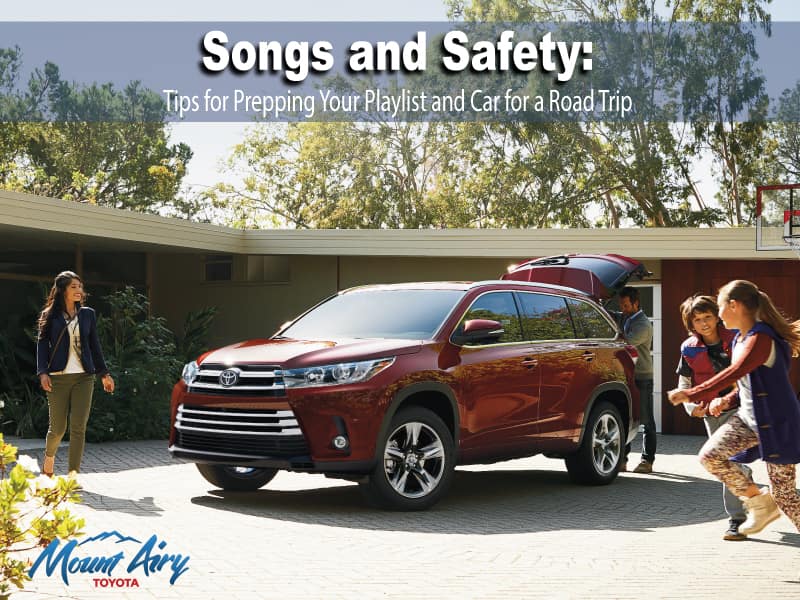
Songs and Safety: Tips for Prepping Your Playlist and Car for a Road Trip

So, you’ve decided to take a family road this summer. You’re excited to see wonderful sights, experience local foods and entertainment in different towns, and feel the breeze flowing through your car as you abandon the daily grind. While there’s nothing like going on a great road trip, ensuring your trip provides the fun and relaxation your family is hoping for will require you to make some preparations, and that includes choosing the right travel music and servicing your vehicle beforehand. Mount Airy Toyota wants to help your family knock out these tasks so that you can set the stage for the road trip of a lifetime: Get the Tunes Ready There are a lot of factors that go into planning a road trip, and the music often gets overlooked. But having the perfect playlist ready can help everyone enjoy the drive more, especially if the songs are easy to sing along to. One thing to keep in mind is that you’ll want all the songs on your playlist to be downloaded on your phone or iPod. That way, you won’t have to use data on your phone or risk not being able to play music in a dead cell zone. Now, to the goodies. Here are some of the best songs for a summer road trip (hint: there’s a little something for everybody!): All-American Songs · Born to Be Wild — Steppenwolf · Sweet Home Alabama — Lynyrd Skynyrd · Living on a Prayer — Bon Jovi · Born in the USA — Bruce Springsteen · My Life — Billy Joel · Nothin’ but a Good Time — Poison · Walk This Way — Aerosmith · One of These Nights — Eagles Classic Rock Songs · Nutbush City Limits — Ike & Tina Turner · Danger Zone — Kenny Loggins · Here I Go Again — Whitesnake · Don’t Stop Believing — Journey · Summer of ‘69 — Bryan Adams · Dude Looks Like a Lady — Aerosmith · Go Your Own Way — Fleetwood Mac · Back in Black — AC/DC Modern Songs · All the Small Things — Blink 182 · Happy — Pharell Williams · Can’t Stop The Feeling — Justin Timberlake · Shut Up & Dance — Walk the Moon · Stupid Love — Lady Gaga · California Gurls — Katy Perry · Set Fire to the Rain — Adele · Uptown Funk — Mark Ronson (feat. Bruno Mars) Songs About Driving · I Drove All Night — Roy Orbison · Paradise by the Dashboard Light — Meatloaf · Drive My Car — The Beatles · Keep the Car Running — Arcade Fire · Route 66 — Chuck Berry · Mustang Sally — The Commitments · Rhythm Made Me Do It — Shania Twain · Pink Cadillac — Bruce Springsteen Get Your Car Ready Now that you have some songs to consider for your playlist, let’s talk about how you can whip your vehicle into shape for the long drive! First of all, you need to make sure you’re secure where the rubber meets the road. Take your vehicle to a trusted mechanic, like the Mount Airy Toyota Service Center, to check your tires and replace them if necessary. If you still have plenty of tread, you may be able to get away with a rotation. Also, have your brakes checked, especially if you notice any grinding, screeching, or delayed functioning. Without having good tires and brakes, you increase your chances of an accident exponentially. Another essential step in preparing your car for the road is to replenish all of the fluids that need it. Along with changing your engine oil and filter, fill up on transmission fluid, brake fluid, power steering fluid, and engine coolant. If you’ve had your battery for at least two years, get it checked by your mechanic. Batteries typically give no warning before they quit, and that’s the last thing you want happening when you're driving in the middle of nowhere! Finally, you’ll want to check the hoses surrounding your radiator for cracks and damage, as well as the serpentine belt. And while you’re at it, throw on a new set of windshield wipers to ensure you’re well-prepared when it rains. Work it into your trip budget to replace any parts necessary for safe driving, and handle all of these tasks before leaving to avoid being thrown a curveball on your travels. Conclusion Making preparations before your road trip can help your entire experience go more smoothly. Remember to take time creating a killer playlist that the whole family will enjoy, and give your car a thorough evaluation. Mount Airy Toyota can handle all of your maintenance and repair needs! Just give us a call to schedule an appointment, and we’ll get your vehicle ready for the open road! (336) 786-2118

Your Holiday Service Guide: Keeping it Safe on the Roads this Winter

This holiday season give the gift that keeps on giving, winter service specials at Mount Airy Toyota! A gift for a loved one, a friend, or even for yourself, it doesn’t matter. What does matter is keeping your vehicles in shape and prepped for the cold weather ahead of us. Come check out some of the unbeatable service special Mount Airy Toyota is offering this season. The great thing about our vehicles, old or new, is that if you take the time to keep them maintained, they will last much much longer. Showing your car just a little love goes a long way, which is why we don’t just encourage you to come see us for your service needs, we also offer the best prices in town. Check out these deals: Oil and Filter Change. When the weather gets cold, so does the oil in your car. And if the oil is not fresh and pure, it becomes difficult for your engine to work with which, in turn, can cause some major damage in the long run. Right now we are offering $29.95 regular oil changes and $39.95 synthetic oil changes. Battery Replacement. Nobody wants to be left out in the cold due to a dead car battery. Extreme weather asks a lot of your car, and if your battery is old or corroded, it's simply not worth the risk of getting stuck out in the elements. This is why we are offering a battery replacement only at $95.95, which includes installation, a 60-month warranty, and an 18-month free replacement. Wiper Blade Replacement. With cold weather approaching, you can count on icy roads, which results in salt and sludge. Nothing makes your windshield wipers work harder than dirt and grime buildup. Stop in today and we'll even install them for you! Act now and get brand new blades for only $19.95. Brake Pad Inspection. Needless to say, your brakes are important. At Mount Airy Toyota, we can take a look at your existing brakes and let you know about how much longer you have until you will need new pads. And if you happen to need them right then, we can take care of that too. But act now to receive a FREE inspection! And if they are in need of changing, we have plenty of options to offer. And there are even more specials running: 15% Off Tundra & Tacoma Accessories. Touch-Up Paint  $9.95—ball-pen top for scratches requiring pin-point application and brush top for chips and scratches that need broader strokes. Free Check Engine Light Analysis—free scanning by one of our professionally trained Toyota Certified mechanics. We can test to check for codes and code interpretation. Free Tire Alignment! Tire rotation for $9.95—includes checking and setting tire pressures, along with a visual inspection of the brake pads and rotors for wear. As you can tell, we have amped our service specials for this year, and we’re pretty excited about it. Stay in Control: How to Drive in Winter Weather Winter snow can be beautiful and a lot of fun. But when it comes to driving in it there are many potential dangers that, if prepared for in advance, can be avoided. This being said, it is shocking how many drivers do not prepare themselves for these possibly treacherous conditions. Here are two basic rules that can keep you safe while driving this winter season: Anticipate what is ahead. Driving on ice and snow requires smooth, precise, and careful control of the steering wheel. Try and keep your wheels straight as much as possible, and when you do have to turn, slowly turn the wheel—this will require you to anticipate turns ahead of time so that you do not end up sliding into other lanes, or worse, off the road. Just remember, you want to avoid any sharp movements of your vehicle. Slow and steady gets you there safely. Know your stopping distances. Slowing down, for upcoming turns or otherwise, requires much more distance when driving on snow or ice. Be sure that you have clear visibility of road signs, stoplights, and other cars so that you can break well before you reach them. When you do apply the brakes, keep your heal on the floor and softly press the brake peddle with the ball of your foot. Again, try and keep your steering as straight as possible to avoid any skidding. If you do happen to hit a patch of ice and feel the vehicle begin to slip, start pumping the brakes by letting off the peddle and pressing (softly) it back down over and over until you regain control of the vehicle. If this does happen, be sure to remain calm and keep your movements soft and slow. With braking and steering under control, drivers can navigate through snow and ice in a controlled and safe way. A word to the wise though, beware of other drivers who do not know these two rules—you can recognize them by their jerky movements and inability to keep from skidding—and keep as much distance between you and them as possible. The Toyota RAV4 Recently, AMCI conducted certified tests to see which vehicles operated at the highest levels while driving in the ice and snow. Many vehicles were chosen for these tests, but only a few were tough enough to make it to the top of the list. So who made it? There were a variety of vehicles that did well, but performing best in acceleration, traction, and handling in these treacherous conditions was the all-wheel-drive Toyota Rav4. What really impressed the judges at AMCI was the Rav4’s ability to go from 0 to 50 mph quickly on snow, and with minimal slippage. It was also able to stop short on ice while going 30 mph. But that’s not all: the Rav4 continued to pique interest by showing top cornering performance on snow, as well as providing top of the line evasive-action performance. These top markings for the Rav4 are due to Toyota’s highly innovative AWD technology, which includes the intricately designed Dynamic Torque Control system. This system, along with the electric power steering mechanisms, helps enhance the driving experience by monitoring and controlling torque transfer between wheels—all four of the wheels—and uses input from a variety of sensors to keep the vehicle moving. Care for Your Car, Care for Yourself There’s no doubt about it, taking care of your car, especially during the winter months, is crucial. But, at Mount Airy Toyota, we realize it is just as important that we take care of ourselves. When you come to us for any service need, we take every measure to adhere to social distancing by conducting our operations with no-touch servicing. To encourage everyone to operate under these safe conditions, we are offering a 10% off social distancing coupon, which applies to ALL of our services offered. Here is the procedure for safely dropping off your car: Simply call us at 336-786-2118 and speak with Will or Russ (our service specialists) to schedule a time to drop off your vehicle. Once your time is set and arrives, all you have to do is drop off the car and wait for us to contact you when it’s finished. It’s that easy: no contact, no worries. Picking up your car is just as easy. Once you receive a text from us saying your vehicle is ready, head to the pickup lot to find your clean, serviced vehicle waiting for you—simply grab and go! At Mount Airy Toyota, we service all makes and all models of vehicles because we want everyone traveling safely this winter. Come see us, visit us online, or give Will or Russ a call today to get your car ready for the cold weather this season.

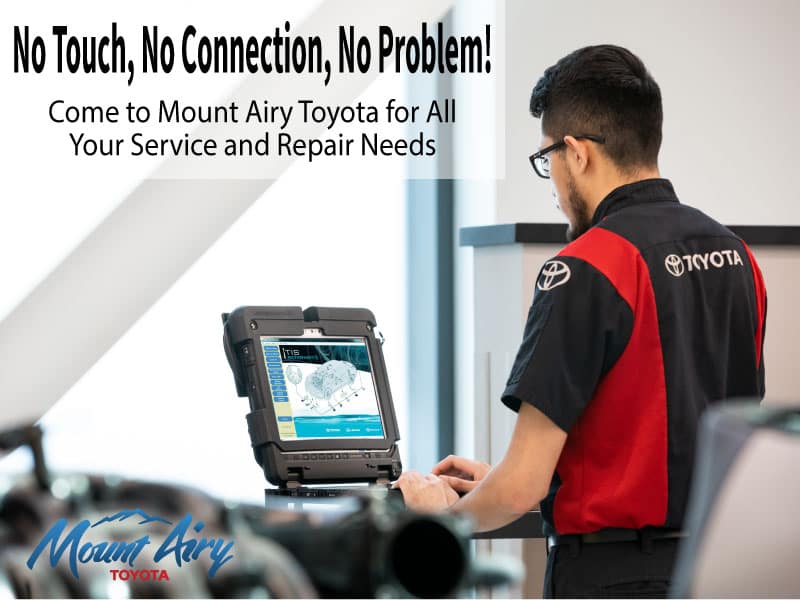
No Touch, No Connection, No Problems! Come to Mount Airy Toyota for All Your Service and Repair Needs

Toyota may be notorious for manufacturing reliable vehicles, but that doesn’t mean that drivers should neglect regular service for their Toyota. After all, any vehicle will eventually cause problems if it isn’t taken care of. Here at Mount Airy Toyota, we have a team of dedicated and qualified Toyota technicians. Not only has each one of our technicians spent thousands of hours training to service every type of Toyota model, but we only use Genuine Toyota parts for our services and repair, and we provide top-notch customer service that has helped us build a reputation for excellence. Whether you’ve bought a new or used Toyota, our dealership is the place to come for your service and repair needs. Below we will discuss the current no-touch service process, as well as some of the most common types of services and repairs that we provide. NO-TOUCH SERVICE No one needs to tell you about the impact that the COVID-19 pandemic has had on everyday Americans. In order to do our part in keeping our guests safe and healthy, we are continuing to take extra precautions by implementing social distancing in our services. However, these precautions won’t cause you any inconvenience. If you need your Toyota serviced, all you have to do is call Will or Russ at (336) 786-2118 to schedule a drop-off time. After dropping your vehicle off, you’ll be notified by text message when it’s ready for pick-up. Then, you can get your vehicle from the Pick-Up Lot and head on your way—no touch, no connection involved! As a bonus, we are offering a social distancing coupon of 10% off all services! SERVICES OFFERED We offer a wide variety of services and repairs at Mount Airy Toyota. Let’s touch on some of the most common ones our guests come in for: Inspection Each year, your vehicle must pass a North Carolina state inspection. Rather than just hope your vehicle passes, why not bring it to us? We’ll be sure to take care of the inspection and address any issues necessary. Here are some factors that play into your vehicle’s inspection: Brakes Tires Lights Steering and suspension Windshield wipers Horn Mirrors Window tinting Oil Change Regularly changing the oil in your vehicle is key to the engine running smoothly for the long-term. Not only do oil changes keep your engine lubricated, but they also keep your engine components cool, both of which help to prolong the life of your engine. Moreover, regular oil changes help to remove the buildup of corrosion-causing sludge and engine-wear particles. All and all, keeping up with your oil changes will help your engine not have to work as hard, meaning it can function like it’s supposed to for longer. Tire Rotation The tires on any vehicle will wear unevenly over time. Generally speaking, the front tires wear on the outside edges, and the rear tires wear more evenly. By having your tires rotated and their positions changed, they will last much longer and allow for a smoother ride and safer handling. Also, regular tire rotations will prolong the life of your tires, saving you time and money in the long-term. As our technicians reposition your tires, they will also check the air pressure of each one and adjust it if necessary. Battery Replacement Your vehicle can’t function without a good battery; it’s that simple. Caring for your battery and replacing it periodically will reduce the likelihood of your vehicle breaking down, which can put you in an inconvenient situation at best. Of course, if you find yourself stranded, we can replace your battery and you get up and running again in no time. Furthermore, your technician will be able to inform you of how to take care of your battery and how often it should be replaced. Brake Repair Needless to say, you don’t want to drive around with bad brakes. At best, brake problems result in annoying sounds. At worst, they can leave you in a dangerous situation. Whether your brakes need a shoe replacement, line replacement, master cylinder repair or replacement, bleeding, random part replacement, or any other type of service, our technicians can take care of it. No matter how durable and reliable your Toyota is, it’s essential to keep up with regular maintenance and service. Our technicians at Mount Airy Toyota are here to provide you with excellent service, whether you have a new or used Toyota model. Be sure to contact us at (336) 786-2118 to inquire about our no-touch service and set up an appointment. We look forward to hearing from you!

Red 2020 Toyota Supra Car Charlotte

The Resurrected Supra Coupe in 2020, and Why it’s Worth the Hype

If you have not heard already, the Toyota Supra is back after two decades of absence in North America. Its arrival in mid-2019 has caused an uproar among major Supra fans and Toyota enthusiasts. Here at Mount Airy Toyota, we are so excited to tell you all about the 2020 Supra, what it means for long-time fans of the car, and how a new generation will be ready to fall in love this year with the Supra. Witness the return of a legendary sports car this summer The Toyota Supra is back for 2020. In terms of hype, it is similar to witnessing the end of Avengers or the final season of Game of Thrones; there are definitely cult followings and there are major fans out there who have awaited its return. After 20 years, this beloved sports car is back. Revival does not even begin to cover it The revival of this 1980s and early 1990s classic, two decades after it was discontinued, was unveiled at the 2019 Detroit Auto Show. Every Supra shares the same core fundamentals with a smooth inline six up front, rear-wheel drive, and a modern chassis. The 2020 Supra will feature the classic long-hood, low-riding, two-door design, and short-deck proportion, as well. But, in line with Toyota’s mission to deliver the purest expression of performance, the 2020 Supra will redefine sports cars just as it has time and time again. Take a step back in time to appreciate the present The 1993 Supra Turbo was praised for its acceleration, skid pad performance, and antilock brakes that set records at a 70 mph stopping distance. The 3.0-liter engine did not rank well with American consumers, however, and with the $39,900 price tag, Toyota only sold 2,901 cars. In 1996, Toyota was required to re-engineer the Supra to include the OBD II systems, inflating the model’s base cost to $38,600. This made the ’93 Supra Turbo model soar to $50,400 in 1996. As a result, Toyota only sold 852 Supras in ’96, and at that time, had not reached the point of selling 10,000 Supras in the United States. By 1998, while Toyota sales were beginning to recover, the Supra just wasn’t selling as expected. Buyers simply were not willing to pay what the Supra costed, despite its incredible performance and advanced powertrain. This led to the development of racing enthusiasts who became cult followers of the Supra, as they understood that the Supra Turbo’s 2JZ-GTE had enormous amounts of power and boost. A true cinematic vehicle For the younger generations who are not long-time fans of the Supra, they just might get all the hype if they have watched one of the biggest film franchises of the past ten years, where the car was featured and gained a new reputation among the millennial audience. The timeline definitely did not stop in the year ’98 for the Toyota Supra. In the year 2000, the National Import Racing Associate director, Craig Lieberman, had modified a Supra Turbo to 600 horsepower and was showing it off at an imported car show. It was at this point that he was approached by a man who asked him to consult on a film about racing. This film was called Redline, and it featured a character named Officer Brian O'Connor, and an all-too-familiar plotline that we all recognize now about street racing and big-rig heists. The film we’re talking about here had a name change, from Redline to The Fast and the Furious. Before the script hit filming, the producers had to change a main character’s vehicle from a Nissan 240SX to, yes, you guessed it, the Supra. This was because the producers needed to pull a character off of a truck and through a car’s sunroof in the movie’s climactic scene, thus requiring a car with a Targa top and the credibility as a power-driven performance car. As the highest grossing film of 2001, and a classic series reaching millions and millions of fans, The Fast and the Furious was a landmark film for car culture and the racing scene across America. It was also because of the film that the Supra went from being unable to sell in ten years what the Corvette sold in one year, to a nine-second drag car capable of holding its line with major racing names. The launch of the 2020 Toyota Supra The Supra is finally back after 20 years, and the newest model is only being offered as an automatic and sporting a BMW engine. The top-end model has an inline-six twin-turbo engine producing 335hp, similar to numbers of the Supra that debuted in 1993. Will it deliver on the hype though? Let’s dive into it. Zero to (almost) 100, real fast If you are interested in power, then you will fall in love with the Toyota Supra. In its advertisements, the Supra reported 335 horsepower and 365-lb of torque. Needless to say, this car can really move. Then, Car and Driver gave it a run and revealed that it can hit 60 mph in only 3.8 seconds. Now that is fast. This powerhouse is being co-developed with BMW and will share its architecture with the upcoming Z4, meaning the 3.0-liter turbocharged engine is shared with the Z4. It will boast a 3-liter, 6-cylinder engine with 335 horsepower, 365-lb-ft. of torque, and an 8-speed automatic transmission. This means going from 0-60 miles an hour in an estimated 4.1 seconds and a top speed of 155 with a curb weight of 3397 pounds. The engine is as far back and as low as possible, which optimizes the center of gravity for a 50:50 front/rear weight distribution—making your drive, no matter the speed, as smooth as possible. Toyota’s approach to the design was to create the best driver’s car, full stop. Drivers in the Supra can control the throttle with millimeter precision. The Supra is extremely well positioned in the market with its manageable and impressive performance. Toyota never sells on just one feature Toyota understands that one of the main selling points of the original supra was the incredible engine and powertrain, but they also know that the rest of the car has to measure up to consumer expectations. That is why Toyota invested so much time into engineering the rest of the car just as carefully as the engine itself. This is not to mention, too, that Toyota has definitely learned from its longstanding history and fan base with the Supra. If the car performed so well, followed by years of low sales, then temporarily forgotten, then Toyota will only build a successor that will be remembered and revered. So let us fully focus on what the Mk.5 has to offer. Styling The first thing you will notice about the 2020 Supra is that it is truly a work of art. The science behind the design is just as impressive and is what really makes the car a masterpiece. The wide grille is designed to channel cool air directly to the turbocharged engine, which in turn, helps optimize performance. The “double-bubble” roof adds space inside the vehicle, while also reducing aerodynamic drive outside. Intakes and vents are everywhere. And, as with any expectation for a sports car, the rear spoiler reduces body life and keeps the Supra planted at high speeds. The wheelbase is 97.2 inches and the length is 172.5. Unlike previous Supras, the 2020 only seats two, with more than sufficient space for someone over 6ft. The cargo area, albeit narrow, can more than handle your weekend getaway luggage. The 2020 Supra has already received great reception on the look and feel of the vehicle, as it remained true to its highly regarded lineage. Control Toyota provided a rigid chassis, adaptive suspension, and Michelin Pilot Super Sport tires to ensure that the Supra drives as good as it looks. Long turns will have you feeling what the car can do, plus you can steer with the extremely responsive throttle. Slide into Sport mode, turn off traction control, and you can really enjoy the Supra’s suspension tuning, steering feel, and body rigidity. With the tightness in the center of the vehicle, the car turns in quickly and provides a comforting sense of confidence at high speeds. Even with high winds and broken pavement, the rigid chassis delivers a sensational ride quality. Safety The Supra is equipped with its active differential and Brembo front brakes, ensuring that the driver has ultimate control over the vehicle. This new model will, of course, come decked out with LED headlights, a 6.5” infotainment screen, forward collision warning, automatic rain-sensing windshield wipers, and a sports mode. Trim levels The Supra will be available in three trim levels: 3.0, 3.0 Premium, and Launch Edition. The standard 3.0 trims include a 6.5-inch touchscreen with Bluetooth connectivity, adaptive suspension, forward collision warning, launch control, and shift paddles. The 3.0 Premium trim upgrades the infotainment screen to an 8.8-inch touchscreen, navigation, wireless Apple CarPlay, a 12-speaker sound system, wireless charging, a color head-up display, and heated, leather-upholstered seats. The GR Supra Launch Edition will only be available to a lucky few. Why? Because the GR Supra Launch Edition is limited to only 1500 units. The Launch edition will include 19-inch, unique matte-black wheels, and a red leather interior, red mirror caps, and an individually numbered interior badge with Akio Toyoda’s signature. The Supra Launch edition is available in Renaissance Red 2.0, Nocturnal or Absolute Zero. Fun fact: The very first globally produced all-new 2020 GR Supra was auctioned off for $2.1 million dollars this year. This all happened at the Barrett-Jackson Auction, where proceeds benefitted the American Heart Association and the Bob Woodruff Foundation, which aids injured veterans and their families. The buyer’s identity hasn’t been released yet, but we do know that the first Supra was flat gray with red mirror caps, black wheels, and had red upholstery. The winner’s car was signed by Toyota CEO Akio Toyoda on the engine bay, and received a racing suit, driving gloves, shoes, and the helmet Akio wore when he personally tested the Supra during its development. Price The base price for this vehicle is $45,000. The Launch edition has a starting MSRP of $55,250. The 3.0 Premium has a starting MSRP of $53,990. The 3.0 has a starting MSRP of $49,990. Additional Specs At A Glance 365lb.–ft. of torque 3397 pounds, total 155 mph top speed 24 city mpg 31 highway mpg The Supra and Mount Airy Toyota The 2020 Supra has had car fanatics awaiting its return for many years, and 2019 has unveiled the iconic sports car once and for all. With the incoming influx of driving impressions and personal reviews, it will be exciting to see how this light, agile, fun, and overall reasonable sports car will deliver to consumers. Mount Airy Toyota is excited to recommend the Supra to any eager sports car fan, and with the starting price at less than $50,000, you’re definitely getting the bang for your buck!

Indicator Lights: What to Know and Why it Matters

You’re driving down I-74, heading back from a weekend at the coast, when suddenly your dashboard lights start chiming at you and light up. What’s happening? Are they telling you of an impending disaster, or are they just gentle reminders and nudges for car maintenance? The trouble is, once you’ve been driving for years, you forget the importance of indicator lights, or what they could mean. Or you buy this car, then that, then another, and you forget that certain brands have different icons or symbols from the previous vehicles you owned. So, it seems a good idea to us, here at Mount Airy Toyota, to review some of the basics as well as look at a few indicator symbols that are unique to particular vehicles we have on our lot. Dashboard indicator lights—maybe not the most exciting things about your vehicle, but they are actually rather essential to the overall function of it. And the indicator lights aren’t just about functions your vehicle performs. They also help you make decisions about maintenance needs, they give you information so that you can make the best decisions (your speedometer and gas gauge both do this) and, of course, they also warn you of critical issues you need to deal with. Let’s look at some key indicator lights on Toyota’s line of vehicles, which uses many of the shared symbols across the industry, and consider their importance. Standard Indicator Lights ABS:  The anti-lock braking system’s indicator light tells you there is a malfunction with either the ABS system or with the Brake Assist system (if equipped). This should be considered an indication of a critical issue that needs to be attended to straight away. If your ABS indicator comes on, be sure you safely navigate it to the nearest mechanic or, better still, call a tow truck—you don’t want your braking system to give out, and end up causing an accident! Charging System: This indicator light will notify you of a malfunction in the vehicle’s charging system. But what does that mean? Obviously, since it looks like a battery, it can imply that your vehicle’s battery isn’t recharging properly, whilst you drive. It can also indicate an electrical issue with your car, which could mean a short in the wiring or could spell damage for things like your alternator or other system motors (windows, windshield wipers, etc.). Obviously check the battery charge, if you have a reader for that, but definitely take your vehicle in for service. Cruise Control Indicator: This one is straight forward: your cruise control is on. Though that seems a no-brainer, if you are ever out on the highway and have turned it on, then stepped on the gas to pass someone, it’s important to check your dashboard to see if the cruise control system is still engaged. Most, but not all vehicles (especially older ones), will disengage the cruise control features if you step on the brakes; but if you step on the gas, it may only let you speed up and then default the car’s speed to the cruise control settings previously established. It’s always safer to check and ensure whether or not the system is still engaged, after manually controlling the gas pedal. Electric Power Steering: This one certainly ranges among the most important indicators, because if you have a malfunction with your Electric Power Steering (EPS) system, you could quite obviously end up in a car accident. It’s so important to visit your dealer straight away if this indicator comes on. Headlight: This indicator informs you when you have the headlights, parking lights, taillights, license plate, or instrumental panel lights on. Pretty straight forward, right? Well, this is also the light you need to look for on the dashboard when shutting off your car and putting your keys away, because no one wants to come back to a car that has a dead battery as a result of leaving the headlights on. (Also, this light won’t illuminate if only the Daytime Running Lights are on.) High-beam Headlight Indicator: Driving from a woodsy, country house and getting on the main highway? Suddenly car after car flashes their high-beams at you, and you start to get annoyed until you look down at your dashboard. There’s that indicator light on, for your high beams, and you realize you had them on when navigating dark country roads—that’s fine, there. But turn them off in well-lit places or on highways, because those lights can be blinding at night (that’s part of the point, so that you can see in very dark areas). The other drivers will thank you. Malfunction Indicator (Engine): This is, of course, the big one! If this turns on, there is some malfunction in the engine control system, the throttle control system (for manual transmission vehicles), or the automatic transmission control system (for automatic transmission vehicles). Go directly to the dealer; do not pass “GO!” and do not collect $200. If you don’t go directly to your dealer when this light pops on, you might really damage your engine and pay far more than $200 to restore it. Low Fuel Level Warning Light (with buzzer): How many times do you look at the gas gauge and promise yourself as it hovers at half a tank, then slips just below, and then flirts with a quarter of a tank, that you will stop and get gas? And still you forget—until this light pops on and beeps at you. Now, you only have a range of 20-30 miles left (depending on the make and model of your vehicle) to locate a gas station and avert the walk of driver’s shame: gas can in hand, slogging it one mile to the next Citgo. Best advice: whenever you flirt with a one-quarter tank, just go and fill up. It’s all-around the smartest way to avoid a totally preventable, highly-irritating scenario! Tire Pressure Warning Light: How many times have you ignored this one? Following the same train of thought with the low fuel level light, we tend to keep telling ourselves that we will put air in the front right tire, the left rear tire, this upcoming Saturday morning when we have more time, or next Tuesday when we pop by Costco. But every time we drive on a tire with lowered pressure, we are making our tires work harder to keep us on the road (there’s a reason they have grooves in the tires—to create grip) and we are speeding up the time when they will finally go bald. These sort of lights seem easily dismissed, because they don’t strike panic like the “check engine” light can, but low tire pressure means replacing costly tires all the sooner and it means poor gas mileage performance. Just get yourself in the habit of filling up your tires when low (and checking their pressure regularly with a cheap pressure gauge, hung from a key fob). It’s just the smarter way to go! Brake System Warning Light (with buzzer): If this comes on, pull over safely, bring the vehicle to a complete stop, and call your dealer immediately. (Don’t forget you have a parking brake if you are in a situation where you’ve lost your brakes. If so, stop accelerating and try to drive off to the shoulder of the road and make use of your auxiliary braking systems.) Do not ignore this light, ever! This is a life or death light, and indicates either low brake fluid (more easily corrected by simply adding more) or a malfunction in the brake system (which your dealer needs to fix). “Smart” Indicator Lights (on newer vehicles): Lane Departure Alert (LDA) Indicator: As cars get smarter, we will see new indicator lights added to our dashboards, like the LDA indicator light. This is a good thing, such new additions, but it means we need to learn what they mean. So, the LDA indicator light tells the drive when she might depart from a lane. If you are on a highway or freeway, with white and yellow lines, the LDA system recognizes these lines with camera sensors; if you begin to float or stray from your lane, the system will beep at you. This sort of system, with its indicator light, is the wave of the future and promises us far smarter driving. That’s a good thing! BSM Outside Rearview Mirror Indicator: The Blind Sport Monitor (BSM) system provides two services to you, the driver: It can assist the driver in making a decision when to change lanes and, paired with the Rear Cross-Traffic Altert (RCTA) function, it can alert a driver when it’s safe (or not) to back up. This feature can be turned on and off in many of the vehicles that come equipped with it, and it uses the cameras positioned around the body of the vehicle to read and sense the other cars and objects around it. Safer driving, in future, will mean smarter driving, and the BSM and RCTA functions are part of the wave of future “smart” driving. Dynamic Radar Cruise Control: Using more cameras and sensors, this system will automatically adjust acceleration and deceleration, as well as, stop the vehicle, when you have the car in cruise control mode. That means your car will read and respond to the speeds and behaviors of cars around it, on the road. Such a feature means we have redundancy built into our driving: sure, we can manually adjust all of these things, but if we have a system that can act as a back up, so we have a safer buffer in our driving decisions, what’s not to like? Again, safer driving in the future will come from smarter features like the Dynamic Radar Cruise Control function. Smarter driving is safer driving, and at Mount Airy Toyota, safety is always our number one concern. Here at Mount Airy, we are excited about the future in driving. Prototypes and innovative designs in the car’s dashboard mean we will see more and more digital dashboards with numerous smart features. The infotainment screens we are getting used to will be child’s play, compared to the rich, digital LED screens that will be virtual cockpits in cars of the future. Your future dashboard will have apps, connect seamlessly to your smartphones, be attached to satellite GPS and interface with GPS systems like Waze, providing dynamic feedback and real-time adjustments—all on your digital dashboard. The more car companies can put into our dashboard, so that we aren’t relying on our phones’ little screens for navigation and information, the better! And it will the digital dashboard, enriched with numerous functions, that will be the future driver’s main interface for interacting with autonomous-driving vehicles. Sure, there will still be a steering wheel in the car, but the main way to master your car will be through touchscreens and voice commands. We are on the verge of a revolution in vehicles and driving habits, and Mount Airy will be there for you in future, as such cars roll off the line and onto salesfloors.

Contact Us

Fill out this form below and we'll contact you shortly
*Required Fields