Blog / Hatchback

The New Toyota Tacoma & Tundra: Which is the Right Truck For You?

The New Toyota Tacoma & Tundra at Mount Airy Toyota NC
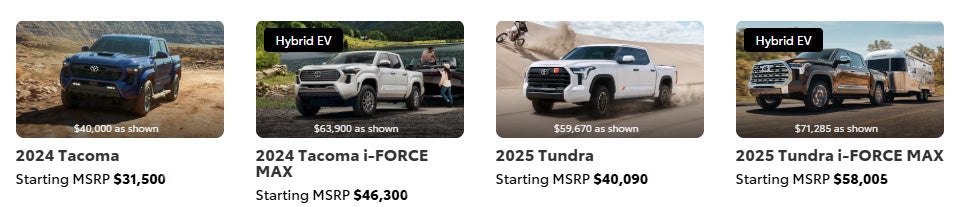
In the world of mid- and full-sized pickup trucks, there are a select few with histories of continued durability and power. Among these, the venerated Toyota Tacoma and Tundra have proven themselves as top contenders by continually, year after year, supplying pickup truck drivers with something rough and tough, yet also something sleek and modern. But of these two fantastic machines, which is the best pick for you?Toyota Trucks - 2025 Tacoma & Tundra Here is a quick glance at some of the new, notable features of both trucks: The new Toyota Tundra comes fitted with a new suspension, plenty of updated technology, a tougher and sportier design, and more available packages, like the two new powertrain options–a twin-turbo V6 engine and a hybrid twin-turbo V6.
  • Twin-Turbo V6: can tow up to 12,000 pounds and comes paired with a 10-speed electronically controlled automatic transmission; sequential shift mode; uphill/downhill shift logic; and TOW/HAUL driving modes.
  • Hybrid Twin-Turbo V6: generates 437 horsepower and 583 lb.-ft. of torque; also comes paired with a 10-speed electronically controlled automatic transmission; sequential shift mode; uphill/downhill shift logic; and TOW/HAUL driving modes.
This year, fans of the top-selling Toyota Tacoma pickup truck will be thrilled to see and sit inside an overhauled interior, a revamp that Tacoma has never seen. Every 2024 Tacoma comes with raised seating, added headroom, and a more adjustable steering column–all designed to bring the new Tacoma to a higher level of comfort and support. The Tacoma also has plenty more upgrades this year on the interior and exterior, as well as, under the hood and body. Tacoma and Tundra: The Specifics It’s a tough decision, choosing between the Tacoma and the Tundra. Both are big, formidable trucks, fitted with all the newest technologies and both are easily customizable to your liking. The Tacoma, the smaller of the two trucks, is one of the highest-rated mid-size pickup trucks in the country, and the full-sized Tundra has made it to the top of most American automaker’s lists as the most popular pickup, pitting itself against the Ford F-150 and the Chevy Silverado 1500. The 2024/2025 models of the Tacoma and Tundra come redesigned for the first time since 2022, making this year a big one for the brand. Both are set to maintain their spot at the top of any serious pickup driver’s list by touting a bulkier frame and a bit more power. Let’s take a closer look:
  • Cab and Bed Sizes
The Tacoma comes as either a two-door Xtra Cab or a four-door Double Cab, each configuration offering a little something different. The Xtra Cab allows for two passengers and has plenty of storage space behind the front seats. The Double Cab, on the other hand, offers a rear seat and allows for up to five passengers. As far as bed size, the Xtra Cab comes with a six-foot bed while the Double Cab comes with a choice of either a five-foot or a six-foot bed. The new Tundra, in all its versions, comes as a four-door along with a little more body length and width. The Double Cab is the smallest of the two options, as the CrewMax comes with larger rear doors and more space in the back for passengers. The Tundra also comes with four bed lengths: the Double Cab with a 6.5-foot or an 8.1-foot bed; the CrewMax comes with either a 5.5-foot short bed or a 6.5-foot bed.
  • Power Under the Hood
Previous versions of the two Toyota trucks had the Tacoma as a V-6 and the Tundra as a V-8. Both come a bit differently now: the Tacoma’s sole engine choice is a turbocharged four-cylinder, while the Tundra comes with a turbocharged V-6. What’s more, the smaller turbo engines offered come with more power than they ever have before, and both the Tacoma and the Tundra offer hybrid options–the i-Force Max with an extra boost of power. The Tacoma comes standard as a turbocharged, 2.4-liter inline-four engine with 228 horsepower. There is a step up with a 278-horsepower version of this engine, and there is also a hybrid version as an option that operates with a four-cylinder engine that produces up to 326 horsepower. As transmission goes, an eight-speed automatic is standard in most models, but there is an available six-speed manual with certain trim levels that can produce as much as 270 horsepower. The new Tundra comes with a twin-turbocharged 3.4-liter, V-6 engine with or without hybrid capabilities. The base version of the Tundra comes with 389 horsepower and the i-Force Max hybrid has 437 hp.
  • Towing and Payload
It’s no surprise the bigger Tundra can tow and haul more than the Tacoma, but as the smaller sibling, the Tacoma can hold its own as well. In the SR5 Double Cab configuration with rear-wheel drive, the Tundra can tow up to 12,000 pounds with a total payload capacity of 1,940 pounds. Meanwhile, the Tacoma is able to handle up to 6,500 pounds and a payload capacity of up to 1,709 pounds–nothing small about that at all!
  • Going Off the Grid
Besides their luxurious rides and standout power, the Tacoma and Tundra trucks have built a reputation for off-roading, primarily in the TRD Pro trim levels. Both trucks offer the TRD Pro option that features tons of surprising upgrades that help to traverse through tough terrain. This version of the Tacoma and Tundra also comes with a more rugged physique with black trim, special coloring, unique wheels, and stylish badging throughout the interior and exterior. The TRD Pro includes four-wheel drive as standard for both models, while this feature comes as optional on most of the other trim levels. Additionally, both trucks under the TRD Pro trims come equipped with lifted suspension setups with special Fox shocks and 33-inch all-terrain tires. For ground clearance, the Tacoma’s smaller size makes it a little better than the Tundra for navigating tighter trails. Lastly, the new Tacoma is introducing a new trim level called the TrailHunter, which is a more extreme version of the TRD Pro. The TrailHunter comes with the same mechanical upgrades as the TRD Pro, and it is set to accommodate overlanding extras like a rooftop tent and accessory lights, as well as, additional power outlets and an onboard compressor–the perfect setup for using your Toyota pickup as an outdoor tent. What is great about the Tacoma and Tundra trucks is that both are large and agile enough to have some fun when off the beaten path, yet they are compact enough to handle any suburban commute; this versatility, in addition to the uncanny longevity, is one of the key factors to the growing popularity of Toyota truck—especially in an age where people like to have the option to head to the mountains on a whim and know that their vehicle is more than capable of handling anything.    
Posted in:

Related Posts

America’s Darling: the History and Reemergence of the Hatchback

In the early 1960s, the hatchback vehicle was introduced to America and we fell in love with it…at least for a time. Though it lost some of its luster throughout the years, the hatchback’s innovative design has been a major influence on what we see on the roads today. Maybe this is why we are currently experiencing a strong reemergence of the hatchback vehicle—is it time for a blast from the past? At Mount Airy Toyota, we like the prospect of seeing more hatchback vehicles on the road, and we have plenty on our lot to offer, so we thought a little history lesson on the cool-looking car could benefit us all. Characteristics of the Hatchback The original hatchbacks were simple cars fitted with a rear door, hinged to the roof, that opened upwards much like a—you guessed it—hatch. These vehicles were rather squatted with a two-box body style. “Two-box” means the trunk and passenger area can easily consist of one volume of space by folding seats down, while the engine is separated into its own volume that can only be accessed by popping the hood. Most vehicles today are designed to be either a two- or three-box system. The original appeal of the hatchback car was not just its sleek, new (at least for its era) look. Car buyers simply loved the fact that you could fold the back seats down to create a massive trunk space, and that the vehicle often came with a removable rigid parcel shelf or a roll-up Tonneau Cover. These were features new to the car industry and they were quite impressive. There is also what’s known as a liftback, which is a hatchback with a single slope from the roofline to the bumper (picture a 1969 Ford Mustang) that has a more horizontal angle than the standard hatchback. Both versions were incredibly popular upon their arrival in the 1930s and 1940s, and the hatch-like door for which the vehicle gets its name can be seen in just about every SUV made today. Of course, nowadays we don’t even have to touch the hatch for it to open; just swing a leg under the back bumper and it magically rises on its own. Oh, how far we have come! The Early Stages of the Hatchback In 1938 Citroen produced the first hatchback, called the 11CV Commerciale. This large hunk of a machine possessed a tailgate that came in two pieces: a top door hinged from the roof, and a bottom door hinged from below. The car sold well enough for Citroen to continue marketing them, and soon after World War II they designed a version of the 11CV Commerciale that had one door hinged from the top only. Though this car was big and bulky and came with a massive rear hatch, it lead to later designs such as the 1949 Vagabond and Traveler vehicles that were more sleek and small, like a modern sedan. It is these models of the hatchback that have been described as the major influences for the hatchbacks manufactured in America sometime later. America’s Version of the Hatchback Just like our current obsession with crossover vehicles (a morphing of the modern sedan and SUV) when the hatchback hit the States, most Americans were quite impressed. Once they noticed their popularity in Europe, big car companies like Chrysler, Ford, and GM immediately went to work on designing a model of our own. Though the first models of the hatchback in the 1960s did well, like the Ford Pinto and Ford Bobcat, it was the Dodge Omni and the Plymouth Horizon, both released in 1978, that set the standard for America’s version of the vehicle. Then later, in the 1980s, the Dodge Shadow and Dodge Lancer managed to keep America’s love affair with the hatchback alive. Despite the decades of progress and popularity with the hatchback, its inclusion into modern life in the late 80s and into the 90s began to wane. We started to want bigger cars with more space and room to move around. Station wagons provided this, as did the entry of the Sport Utility Vehicle and, as fads always do, the American hatchback slowly lost its tracking. But just as fads fade away, it only takes a handful of years before they reemerge into popular culture, often with a new take on an old idea. And if you have been paying much attention to what’s new in the world of vehicles, it seems the hatchback is on its way back into our lives. A New Savior? It’s tough to say why things come back into fashion. Have we run out of ideas? Is there really nothing new under the sun? Just look at the fashion industry and you can see just how circular trends can be. Despite the dubious nature of American trends, there could be an easy explanation for why the hatchback is reemerging. There’s no disputing the fact we see more SUVs and crossovers on the road than sedans these days, as the car industry has had a massive drop in sedan sales over the last decade. With this in mind, it could be said the arrival of modernized hatchbacks is an effort to popularize the sedan again (or at least a modernized version of it). According to an article from USA Today, “In 2017, compact and subcompact car sales are down 25%.” Though this may not seem like much of a drop in number, even the smallest fluctuation in sales, either up or down, can have drastic repercussions. The article goes on to say that “Hatchbacks in those classes have risen 16%.” So with one (the sedan) going down, and the other (the hatchback) going up in sales, it’s safe to say the projected models of hatchbacks to come out in the next few years will test the market strength of this new style of sedan. Actually, that 16% figure already indicates an interest in the hatchback design by American car buyers, and the hope is this number will continue to rise. And judging from what we have seen in sales at Mount Airy Toyota, an increase does indeed seem probable. The Modern Hatchback So if you are in the market for a new car, and are considering a hatchback—as many car buyers these days are—there are a few things to consider. In fact, we’ve come up with a list of five tips to think about before you get too far along in the process. Here they are: Fun or Family? Today’s hatchbacks typically come in two styles: compact and midsize. The compact is closest in form to its ancestors, except that it has much more power and pizazz. These are sporty, fun-to-drive cars with two doors and the iconic scrunched rear. Though they’re small, they are the perfect weekend ride. The midsize is a four-door wagon-like car that maintains the hatchback look (as it does have the hatch in the back), but it is considerably larger than the compact model. This car could actually serve as a nice family vehicle with plenty of room to stretch and store goods. A New Crossover? Not all, but some hatchbacks coming out are large enough to be considered a small SUV, or a large sedan. But unlike the sport utility vehicle and the sedan, new hatchbacks still allow for the rear seats to fold down in order to provide even more cargo space. This might seem like a minor detail, but once you actually lay eyes on the space created from losing the back seats, you’ll realize this is a big selling point. An Easier Drive. Since the hatchback integrates the trunk space into the rear of the car more so than any other, it is shorter in length. This means it is easier to park and maneuver around tight spaces. This is great for big cities and congested areas and can make your life so much better. And the ease doesn’t stop there. Take any modern hatchback and compare its turning radius to that of a typical sedan of the same price range and you’ll notice a big difference. Hatchbacks make sharp turns simple, quick, and fun. And you can’t help but feel a little safer knowing that. Low Cost, Big Results. Because they are smaller in nature than a sedan (and definitely smaller than an SUV or crossover), hatchbacks don’t cost as much. Not only that, but they also do better on fuel, and that’s not even considering the hybrid and all-electric versions of the hatchback—yes, the modern hatchback can come as gas-powered, hybrid, or electric! Rise in Popularity. Don’t believe the naysayers who love to hate on the hatchback, whether old or new. The truth is, the American hatchback is on its way up! That 16% rise in sales mentioned earlier is just the tip of the iceberg. Hatchbacks are back and they’re here to win America’s hearts all over again. Toyota’s New Hatchbacks Currently, Toyota has some impressive hatchbacks to offer, two of which we find to be our favorites: one in the Corolla and another in the Prius. Let’s have a look at some of the specs for each. Corolla Hatchback: Comes with a starting MSRP of $20,140 Offers 30/38 estimated miles-per-gallon Has three trim levels—SE (L4 2.0L, 6MT); SE (L4 2.0L, CVT); and XSE (L4 2.0L, 6MT) Available with a dynamic force engine; optimized suspension; leather-trimmed sport seats; 6-speed intelligent manual transmission; rear window spoiler; and wearable connectivity It also comes with a chrome grille surround, LED taillights, LED fog lights, 18-inch alloy wheels, and piano-black accents and soft-touch materials throughout Prius C: Comes with a starting MSRP of $21,530 Has an estimated 48/43 mpg Available in seven different colors—Tide Pool Pearl, Blizzard Pearl, Classic Silver Metallic, Magnetic Gray Metallic, Black Sand Pearl, Absolutely Red, and Blue Streak Metallic Offered in an L or LE trim level Features the following: pre-collision system with pedestrian detection; lane departure alert; automatic high beams; a sporty exterior shape; 15-inch alloy wheels; versatile design; 60/40 split rear seating; and a premium interior And as far as technology goes, there is a standard backup camera, a smart key system with a push-bottom start, and a multi-information display See to Believe There are plenty more specs to both Toyota hatchbacks, but this is one type of vehicle you really have to see to believe. There’s just something about its performance, its comfortable-cool atmosphere that just can’t be explained. Like it or not, the hatchback is about to experience its own renaissance and we couldn’t be more excited. Just take a look at what we have on our lot right now— 2019 Toyota Corolla Hatchback (SE CVT) in Blizzard Pearl for only $21,842 2019 Toyota Corolla Hatchback (XSE CVT) in Blizzard Pearl for only $26,681 2019 Toyota Corolla Hatchback (SE CVT) in Classic Silver Metallic for only $21,692 Come in today and test drive the all-new Toyota hatchbacks. Mount Airy Toyota is confident you will be impressed with this blast from the past and, as always, you simply won’t find better pricing anywhere else. See you soon!     -Andrae Bergeron *Sources: https://www.globalcarsbrands.com/history-of-hatchbacks-and-the-best-hatchback-cars/ https://www.usatoday.com/story/money/cars/2017/05/28/hatchback-cars-stage-comeback/102258000/ https://www.toyota.com/hatchback-cars/


In Stock Toyota Tacoma, Toyota Tundra

Could the Japan Earthquake Affect Toyota Buying in Mount Airy?

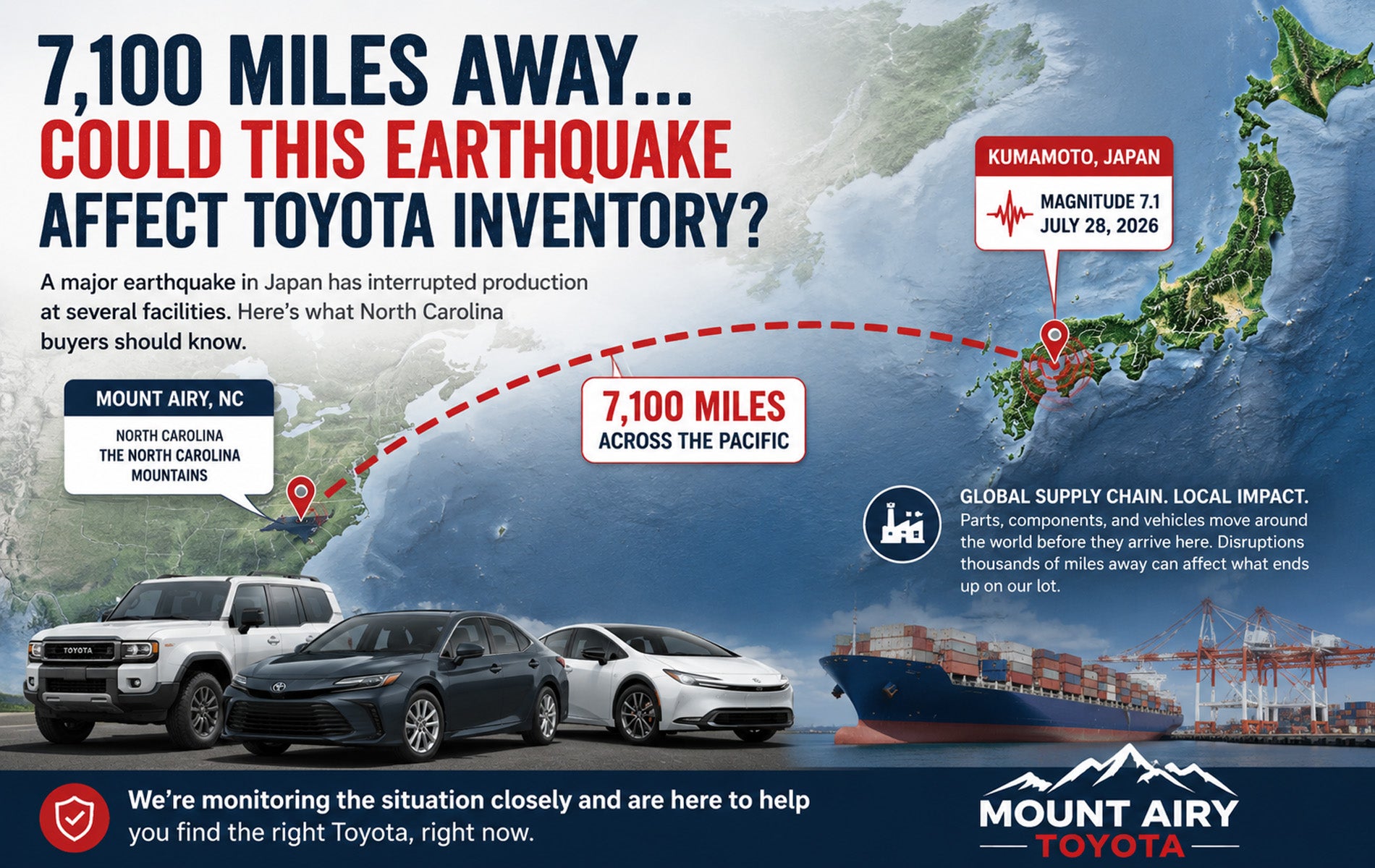
How could an earthquake more than 7,100 miles away from the North Carolina mountains impact your bottom line if you're car shopping? It's all about the supply chain. The truth is, no one has a crystal ball and knows for certain, but smart buyers are considering the possible impact. Toyota and several other Japanese manufacturers temporarily paused production at some facilities following the recent earthquake while engineers inspected plants, suppliers, and transportation infrastructure. That's a standard safety procedure after a significant seismic event and doesn't necessarily indicate long-term production problems. Still, the pandemic and the shortages it caused in our supply chain are still fresh enough in our memories to cause caution. It's a reminder that today's automotive supply chain stretches around the globe, and events thousands of miles away can eventually influence what shows up on dealership lots here in North Carolina. Which Toyota Models Could Be Affected? Industry analysts have identified a few models that could experience tighter inventory if production disruptions continue for an extended period. These include: Toyota Land Cruiser Toyota Prius Toyota Corolla It's important to emphasize that no widespread shortages have been announced. At this point, manufacturers are still evaluating facilities, suppliers, and logistics before determining whether production schedules will be affected over the coming weeks. We've Seen This Before This isn't the first time the automotive industry has faced unexpected challenges. Over the past fifteen years, manufacturers have dealt with: The 2011 earthquake and tsunami in Japan Global semiconductor shortages during the COVID-19 pandemic Shipping delays and port congestion Severe weather events affecting manufacturing plants Labor disruptions and transportation bottlenecks Each event affected inventory differently. Some caused only minor delays, while others created shortages that lasted months. The lesson is simple: the automotive industry has become very good at adapting, but unexpected events can still influence availability. Should You Buy Now? There's no reason to panic or rush into a purchase simply because of one news story. However, if you've already decided to purchase a specific Toyota—especially a particular trim level, color, or package—it may be worth beginning your search sooner rather than later. Limited-production models often have less flexibility than high-volume vehicles, and if inventories tighten, buyers may have fewer choices. If production returns to normal quickly, nothing changes. If disruptions last longer than expected, shoppers who waited may discover longer delivery times or fewer vehicles matching exactly what they wanted. What Mount Airy Toyota Is Watching Like dealerships across the country, Mount Airy Toyota closely monitors manufacturer updates and inventory availability. As information becomes available from Toyota, we'll continue helping customers find the right vehicle, whether it's already on our lot, arriving soon, or available through Toyota's dealer network. If you're considering a new Toyota and have questions about availability, our team is happy to discuss current inventory, incoming models, and your options. What's in Stock Now If you're interested in buying a Toyota right now, Mount Airy Toyota has 41 new vehicles in stock on our lot today. A Snapshot of Today’s New Car IN STOCK Inventory  at Mount Airy Toyota 1 Toyota 4Runner Limited – White 1 Toyota bZ XLE Plus – Black 1 Toyota bZ Woodland Premium – White 4 Toyota Camry XSE – Black SE – Black (2) SE – Gray 1 Toyota Corolla Hybrid LE – Gray 1 Toyota Crown Platinum – White 1 Toyota Grand Highlander Platinum – White 1 Toyota Highlander Hybrid Limited – Black 2 Toyota Prius Plug-In Hybrid XSE – Gray XSE Premium – White 2 Toyota RAV4 Plug-In Hybrid SE – White XSE – Black 3 Toyota Sequoia Platinum – Gray Capstone – Gray TRD Pro – White 1 Toyota Sienna XLE – Gray 11 Toyota Tacoma TRD Sport – Black (3) TRD Sport – White TRD Pro Hybrid – Black TRD Pro Hybrid – White Trailhunter Hybrid – Black TRD Off Road Hybrid – Blue TRD Off Road – Black TRD Off Road – Silver SR5 – Silver 11 Toyota Tundra Limited – Black (3) Limited – Gray (2) SR5 – Red (2) SR5 – Gray 1794 Edition Hybrid – Black TRD Pro Hybrid – White Capstone Hybrid – Gray We have an additional 36 vehicles that are in transit or in production. If you have any inclination to buy one of our vehicles listed as In Transit or In Production, reserve your preferred model as soon as possible. Whether you're shopping for a dependable Corolla, an efficient Prius, a capable Land Cruiser, or another Toyota model, Mount Airy Toyota is here to help you find the vehicle that best fits your needs.  Call for assistance in finding your dream car!  336-786-2118

Are hybrid batteries safe?

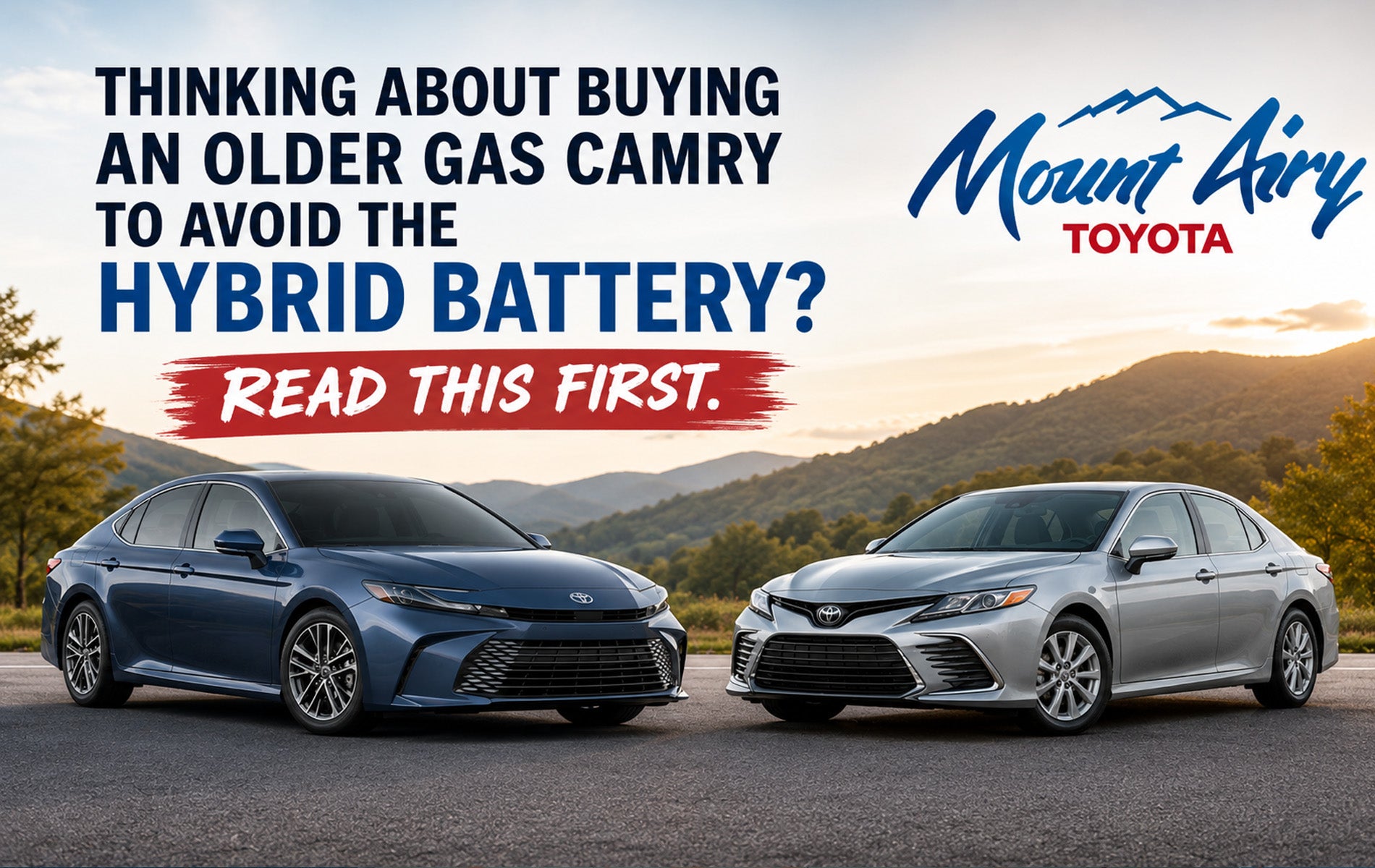
Thinking About Buying an Older Gas Camry to Avoid the Hybrid Battery? Read This First.

"Should You Buy a New Camry Hybrid or an Older Gas Camry? The Facts May Surprise You." For many Toyota shoppers, this is one of the biggest decisions they'll make. The good news is that today's Toyota hybrid technology has been on the road for more than two decades and has earned one of the strongest reliability records in the automotive industry. Still, that doesn't automatically make a new Camry Hybrid the right choice for every driver. For many shoppers, the decision isn't really about fuel economy. It's about the battery. Questions like these come up every day: How long does the hybrid battery last? What if it fails after the warranty expires? Will I be able to find someone to repair it? Are hybrid batteries safe? Should I avoid a hybrid altogether and buy an older gas-powered Camry instead? They're fair questions. The good news is that many of the stories you've heard probably refer to fully electric vehicles (EVs) rather than Toyota's proven hybrid technology. Before comparing ownership costs, let's clear up one of the biggest misconceptions. Hybrid vs. Electric Vehicle: They're Not the Same Thing Many people use the words hybrid and electric vehicle interchangeably.  They shouldn't.  Although both use batteries, they work very differently. A battery-electric vehicle (EV) relies entirely on a large battery pack that must be plugged into a charger. When the battery is depleted, you recharge before driving again. A Toyota Camry Hybrid never needs to be plugged in. Instead, it combines a gasoline engine with a much smaller high-voltage battery and electric motor. The battery automatically recharges while you drive using the gasoline engine and regenerative braking system. From the driver's seat, ownership feels exactly like a traditional gasoline vehicle.  You simply stop at a gas station, fill the tank, and drive away.Because of this, many concerns commonly associated with electric vehicles simply don't apply to the Camry Hybrid. For example: Concern EV Camry Hybrid Plug-in charging required ✔ ✘ Range anxiety ✔ ✘ Public charging stations ✔ ✘ Gasoline engine backup ✘ ✔ Regenerative braking ✔ ✔ Once shoppers understand this difference, many begin looking at hybrids very differently. Which Camry Costs Less to Drive? Let's compare a realistic ownership scenario. Assume a typical Mount Airy commuter drives: 15 miles each weekday (approximately 3,900 commuting miles annually) Plus shopping Weekend travel Family activities Vacations Total annual driving: 12,000 miles Using the average North Carolina gasoline price over the past several months (approximately $3.53 per gallon) and EPA combined fuel economy estimates: New Toyota Camry Hybrid vs 2022 Toyota Camry Gas Annual Miles 12,000 12,000 Combined MPG 51 MPG 32 MPG Fuel Used 235 gallons 375 gallons Annual Fuel Cost $830 $1,324 Estimated Annual Fuel Savings:  ~ $494 each year Five-year Savings:  $2,470 Unlike some hybrid comparisons where savings are relatively modest, the Camry Hybrid delivers meaningful fuel savings because of its excellent fuel economy. Fuel savings alone probably won't pay for the vehicle, but they're certainly enough to become part of the buying decision. Myth or Fact? "The Hybrid Battery Won't Last." The Concern Many shoppers picture the battery wearing out after 75,000 or 100,000 miles. The Facts Toyota has been building hybrid vehicles for more than 25 years.  Many original Prius and Camry Hybrid batteries remain on the road well beyond 200,000 miles, and some exceed 300,000 miles. Toyota carefully manages battery charging levels to reduce wear and maximize longevity.  Unlike your smartphone, the battery isn't constantly charged to 100% and completely discharged. Instead, it operates within a carefully controlled range designed to extend its useful life. Bottom Line - Mostly Myth Battery failures can occur, but they are far less common than many shoppers expect. "Replacing the Battery Will Cost a Fortune." The Concern This is probably the number one reason buyers avoid hybrids. The Facts Yes.  A hybrid battery replacement outside warranty can be expensive.  Depending on the model and repair option selected, replacement costs can range from a few thousand dollars to several thousand dollars. However...   Many owners never replace the battery while they own the vehicle.  In addition, today's buyers have more choices than they did fifteen years ago. Options now include: New Toyota batteries Factory remanufactured batteries Professionally rebuilt battery packs Independent hybrid repair specialists Bottom Line Partly Fact Replacement is expensive.  Replacement is also much less common than most shoppers believe. "Hybrid Vehicles Are Dangerous." The Concern News stories involving lithium batteries sometimes make shoppers nervous. The Facts Toyota hybrid systems include multiple safety features, including automatic high-voltage disconnects during many collision events and extensive crash testing.  It's also important to remember that a Camry Hybrid's battery pack is much smaller than the battery found in a fully electric vehicle.  Hybrid battery fires receive significant media attention because they're unusual—not because they're common. Bottom Line Mostly Myth Toyota hybrids have earned an excellent safety record. "North Carolina Summers Will Ruin the Battery." The Concern Heat damages batteries.  North Carolina gets hot.  Does that shorten battery life? The Facts Extreme temperatures can temporarily reduce battery efficiency.  However, Toyota designed its hybrid battery system with thermal management strategies intended to help protect long-term durability.  Like any vehicle, routine maintenance and keeping cooling systems functioning properly contribute to long battery life. Bottom Line Mostly Myth Hot weather may affect efficiency slightly on extremely hot days, but it typically does not significantly shorten battery life by itself. "Nobody Around Here Can Repair a Hybrid." Twenty years ago, this concern carried more weight.  Today, it's much less of an issue.  Toyota dealerships like Mount Airy Toyota service hybrid vehicles every day.  In addition, many independent repair facilities employ ASE-certified technicians trained to diagnose and repair hybrid systems.  Replacement parts are more widely available than ever before. For most owners, finding qualified service is no longer difficult. Bottom Line Myth "The Gas Camry Costs Less to Maintain." Many buyers assume hybrids are more expensive to maintain. In reality, both vehicles require: Oil changes Tire rotations Cabin air filters Coolant service Inspections However, the hybrid also benefits from regenerative braking, which often reduces brake wear.  Because the electric motor assists during acceleration, some drivetrain components experience less stress during everyday driving.  Routine maintenance costs are often surprisingly similar between the two vehicles. Bottom Line Mostly Myth "Hybrid Batteries Are Bad for the Environment." This is a more complicated discussion.  Hybrid batteries require materials such as lithium and nickel, and questions about mining and ethical sourcing are valid. At the same time, hybrids consume substantially less gasoline over their lifetime, produce fewer tailpipe emissions, and Toyota has invested heavily in battery recycling and responsible end-of-life management. Like nearly every modern technology, there are environmental trade-offs.  The question isn't whether hybrid batteries have an environmental impact—they do.  The better question is whether the lifetime reduction in fuel consumption and emissions outweighs those impacts.  Reasonable people can disagree, but it's important to understand the complete picture rather than focusing on only one side of the equation. Which Camry Is Right for You? Choose the used gas-powered Camry if: You want the lowest purchase price. You drive relatively few miles each year. You're comfortable buying a vehicle that's several years old. You prefer traditional automotive technology. Choose the new Camry Hybrid if: You commute regularly. You plan to keep the vehicle for many years. You want outstanding fuel economy. You value the latest Toyota Safety Sense technology. You appreciate lower operating costs over time. You want the peace of mind of a full factory warranty. The Bottom Line If you're considering an older gas-powered Camry simply because you're worried about hybrid batteries, today's Toyota hybrid technology deserves a closer look. Many of the concerns shoppers have—battery longevity, maintenance costs, safety, and repairability—were more understandable twenty years ago than they are today. Toyota has spent decades refining its hybrid system, and millions of owners have demonstrated that these vehicles can deliver outstanding reliability and low operating costs. That doesn't mean a new Camry Hybrid is automatically the right choice for everyone. An older gas-powered Camry remains one of the most dependable sedans on the road and may be the better fit for buyers focused on upfront affordability. The smartest decision isn't based on fear of a battery—it's based on understanding the facts, comparing the long-term costs, and choosing the Camry that best fits your driving habits, budget, and plans for the years ahead.