Blog / Toyota Warranty Information

Toyota Extended Warranties Explained: Answers From Mount Airy Toyota's Service Experts

Mount Airy Toyota - A Scott McCorkle Dealership

Is a Toyota Vehicle Service Agreement worth buying? When should you purchase one? And how do you know whether you're getting Toyota-backed protection?


For this article, we went beyond the standard warranty information available online. We asked an experienced technician in our own Mount Airy Toyota service department to share what happens when a vehicle comes in for a covered repair.

What Is a Toyota Vehicle Service Agreement?

A Toyota Vehicle Service Agreement (VSA) is an optional protection plan that helps pay for certain covered vehicle repairs, subject to the terms of the agreement.

Unlike your Toyota's original factory warranty, a VSA is something you choose to purchase for additional protection.

Toyota Financial Services offers several coverage options, including Platinum, Gold, and Powertrain protection. Specialized protection is also available for eligible battery-electric vehicles.
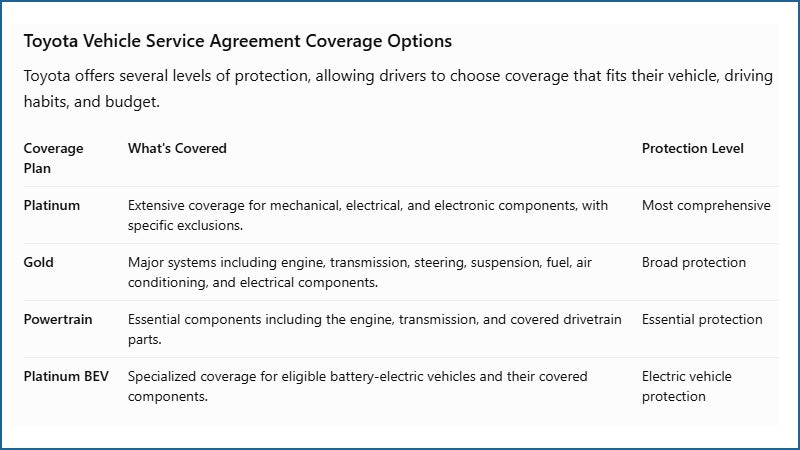
Toyota Warranty Levels
Bonus Info ...

What's a Powertrain?

You may have heard the term powertrain warranty without knowing exactly what it means.

A powertrain is the group of parts in a car or truck that create power and use that power to move the vehicle.  Think of it this way: The engine makes the power, and the rest of the powertrain delivers that power to the wheels.

Engine: Creates the power needed to move the vehicle.

Transmission: Controls how that power is delivered as the vehicle changes speed.

Driveshaft: Carries power toward the wheels on many vehicles.

Differential: Helps wheels turn at different speeds when going around corners.

Axles: Help transfer power to the wheels.

What's the Difference Between a Powertrain and a Drivetrain?  The powertrain includes the engine or motor and the parts that deliver power to the wheels.  The drivetrain generally refers to the parts that deliver that power, excluding the engine or motor.  Simply put: The powertrain creates and delivers the power. The drivetrain delivers it to the wheels.

We asked a Mount Airy Toyota service technician to explain Toyota Vehicle Service Agreements from the perspective of someone who works with these agreements when vehicles come in for repairs.

Get the 411 on how these agreements work, what coverage options may be available, and what Toyota owners should know before making a decision.


Toyota Vehicle Service Agreements Explained

Is an Extended Warranty Worth Buying on a Reliable Toyota?

This may be the most common question we hear.  Toyota vehicles are known for lasting a long time. So why spend extra money on protection when you may never need it?  It's a fair question.

Here in the Mount Airy area, we see Toyota owners who depend on their vehicles for everything from daily commutes to Winston-Salem to traveling between communities like Dobson, Pilot Mountain, and Galax, Virginia.

Some drivers put thousands of miles on their vehicles each month. Others drive relatively little but plan to keep their Toyota for ten years or longer.  The answer depends on how long you plan to keep your Toyota, how much you drive, the coverage you already have, and how comfortable you are paying for unexpected repairs.

Modern vehicles also contain sophisticated technology. Electronic controls, sensors, displays, and other components can be expensive to repair or replace.

A VSA often help reduce the financial impact of certain covered repairs.

Questions Worth Asking Yourself

How long will I keep my Toyota? If you plan to drive it for many years, additional protection may become more valuable as the vehicle ages.

How many miles do I drive? A driver commuting from Mount Airy to Winston-Salem several days a week will accumulate mileage much faster than someone who primarily drives around town.

Could I comfortably pay for an unexpected major repair? Some owners prefer a predictable upfront expense rather than the possibility of a large repair bill.

What protection do I already have? Your Toyota may already have factory warranty, powertrain, hybrid-component, or Certified Pre-Owned coverage.

Does the VSA protect the components I'm concerned about? Compare the actual agreement against your vehicle's existing coverage.

If you plan to keep your Toyota for many years, additional coverage may be worth considering.

If Toyota vehicles are so reliable, why would anyone need an extended warranty?

We asked one of our Mount Airy Toyota service technicians to explain why some owners choose additional protection and how a VSA can help with the cost of covered repairs involving genuine Toyota parts.

His perspective comes from working on Toyota vehicles, not simply selling protection plans.

Is An Extended Warranty Worthwhile on a Reliable Toyota?


Should You Buy a Toyota VSA When You Purchase Your Vehicle or Wait?

For an eligible new or leased Toyota, an official Toyota-backed VSA can generally be purchased before the vehicle reaches three years or 36,000 total miles, whichever comes first, measured from its original in-service date.  That gives many new Toyota owners time to consider their options.   However, waiting has some important considerations.

An Insider Tip From Mount Airy Toyota

One advantage of purchasing a VSA when you buy your vehicle is that you may be able to include the cost in your vehicle financing.

For some customers, that makes the expense easier to manage than paying for the agreement separately later.   However, financing the VSA may also mean paying interest on its cost. Compare the total expense before making your decision.  If you're unsure, ask our finance team at Mount Airy Toyota to explain the options available for your particular vehicle.

Does Toyota VSA Pricing Change as Your Vehicle Gets Older?

Yes, it can.

The price of a Toyota Vehicle Service Agreement may change based on the vehicle's age, mileage, and other factors.  Generally, vehicles with more miles may cost more to protect because they have a greater chance of needing repairs.

Are Toyota VSA Price Increases Published Online?

No. Toyota dealerships do not publish universal VSA pricing charts or mileage-based price increases online.

Every vehicle and agreement is different. Pricing depends on the vehicle, the coverage selected, and the selling dealership.

Can You Buy a Toyota VSA Directly From Toyota?

No. Toyota-backed Vehicle Service Agreements are sold through participating Toyota dealerships.

You cannot simply visit Toyota's corporate website and purchase a VSA directly.

Can You Shop Different Toyota Dealerships?

Yes. Eligible customers can compare available Toyota VSA options and prices at participating Toyota dealerships.  You are not necessarily limited to the dealership where you purchased your vehicle.   Because dealerships may offer different retail prices, it can be worthwhile to compare quotes for the same coverage, deductible, and term.

Does Mount Airy Toyota Sell Toyota-Backed Vehicle Service Agreements?

Yes. Mount Airy Toyota offers Toyota-backed Vehicle Service Agreements.

Whether you purchased your Toyota here in Mount Airy or at another participating dealership, our team can help explain available protection options and determine whether your vehicle qualifies.  We welcome questions from Toyota owners throughout Surry County, including Dobson, Pilot Mountain, Elkin, and neighboring Virginia communities.

Toyota-Backed VSAs vs. Third-Party Extended Warranties: What's the Difference?

Here's something that surprises many Toyota buyers:  Just because you purchase an extended warranty at a Toyota dealership doesn't automatically mean you're buying a Toyota-backed agreement.

Some dealerships offer Toyota Vehicle Service Agreements. Others offer third-party service contracts. Some offer both.  Third-party providers may include companies such as Fidelity Warranty Services, JM&A, Zurich, CNA National, or Assurant.  Third-party agreements are not necessarily bad products. Some may offer coverage or pricing that better fits a customer's needs.  But there can be important differences in how repairs are approved, which parts are covered, what documentation is required, and what additional benefits are available.

Why Can Toyota-Backed Service Agreements Make Repairs Faster?

This is where the experience of our Mount Airy Toyota service department becomes especially valuable.

Our Toyota-trained technicians work with Toyota vehicles every day. They understand the manufacturer's repair procedures, use genuine Toyota parts, and are familiar with Toyota's service agreement requirements.

Toyota dealerships also regularly work with Toyota VSA representatives. This familiarity helps service departments understand which repairs are covered, how claims are handled, and what parts are approved.  Because Toyota-backed agreements use established repair procedures and pricing, the claims process can be relatively straightforward.

Third-party service agreements may involve additional steps.

  • Repair Authorization: The dealership may need to contact the third-party warranty company before beginning repairs.

  • Coverage Verification: The service department may need to confirm that the specific repair and replacement parts are covered.

  • Price Negotiations: Some third-party companies negotiate approved labor rates, parts prices, and total repair costs.

  • Parts Searches: The provider may require the dealership to locate alternative parts that meet its pricing or replacement requirements.

  • Additional Documentation: The dealership may need to submit extra paperwork or wait for approval before proceeding.

These extra steps can delay the repair process and keep the customer without their vehicle longer.

For drivers who rely on their Toyota to get to work, take children to school, or travel throughout the foothills of North Carolina and southern Virginia, getting a vehicle repaired and back on the road matters.

The bottom line: Toyota-backed VSAs can make the repair process smoother and faster because Toyota dealerships already know the coverage, use approved parts, and work within established claims procedures.

That doesn't mean every third-party agreement is a bad choice. It simply means that the company backing your agreement can make a difference in your service experience.

Why Might a Toyota Dealership Sell a Third-Party Agreement?

Each dealership decides which protection products it wants to offer.  Factors may include pricing, provider relationships, claims procedures, available coverage, and dealership compensation.  The important thing for customers is knowing exactly what they're purchasing.

How Can You Tell Whether Your Agreement Is Backed by Toyota?

Before signing, ask your finance manager:

"Is this an official Toyota Vehicle Service Agreement administered through Toyota Financial Services, or is it a third-party service contract?"

Then check the paperwork to identify the provider and administrator.  You should also ask about deductibles, approved repair locations, replacement parts, rental car benefits, and the claims process.


Are Third-Party Warranties Any Good?

Are Third Party Warranties Any Good?

We asked an experienced Mount Airy Toyota service technician to compare Toyota-backed VSAs with third-party agreements based on what happens in the service department.

He explains why claims procedures, documentation, rental car benefits, and repair approvals can make a difference when your vehicle needs service.

It's information that customers don't always hear when they're sitting in the dealership finance office.

Watch: Toyota vs. Third-Party Vehicle Service Agreements

What About Toyota Certified Pre-Owned Vehicles?

Toyota Certified Used Vehicles, also called Certified Pre-Owned (CPO) vehicles, have their own warranty protections and optional service agreements.  Certified Pre-Owned Toyotas are popular with drivers who want Toyota reliability and warranty protection without purchasing a brand-new vehicle.

But there's an important distinction: The rules for purchasing additional protection on a Certified Pre-Owned Toyota may be different from those for a new Toyota.

Doesn't a Toyota Certified Pre-Owned Vehicle Already Have a Warranty?

Yes. Eligible Toyota Certified Used Vehicles come with warranty protection as part of their certification.  However, the amount and type of coverage depend on the vehicle's certification category and Toyota's applicable warranty terms.

An optional Toyota Certified Used Vehicle Service Agreement is a separate product that customers may purchase for additional protection.

Why Buy Additional Coverage on a Certified Toyota?

Certification provides valuable peace of mind, but it doesn't mean every component is protected against every repair expense for as long as you own the vehicle.

An optional VSA may offer broader protection or a different coverage period, depending on the plan.

Before purchasing, compare the coverage already included with the certified vehicle against the optional agreement. Pay special attention to overlapping coverage, exclusions, and when each protection period ends.

Do You Have to Buy a Certified Pre-Owned VSA at the Time of Purchase?

Not necessarily, but the answer depends on the specific agreement.

Toyota Financial Services materials describe certain eligible Certified Used Vehicle Service Agreements as available within the first 12 months or 12,000 miles after the certified vehicle is purchased or leased, whichever comes first.

However, other certified protection options, including certain Certified Plus agreements, may require purchase at the time of the vehicle transaction.

Because these rules vary by product, customers should not assume they can wait until the original warranty is nearly expired.

Ask the Mount Airy Toyota finance team to confirm the purchase deadline for the exact Certified Used Vehicle Service Agreement you're considering.

When Does Certified Pre-Owned VSA Coverage Begin?

Unlike many new-vehicle agreements, certain Toyota Certified Used Vehicle Service Agreements measure their time and mileage terms from the date and odometer reading when the agreement is purchased.

For example, imagine purchasing a Certified Pre-Owned Toyota with 30,000 miles.

Six months later, your vehicle has 36,000 miles.

If the agreement permits a later purchase and your vehicle remains eligible, the coverage term may be calculated using the date and mileage at which you purchase the VSA.

The exact starting point, coverage limits, and eligibility rules depend on the agreement.

Watch: Toyota Certified Pre-Owned Vehicle Service Agreements


Toyota Certified Pre-Owned Vehicle Service Agreements.

Thinking about purchasing a Toyota Certified Used Vehicle?

We asked an experienced technician in our Mount Airy Toyota service department to explain important considerations about Certified Pre-Owned Vehicle Service Agreements.

He discusses how these agreements work and why the rules may differ from those for new Toyota vehicles.

Watch: Toyota Certified Pre-Owned Vehicle Service Agreements: What You Need to Know


Questions to Ask Before Purchasing a Toyota Vehicle Service Agreement

Whether you're buying a new Toyota, a used Toyota, or a Certified Pre-Owned Toyota, asking a few questions can help you make an informed decision.

Who Backs and Administers the Agreement?

Is it an official Toyota-backed VSA or a third-party service contract?

What Is Covered?

Ask to see the actual list of covered components and exclusions. Don't assume that the words "extended warranty" mean everything on your vehicle is protected.

When Does Coverage Begin and End?

Confirm both the time and mileage limits. Ask whether the agreement starts from the vehicle's original in-service date or the date you purchase the agreement.

Where Can I Get Repairs?

Ask whether repairs can be performed at participating Toyota dealerships nationwide and whether prior authorization is required.

What Will I Pay?

Compare the agreement price, deductible, and any additional costs. If you finance the agreement, consider the interest expense as well.

Don't feel pressured to purchase protection you don't understand. Ask questions, read the contract, and make sure the coverage fits your vehicle and your plans.

Have More Questions? Talk to Your Neighbors at Mount Airy Toyota

Mount Airy Toyota has been part of the Surry County automotive community for generations.

Our service department includes Toyota-trained technicians who work with genuine Toyota parts and understand the manufacturer's repair procedures.

We believe that experience matters, especially when you're trying to decide whether additional warranty protection is worth the investment.

Whether you live in Mount Airy, Dobson, Pilot Mountain, Elkin, or across the Virginia state line in Cana or Galax, we're happy to help you understand your Toyota's warranty coverage.

You don't have to be purchasing a vehicle to ask questions about a Vehicle Service Agreement.

Contact Mount Airy Toyota

Mount Airy Toyota

508 N. Andy Griffith Parkway

Mount Airy, NC 27030

Phone: 336-786-2118

Website: www.mountairytoyota.com

Schedule Toyota Service

Our sales, finance, and service teams can help explain your existing warranty protection, explore additional coverage options, and determine which agreements may be available for your Toyota.

Coverage, benefits, eligibility, deductibles, purchase windows, and terms vary by agreement and vehicle. Vehicle Service Agreements are optional service contracts, not extensions of the manufacturer's limited warranty. The actual contract controls all coverage and benefit determinations.


Posted in:

Recommended Posts

Mount Airy Toyotathon November 2026

What Is Toyotathon?

Mount Airy Toyotathon is Almost Here!  Look for Big Savings in November! Why Toyota's Biggest Sales Event Is Different You have probably seen the commercials. The giant red bows appear. The holiday music starts. And suddenly, Toyotathon is back. But what exactly is Toyotathon? And is it really different from the countless holiday, year-end and clearance sales advertised by other automobile manufacturers? Actually, yes. Toyotathon is Toyota's annual year-end sales event, a tradition that dates back nearly 50 years. But to understand why Toyotathon is important, it helps to understand something else about Toyota: Toyota takes a very different approach to discounting its vehicles. That approach is also connected to something Toyota owners care about long after they drive away from the dealership: resale value. What Is Toyotathon? Toyotathon is Toyota's signature annual year-end sales event. During Toyotathon, Toyota traditionally makes special manufacturer-supported offers available on eligible vehicles. Depending on the year, model and market, those can include special financing rates, lease offers, customer incentives and other programs. Toyota itself has historically described Toyotathon offers as some of its best of the year. During its 2012 Toyotathon, for example, Toyota executives described the event as featuring some of the company's best offers of the year, including low interest rates and lease rates. That distinction is important. A dealership can call almost anything a "sale." Toyotathon is different because it is an actual Toyota manufacturer sales event, supported and promoted nationally by Toyota. And Toyota doesn't approach vehicle discounting quite like everyone else. Why Toyota Pricing Is Different Here's something many car shoppers don't know.  Toyota closely controls the way its dealers advertise new Toyota vehicle pricing. Toyota uses Minimum Allowable Advertised Price guidelines, commonly called MAAP, as part of its dealer marketing program. In simple terms, Toyota establishes rules governing how low participating dealers can advertise new Toyota vehicles. Manufacturer incentives that are available to consumers can be reflected in those advertised prices. But a Toyota dealer generally can't simply decide to advertise a new Toyota thousands of dollars below the allowable advertised price just to undercut another Toyota dealer down the road.  Why? One reason is to avoid the race to the bottom that can occur when dealerships compete primarily by advertising increasingly lower prices on the same new product. We've dealt with Toyota advertising compliance ourselves here at Mount Airy Toyota. If an advertised price falls outside Toyota's pricing guidelines, the dealership can receive a communication from Toyota's compliance team asking that it be corrected. In our experience, pricing discrepancies are often something simple, such as a database issue, incorrect incentive, feed problem or typo. They are generally easy to correct. Ignoring Toyota's advertising requirements, however, can eventually result in penalties under Toyota's dealer marketing program. But the important point for consumers isn't the technical compliance process.  It's why Toyota cares about pricing in the first place. Why Would Toyota Want to Keep Prices Steady? Because the price of a new Toyota today can affect what that Toyota is worth tomorrow. Here's a simple example. Example:  Suppose you buy a new vehicle for $40,000. Six months later, dealers are routinely advertising brand-new versions of the same vehicle for $34,000. Now imagine you're trying to trade your six-month-old vehicle. Your used vehicle can't be valued in a vacuum. It has to compete with what another shopper can pay for a brand-new one. If a brand-new version is readily available for $34,000, the market can't reasonably continue valuing your used vehicle as though the new one still costs $40,000. The discount on the new vehicle didn't just change the value of the one sitting on the dealer's lot. It potentially affected the value of every comparable used vehicle already on the road. Repeat that process year after year with large rebates and increasingly aggressive dealer discounts, and a manufacturer can gradually train the market to expect its vehicles to sell for considerably less than their sticker prices. That's the "race to the bottom" Toyota's pricing discipline is designed to help avoid. Instead of encouraging Toyota dealers to compete by continually advertising lower and lower prices on identical new vehicles, Toyota maintains standards around advertised pricing and takes a disciplined approach to manufacturer incentives. That helps establish greater consistency in new Toyota pricing. And consistent new-vehicle pricing can help protect used-vehicle values because Toyota isn't constantly resetting the market value of its own products downward. Does Toyota's Pricing Strategy Help Toyota Resale Value? There are many reasons Toyotas have historically maintained strong resale values. Reliability matters. Durability matters. Consumer demand matters. Product quality, inventory, reputation and the desirability of individual Toyota models all matter. But so does what Toyota doesn't do: continually discount the price of its new vehicles. And the connection between incentives and resale value isn't just our theory. It is something the automotive industry's residual-value experts specifically measure and discuss. J.D. Power's ALG division, one of the industry's leading authorities on residual values, has stated that manufacturer incentives can have a direct negative effect on the resale values of older models. That makes the relationship pretty straightforward. Large and repeated discounts can lower the effective market price of new vehicles. Lower new-vehicle prices put pressure on the value of comparable used vehicles. Avoiding excessive discounting can therefore help a manufacturer protect residual values. And Toyota's results are impressive. For 2026, J.D. Power named Toyota the top mass-market brand in its U.S. ALG Residual Value Awards. In explaining Toyota's performance, J.D. Power specifically pointed to Toyota's strong wholesale retention, brand value and its disciplined approach to incentives and rental fleets. That's an important connection. Toyota is disciplined about discounting new vehicles. Independent automotive experts identify disciplined incentives as a factor in Toyota's strong residual values. And Toyota owners ultimately benefit when their vehicles retain more of their value. Toyota also received more individual 2026 ALG model awards than any other manufacturer, with the Toyota GR Supra, GR86, Camry, Sequoia, Tundra and Tacoma each winning their respective categories. Kelley Blue Book tells a similar story. KBB named Toyota its 2026 Best Resale Value Brand, marking Toyota's sixth consecutive win and tenth overall win for the award. Toyota's projected average five-year resale value for 2026 is 53% of original MSRP. And five of the ten vehicles on KBB's 2026 Best Resale Value Top 10 are Toyotas: Toyota Tacoma: 63.0% Toyota Tundra: 59.9% Toyota 4Runner: 58.0% Toyota GR Supra: 56.0% Toyota Sienna: 54.3% The Toyota Tacoma actually holds the #1 position in the country on KBB's 2026 list. So Toyota's approach asks buyers to look beyond the size of today's advertised discount. A vehicle that is worth more when you're ready to trade it can ultimately be a better value than one that needed a huge discount to sell when it was new. The price you pay matters. The value you keep matters, too. And that's part of what makes Toyotathon different. So What Makes Toyotathon Different? Toyota's pricing philosophy is precisely what makes Toyotathon interesting. Throughout the year, Toyota maintains considerable discipline around advertised new-vehicle pricing and manufacturer incentives. Toyota dealers aren't simply encouraged to continually undercut one another with bigger and bigger advertised discounts. Then comes Toyotathon.  During its signature year-end event, Toyota itself traditionally puts special promotional support behind eligible vehicles.  In other words, the manufacturer that spends the year protecting pricing integrity is now the one creating the sales opportunity. That doesn't mean every Toyota suddenly has thousands of dollars knocked off the price.  Depending on the vehicle and the year's Toyotathon program, the opportunity could take the form of special APR financing, lease offers, customer cash or another Toyota-supported incentive. Some models may have considerably stronger Toyotathon offers than others.  But that's precisely why Toyotathon gets attention. When a manufacturer known for protecting vehicle values throughout the year decides it's time for its biggest sales event, Toyota shoppers have a reason to pay attention. Toyota's approach isn't simply about keeping today's new-vehicle price from falling. It's also about protecting the value of the Toyota product over time. If Toyota dealers continually competed by advertising identical vehicles for less and less, those lower new-car prices would eventually become part of the equation used to value used Toyotas.  Toyota takes a different approach. It maintains disciplined advertised pricing. It controls the manufacturer incentives that can be incorporated into those advertised prices. And its vehicles consistently rank among the industry's leaders in retained value. Toyotathon History - Toyotathon Started as a 36-Hour Sales Experiment Toyotathon also has a much more interesting history than you might expect.  The event dates to the 1970s.  Toyota's own corporate history records a nationwide Toyotathon sales event in March 1977 that set a new-order record. The concept grew out of an extraordinarily successful regional promotion. Historical accounts describe an early Toyotathon as an intense 36-hour sales event, with participating dealerships staying open around the clock while customers were bombarded with television advertising.  It worked. Approximately 3,000 vehicles were sold during the original 36-hour event, with hundreds more sold afterward.  The idea spread. By the end of the 1970s, Toyotathon was evolving into the November and December year-end event Americans would eventually recognize from television. By 2011, Toyota was referring to its annual year-end Toyotathon as the 32nd edition. Toyota reported that year's event included low interest rates and special lease programs on most 2011 and 2012 models. In 2013, Toyota said its annual year-end Toyotathon would peak during the week between Christmas and New Year's and described the available financing and lease rates as providing some of its best deals of the year. What began as a frantic 36-hour experiment had become an American automotive holiday tradition. Why Is It Called "Toyotathon"? This may be our favorite part.  The name Toyotathon combines Toyota with the suffix "-athon." We now attach "-athon" to all kinds of things, but the convention comes from the word marathon. Over time, "-athon" became shorthand for something unusually long, intensive or concentrated. Think: telethon. dance-a-thon. walk-a-thon. read-a-thon. hackathon. And, eventually, Toyotathon. Toyota certainly wasn't the last advertiser to have fun with it.  Diet Pepsi MAX once created a "Yawn-a-Thon" as part of its "Wake Up, People!" advertising campaign, complete with a spoof telethon and celebrity wake-up calls. There have been Brand-a-thons in the advertising industry, where agencies participate in intensive branding competitions.  "Snackathon" has even been registered as a trademark for an online snack retailer. And the "-athon" formula remains so recognizable that fundraising organizations routinely create Color-A-Thons, Run-a-Thons and similar events. Toyota, however, may have created one of advertising's most enduring branded versions of the idea.  Nearly half a century later, people don't need anyone to explain that a Toyotathon involves selling Toyotas. Toyotathon Has Even Become Part of Pop Culture If you need evidence that Toyotathon has become bigger than an ordinary automotive promotion, consider what Toyota did recently.  For Toyotathon 2025, Toyota and its advertising agency Saatchi & Saatchi teamed up with Sisqó to turn his famous "Thong Song" into "The 'Thon Song." Yes. Really. The campaign included a fully produced song and music video, streaming releases and a Christmas Day NFL debut on Netflix.  The campaign went on to receive recognition at the 2026 Clio Awards. After nearly 50 years, Toyota wasn't simply advertising a sale anymore. It was poking fun at the fact that Americans already know what Toyotathon is. When Is Toyotathon 2026? Toyotathon traditionally begins around November and continues through the year-end holiday shopping season.  As we get closer to Toyotathon 2026, we'll update our website with specific Toyota offers available at Mount Airy Toyota in Mount Airy, NC. Remember that Toyotathon offers can vary by model and may have specific eligibility requirements and expiration dates. Should You Wait for Toyotathon to Buy a Toyota? Not necessarily.  If Mount Airy Toyota has the Toyota you want now, particularly if you're looking for a specific model, trim level, drivetrain, package or color combination, waiting for an incentive that may or may not apply to that vehicle doesn't always make sense. But if you're shopping for a new Toyota during the year-end period, Toyotathon is absolutely worth investigating. Ask us what Toyota is offering on the models you're considering. Ask whether the better opportunity is cash, financing or leasing. And don't evaluate a vehicle purchase based solely on the biggest advertised discount. Consider what you're buying, what you're paying and what that vehicle may still be worth several years from now.  That's especially relevant with Toyota. When Toyota announces the offers for Toyotathon 2026, we'll let you know what's actually a great deal, which Toyota models qualify and what you need to know before you buy.  Until then, stop by Mount Airy Toyota in Mount Airy, NC, and ask us about Toyotathon.   After all, we've been doing this almost as long as Toyota has.

In Stock Toyota Tacoma, Toyota Tundra

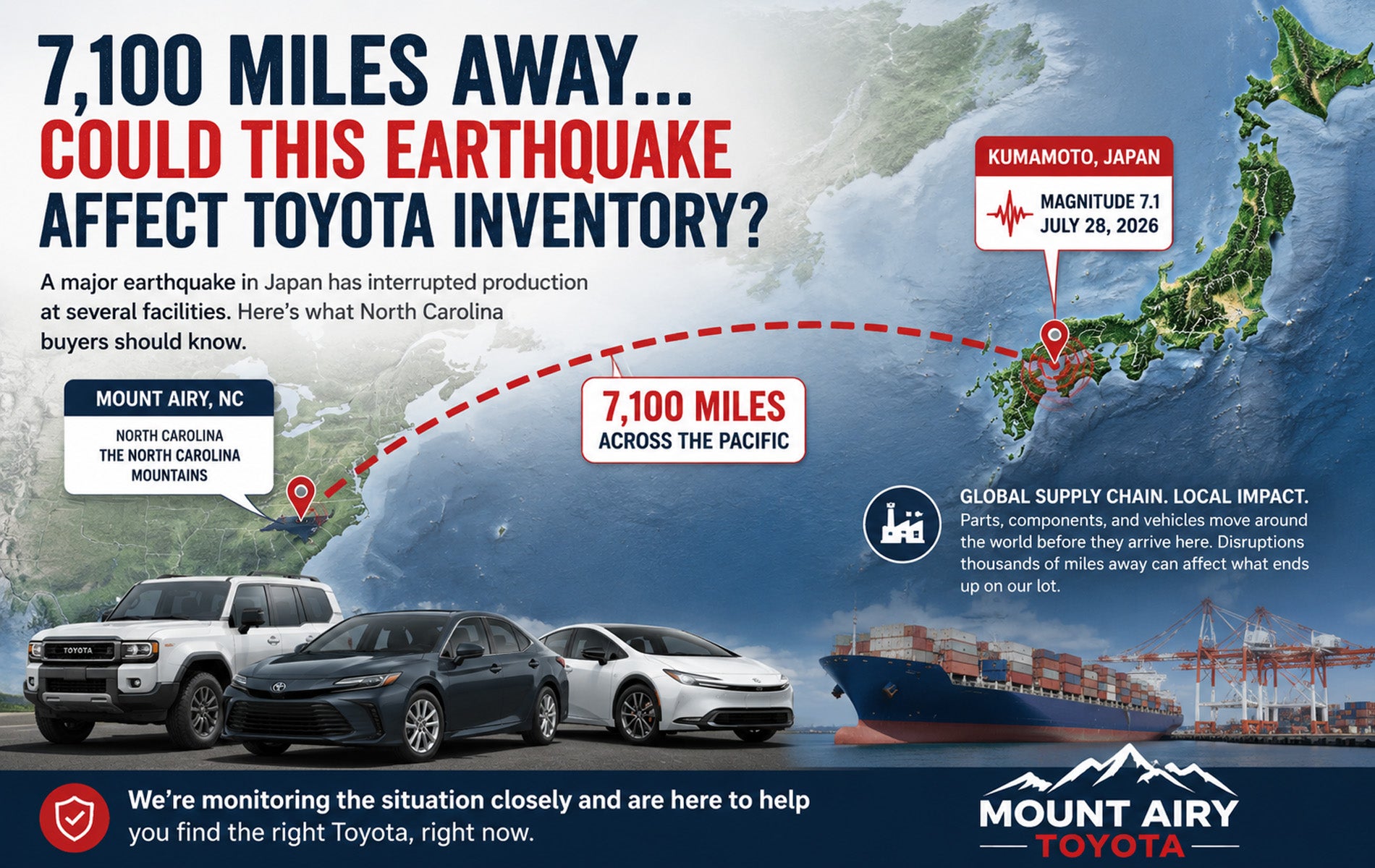
Could the Japan Earthquake Affect Toyota Buying in Mount Airy?

How could an earthquake more than 7,100 miles away from the North Carolina mountains impact your bottom line if you're car shopping? It's all about the supply chain. The truth is, no one has a crystal ball and knows for certain, but smart buyers are considering the possible impact. Toyota and several other Japanese manufacturers temporarily paused production at some facilities following the recent earthquake while engineers inspected plants, suppliers, and transportation infrastructure. That's a standard safety procedure after a significant seismic event and doesn't necessarily indicate long-term production problems. Still, the pandemic and the shortages it caused in our supply chain are still fresh enough in our memories to cause caution. It's a reminder that today's automotive supply chain stretches around the globe, and events thousands of miles away can eventually influence what shows up on dealership lots here in North Carolina. Which Toyota Models Could Be Affected? Industry analysts have identified a few models that could experience tighter inventory if production disruptions continue for an extended period. These include: Toyota Land Cruiser Toyota Prius Toyota Corolla It's important to emphasize that no widespread shortages have been announced. At this point, manufacturers are still evaluating facilities, suppliers, and logistics before determining whether production schedules will be affected over the coming weeks. We've Seen This Before This isn't the first time the automotive industry has faced unexpected challenges. Over the past fifteen years, manufacturers have dealt with: The 2011 earthquake and tsunami in Japan Global semiconductor shortages during the COVID-19 pandemic Shipping delays and port congestion Severe weather events affecting manufacturing plants Labor disruptions and transportation bottlenecks Each event affected inventory differently. Some caused only minor delays, while others created shortages that lasted months. The lesson is simple: the automotive industry has become very good at adapting, but unexpected events can still influence availability. Should You Buy Now? There's no reason to panic or rush into a purchase simply because of one news story. However, if you've already decided to purchase a specific Toyota—especially a particular trim level, color, or package—it may be worth beginning your search sooner rather than later. Limited-production models often have less flexibility than high-volume vehicles, and if inventories tighten, buyers may have fewer choices. If production returns to normal quickly, nothing changes. If disruptions last longer than expected, shoppers who waited may discover longer delivery times or fewer vehicles matching exactly what they wanted. What Mount Airy Toyota Is Watching Like dealerships across the country, Mount Airy Toyota closely monitors manufacturer updates and inventory availability. As information becomes available from Toyota, we'll continue helping customers find the right vehicle, whether it's already on our lot, arriving soon, or available through Toyota's dealer network. If you're considering a new Toyota and have questions about availability, our team is happy to discuss current inventory, incoming models, and your options. What's in Stock Now If you're interested in buying a Toyota right now, Mount Airy Toyota has 41 new vehicles in stock on our lot today. A Snapshot of Today’s New Car IN STOCK Inventory  at Mount Airy Toyota 1 Toyota 4Runner Limited – White 1 Toyota bZ XLE Plus – Black 1 Toyota bZ Woodland Premium – White 4 Toyota Camry XSE – Black SE – Black (2) SE – Gray 1 Toyota Corolla Hybrid LE – Gray 1 Toyota Crown Platinum – White 1 Toyota Grand Highlander Platinum – White 1 Toyota Highlander Hybrid Limited – Black 2 Toyota Prius Plug-In Hybrid XSE – Gray XSE Premium – White 2 Toyota RAV4 Plug-In Hybrid SE – White XSE – Black 3 Toyota Sequoia Platinum – Gray Capstone – Gray TRD Pro – White 1 Toyota Sienna XLE – Gray 11 Toyota Tacoma TRD Sport – Black (3) TRD Sport – White TRD Pro Hybrid – Black TRD Pro Hybrid – White Trailhunter Hybrid – Black TRD Off Road Hybrid – Blue TRD Off Road – Black TRD Off Road – Silver SR5 – Silver 11 Toyota Tundra Limited – Black (3) Limited – Gray (2) SR5 – Red (2) SR5 – Gray 1794 Edition Hybrid – Black TRD Pro Hybrid – White Capstone Hybrid – Gray We have an additional 36 vehicles that are in transit or in production. If you have any inclination to buy one of our vehicles listed as In Transit or In Production, reserve your preferred model as soon as possible. Whether you're shopping for a dependable Corolla, an efficient Prius, a capable Land Cruiser, or another Toyota model, Mount Airy Toyota is here to help you find the vehicle that best fits your needs.  Call for assistance in finding your dream car!  336-786-2118

Are hybrid batteries safe?

Thinking About Buying an Older Gas Camry to Avoid the Hybrid Battery? Read This First.

"Should You Buy a New Camry Hybrid or an Older Gas Camry? The Facts May Surprise You." For many Toyota shoppers, this is one of the biggest decisions they'll make. The good news is that today's Toyota hybrid technology has been on the road for more than two decades and has earned one of the strongest reliability records in the automotive industry. Still, that doesn't automatically make a new Camry Hybrid the right choice for every driver. For many shoppers, the decision isn't really about fuel economy. It's about the battery. Questions like these come up every day: How long does the hybrid battery last? What if it fails after the warranty expires? Will I be able to find someone to repair it? Are hybrid batteries safe? Should I avoid a hybrid altogether and buy an older gas-powered Camry instead? They're fair questions. The good news is that many of the stories you've heard probably refer to fully electric vehicles (EVs) rather than Toyota's proven hybrid technology. Before comparing ownership costs, let's clear up one of the biggest misconceptions. Hybrid vs. Electric Vehicle: They're Not the Same Thing Many people use the words hybrid and electric vehicle interchangeably.  They shouldn't.  Although both use batteries, they work very differently. A battery-electric vehicle (EV) relies entirely on a large battery pack that must be plugged into a charger. When the battery is depleted, you recharge before driving again. A Toyota Camry Hybrid never needs to be plugged in. Instead, it combines a gasoline engine with a much smaller high-voltage battery and electric motor. The battery automatically recharges while you drive using the gasoline engine and regenerative braking system. From the driver's seat, ownership feels exactly like a traditional gasoline vehicle.  You simply stop at a gas station, fill the tank, and drive away.Because of this, many concerns commonly associated with electric vehicles simply don't apply to the Camry Hybrid. For example: Concern EV Camry Hybrid Plug-in charging required ✔ ✘ Range anxiety ✔ ✘ Public charging stations ✔ ✘ Gasoline engine backup ✘ ✔ Regenerative braking ✔ ✔ Once shoppers understand this difference, many begin looking at hybrids very differently. Which Camry Costs Less to Drive? Let's compare a realistic ownership scenario. Assume a typical Mount Airy commuter drives: 15 miles each weekday (approximately 3,900 commuting miles annually) Plus shopping Weekend travel Family activities Vacations Total annual driving: 12,000 miles Using the average North Carolina gasoline price over the past several months (approximately $3.53 per gallon) and EPA combined fuel economy estimates: New Toyota Camry Hybrid vs 2022 Toyota Camry Gas Annual Miles 12,000 12,000 Combined MPG 51 MPG 32 MPG Fuel Used 235 gallons 375 gallons Annual Fuel Cost $830 $1,324 Estimated Annual Fuel Savings:  ~ $494 each year Five-year Savings:  $2,470 Unlike some hybrid comparisons where savings are relatively modest, the Camry Hybrid delivers meaningful fuel savings because of its excellent fuel economy. Fuel savings alone probably won't pay for the vehicle, but they're certainly enough to become part of the buying decision. Myth or Fact? "The Hybrid Battery Won't Last." The Concern Many shoppers picture the battery wearing out after 75,000 or 100,000 miles. The Facts Toyota has been building hybrid vehicles for more than 25 years.  Many original Prius and Camry Hybrid batteries remain on the road well beyond 200,000 miles, and some exceed 300,000 miles. Toyota carefully manages battery charging levels to reduce wear and maximize longevity.  Unlike your smartphone, the battery isn't constantly charged to 100% and completely discharged. Instead, it operates within a carefully controlled range designed to extend its useful life. Bottom Line - Mostly Myth Battery failures can occur, but they are far less common than many shoppers expect. "Replacing the Battery Will Cost a Fortune." The Concern This is probably the number one reason buyers avoid hybrids. The Facts Yes.  A hybrid battery replacement outside warranty can be expensive.  Depending on the model and repair option selected, replacement costs can range from a few thousand dollars to several thousand dollars. However...   Many owners never replace the battery while they own the vehicle.  In addition, today's buyers have more choices than they did fifteen years ago. Options now include: New Toyota batteries Factory remanufactured batteries Professionally rebuilt battery packs Independent hybrid repair specialists Bottom Line Partly Fact Replacement is expensive.  Replacement is also much less common than most shoppers believe. "Hybrid Vehicles Are Dangerous." The Concern News stories involving lithium batteries sometimes make shoppers nervous. The Facts Toyota hybrid systems include multiple safety features, including automatic high-voltage disconnects during many collision events and extensive crash testing.  It's also important to remember that a Camry Hybrid's battery pack is much smaller than the battery found in a fully electric vehicle.  Hybrid battery fires receive significant media attention because they're unusual—not because they're common. Bottom Line Mostly Myth Toyota hybrids have earned an excellent safety record. "North Carolina Summers Will Ruin the Battery." The Concern Heat damages batteries.  North Carolina gets hot.  Does that shorten battery life? The Facts Extreme temperatures can temporarily reduce battery efficiency.  However, Toyota designed its hybrid battery system with thermal management strategies intended to help protect long-term durability.  Like any vehicle, routine maintenance and keeping cooling systems functioning properly contribute to long battery life. Bottom Line Mostly Myth Hot weather may affect efficiency slightly on extremely hot days, but it typically does not significantly shorten battery life by itself. "Nobody Around Here Can Repair a Hybrid." Twenty years ago, this concern carried more weight.  Today, it's much less of an issue.  Toyota dealerships like Mount Airy Toyota service hybrid vehicles every day.  In addition, many independent repair facilities employ ASE-certified technicians trained to diagnose and repair hybrid systems.  Replacement parts are more widely available than ever before. For most owners, finding qualified service is no longer difficult. Bottom Line Myth "The Gas Camry Costs Less to Maintain." Many buyers assume hybrids are more expensive to maintain. In reality, both vehicles require: Oil changes Tire rotations Cabin air filters Coolant service Inspections However, the hybrid also benefits from regenerative braking, which often reduces brake wear.  Because the electric motor assists during acceleration, some drivetrain components experience less stress during everyday driving.  Routine maintenance costs are often surprisingly similar between the two vehicles. Bottom Line Mostly Myth "Hybrid Batteries Are Bad for the Environment." This is a more complicated discussion.  Hybrid batteries require materials such as lithium and nickel, and questions about mining and ethical sourcing are valid. At the same time, hybrids consume substantially less gasoline over their lifetime, produce fewer tailpipe emissions, and Toyota has invested heavily in battery recycling and responsible end-of-life management. Like nearly every modern technology, there are environmental trade-offs.  The question isn't whether hybrid batteries have an environmental impact—they do.  The better question is whether the lifetime reduction in fuel consumption and emissions outweighs those impacts.  Reasonable people can disagree, but it's important to understand the complete picture rather than focusing on only one side of the equation. Which Camry Is Right for You? Choose the used gas-powered Camry if: You want the lowest purchase price. You drive relatively few miles each year. You're comfortable buying a vehicle that's several years old. You prefer traditional automotive technology. Choose the new Camry Hybrid if: You commute regularly. You plan to keep the vehicle for many years. You want outstanding fuel economy. You value the latest Toyota Safety Sense technology. You appreciate lower operating costs over time. You want the peace of mind of a full factory warranty. The Bottom Line If you're considering an older gas-powered Camry simply because you're worried about hybrid batteries, today's Toyota hybrid technology deserves a closer look. Many of the concerns shoppers have—battery longevity, maintenance costs, safety, and repairability—were more understandable twenty years ago than they are today. Toyota has spent decades refining its hybrid system, and millions of owners have demonstrated that these vehicles can deliver outstanding reliability and low operating costs. That doesn't mean a new Camry Hybrid is automatically the right choice for everyone. An older gas-powered Camry remains one of the most dependable sedans on the road and may be the better fit for buyers focused on upfront affordability. The smartest decision isn't based on fear of a battery—it's based on understanding the facts, comparing the long-term costs, and choosing the Camry that best fits your driving habits, budget, and plans for the years ahead.