Blog / New Pickup Trucks

Toyota Tacoma vs. Ford Ranger in Mount Airy, NC

Toyota Tacoma vs Ford Ranger Mount Airy NC
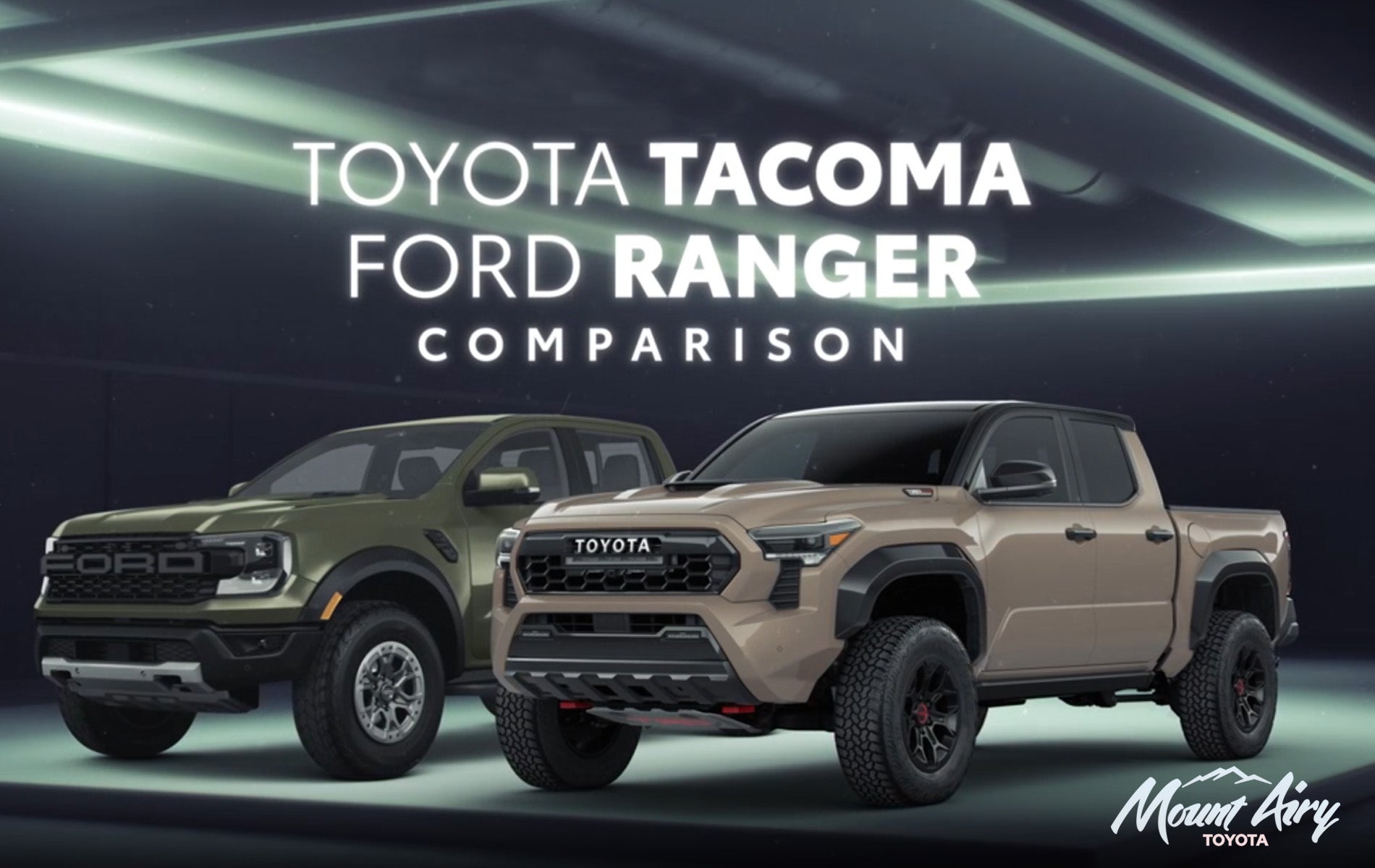
A Local Comparison for Surry County Drivers If you’re shopping for a New or Used Toyota Tacoma in Mount Airy, NC or comparing it to a Ford Ranger near Pilot Mountain, Galax, or anywhere in Surry County, you’ve narrowed it down to two very solid midsize trucks. Bottom line — both are good choices. The real decision comes down to two simple questions:One: How will you use your truck around Mount Airy and Northwest North Carolina?Two: How important is long-term resale value?

How Will This Truck Fit Into Your Daily Life in Surry County?

Don’t just compare numbers — compare lifestyles. After the purchase, payload differences and acceleration times fade away. What remains is how the truck fits your daily routine. Is it comfortable on your commute? Easy to maneuver in town? Simple to operate when you just want the heat on and the cup holder within reach? How does it feel going over the same speed bump you hit every day? If you regularly haul construction materials across Mount Airy, Cana, or over toward Wilkesboro, the Ford Ranger does offer a slightly higher payload — 1,366 lbs compared to the Toyota Tacoma’s 1,200 lbs. But let’s put that into perspective. The difference is only 166 lbs. That’s roughly the weight of one extra adult or a couple of extra bags of concrete. For most drivers in Mount Airy, that difference rarely changes day-to-day life. Now think about how you actually use your truck. If you’re commuting from Mount Airy to Winston-Salem or Greensboro on Highway 52… If you’re driving NC Highway 103 between North Carolina and Virginia… If you’re running errands in Surry County or heading out for a weekend in the Blue Ridge Mountains… Comfort starts to matter. The Toyota Tacoma offers:
  • A smoother ride thanks to rear coil springs
  • Available heated and cooled seats
  • Strong rear-seat storage for tools, gear, or a 12-pack of water
  • Hybrid options for better fuel efficiency
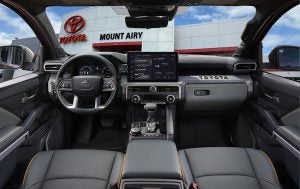
On those winding mountain roads around Pilot Mountain, Fancy Gap, and West Jefferson, the Tacoma’s coil spring suspension provides a more compliant, controlled feel compared to the Ranger’s leaf springs. Over time, especially on twisty, uneven pavement, that smoother ride makes a difference. For daily driving in Mount Airy and across Northwest North Carolina, that comfort adds up. Simple Controls for Everyday Driving We hear it all the time from drivers around Surry County — not everyone wants to dig through a touchscreen just to adjust the heat in January. Toyota kept physical HVAC buttons in the Tacoma. They’re simple. They work. They’re easy to operate on the go. You still get modern features like push-button start and remote start. But the everyday controls remain practical and user-friendly — something many North Carolina truck buyers appreciate.

How Important Is Long-Term Resale Value in North Carolina?

When shoppers compare the Toyota Tacoma vs. Ford Ranger in North Carolina, resale value often becomes the deciding factor. Year after year, Toyota trucks hold their value exceptionally well across Mount Airy, Winston-Salem, Greensboro, and throughout the state. Toyota’s resale strength isn’t accidental. The company has maintained pricing discipline for decades, avoiding heavy discounting just to match short-term local competition. That consistency helps protect long-term value and keeps resale prices strong. And there’s something else our service team hears often from Tacoma owners in Surry County: When you walk out to your truck in the morning, you expect it to start — and it does. Toyota has built a worldwide reputation for reliability, and that matters whether you’re driving around Mount Airy, heading into Virginia, or taking a weekend trip into the mountains. The Practical Decision Here’s the straightforward way to think about it: Do you need the ability to carry one more bag of concrete occasionally? Or would you rather enjoy a smoother, more comfortable ride every single day? Most drivers in Mount Airy, Pilot Mountain, Galax, and across Surry County use their truck for commuting, errands, work projects, short vacations, and seasonal fishing trips far more often than they max out payload capacity. For most North Carolina truck buyers, comfort, reliability, and long-term value win out. That’s why many local drivers choose the Toyota Tacoma. If you’re looking for a Toyota Tacoma near Mount Airy, NC, or comparing it to a Ford Ranger in Surry County, we’d be glad to help. Call us at 336-786-2118 to schedule a test drive. Whether you're coming from Mount Airy, Pilot Mountain, Galax, Cana, or anywhere nearby, we’ll have your Tacoma ready when you arrive. 2026 Toyota Tacoma vs. 2026 Ford RangerSide-by-Side ComparisonPerformance & Capability
Toyota TacomaCategoryFord Ranger
2.4L Turbo 4-cylinder / Hybrid availableBase Engine2.3L Turbo 4-cylinder (270 hp)
~243–317 lb-ft (varies by trim)Torque~310 lb-ft
~1,200 lbsPayload~1,366 lbs
Rear coil springsRear SuspensionRear leaf springs
Smoother daily rideRide ComfortFirmer ride unless loaded
Rear locking differentialOff-RoadRear locking differential
Crawl Control & terrain modesDrive ModesTerrain management modes
Interior & Comfort
Toyota TacomaCategoryFord Ranger
Heated & cooled seats availableSeat ComfortHeated seats available
Power seats availablePower SeatsPower seats available
Push-button startConveniencePush-button start available
More interior storageStoragePractical storage layout
Rear seats fold down with under-seat storageRear UtilityRear seats fold up
Slightly more rear legroomRear LegroomSlightly less rear legroom
Physical HVAC buttonsClimate ControlsMore screen-based controls
Bedliner often standardBed FeaturesBedliner optional
No 360° camera on most trims360 CameraAvailable 360° camera
     
Posted in:

Related Posts

2026 Tacoma TRD Pro vs 2026 Tacoma Trailhunter

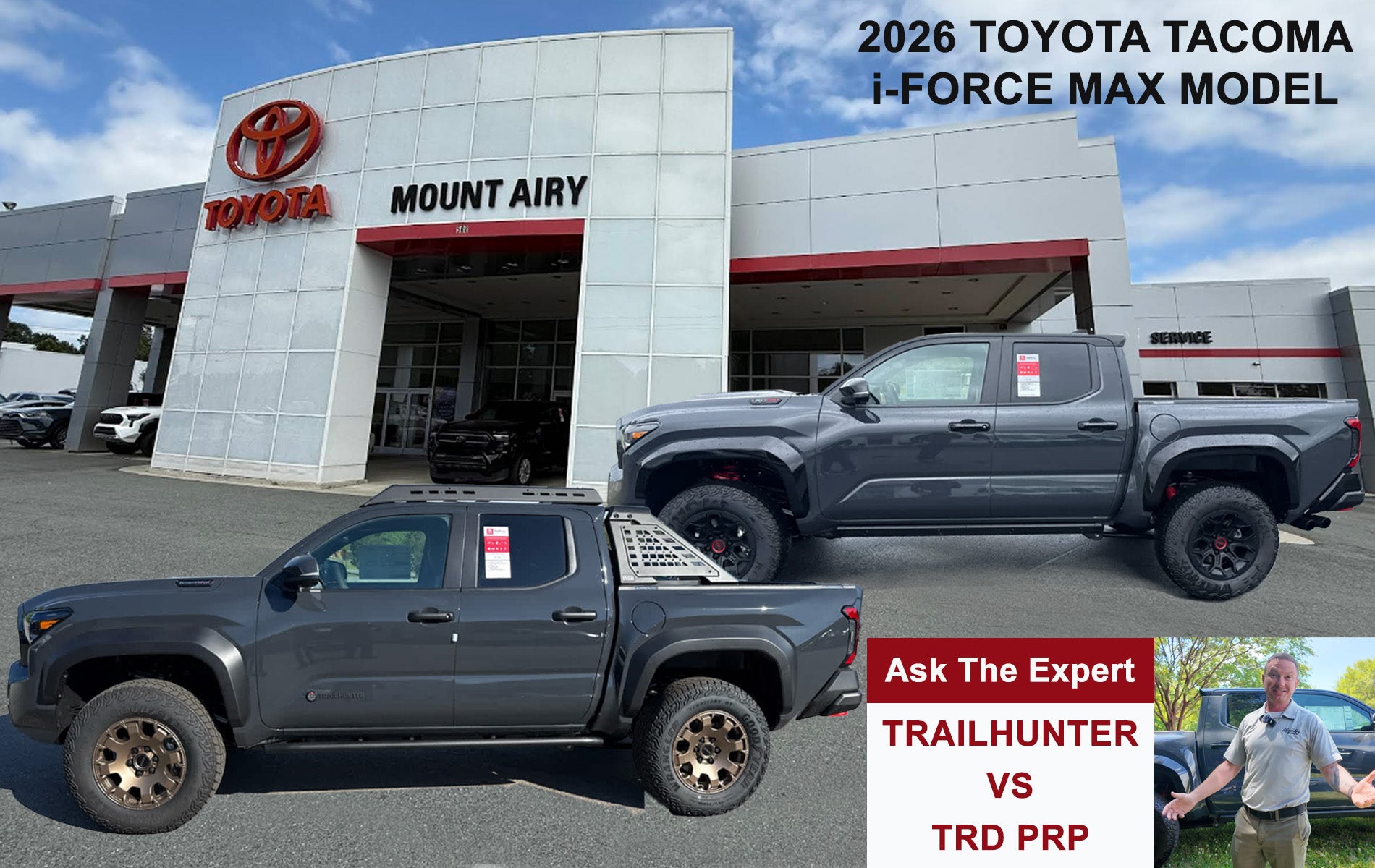
2026 Toyota Tacoma i-FORCE MAX TRD Pro vs Trailhunter: Which Off-Road Tacoma Is Right for You?

When Toyota redesigned the Tacoma, they did more than refresh America’s favorite midsize truck. They created two completely different personalities at the top of the off-road lineup: the 2026 Toyota Tacoma TRD Pro and the 2026 Toyota Tacoma Trailhunter. At first glance, these trucks look very similar. Both are aggressive, lifted, rugged, and packed with advanced off-road technology. Both feature Toyota’s new hybrid i-FORCE MAX powertrain. Both are built to go far beyond pavement. But according to Chris Pack at Mount Airy Toyota, these trucks are designed for two very different types of truck owners. If you love high-speed desert runs, aggressive off-road driving, and sporty performance, the TRD Pro may be your perfect Tacoma.  If your idea of adventure involves rooftop tents, camping gear, long-distance overlanding, and remote trails, the Trailhunter was practically built for you. Mount Airy Toyota sales person Chris Pack recently reviewed both trucks side-by-side on camera at Mount Airy Toyota, giving customers a real-world look at what separates these two highly capable Tacoma models. The Shared DNA: What Both Trucks Have in Common Before diving into the differences, it’s important to understand just how much capability both trucks share.  Both the Tacoma TRD Pro and Trailhunter come equipped with Toyota’s impressive new: 4-liter i-FORCE MAX hybrid powertrain 326 horsepower 465 lb-ft of torque This new hybrid system is a major leap forward for Tacoma performance. Toyota combines a turbocharged 2.4-liter engine with an electric motor, hybrid battery pack, and hybrid electronics to create enormous low-end torque and smoother power delivery.  The result is a truck that feels dramatically stronger than previous Tacoma generations. Both trucks also feature serious off-road hardware, including: Locking rear differentials (diff locks) Transfer case locks Electronic sway bar disconnects Underbody armor Recovery hooks Wider fender flares ARB steel rear bumpers LED bed lighting Power sliding rear glass Power tailgates 18-inch wheels wrapped in Goodyear Wrangler Territory 265/70R18 tires (That tire size translates to: 265 mm tire width, Sidewall height equal to 70% of tire width, Radial construction, 18-inch wheel fitment) The Biggest Difference is Lifestyle According to Chris Pack, the biggest difference between these two trucks is simple:  The TRD Pro is designed for performance off-roading. If you like running through creeks in the North Carolina mountains this might be the right truck for you.  It will get you where you need to go fast and the isodynamic seats ensure a smooth ride!  The Trailhunter is designed for camping, fishing, and weekend travel.  It's rugged and full of factory-included extras! Tacoma TRD Pro: Built for High-Speed Off-Road Performance The TRD Pro is Toyota’s performance-focused off-road Tacoma. It is engineered for: High-speed desert driving Aggressive trail running Jumps and harsh impacts Sporty handling Baja-inspired performance The TRD Pro suspension uses: 5-inch FOX Internal Bypass QS3 shocks Rear remote reservoirs Performance-tuned suspension geometry Increased wheel travel These FOX shocks are specifically engineered to absorb impacts at speed while maintaining stability and control over rough terrain. Chris points out that the TRD Pro sits slightly taller than the Trailhunter and feels noticeably sportier behind the wheel. The TRD Pro also includes custom color accents that run throughout the vehicle inside, out and underneath: Red upper control arms on the suspension Red interior accents on the leather seats Painted black fender flares TRD-specific styling on the dashboard, door and center console Signature black-tip TRD exhaust The exhaust pipes and sound are another key "personality" difference. The TRD Pro’s performance exhaust delivers a deeper, sportier tone designed to complement its aggressive off-road character. Even the startup sound feels more performance-oriented. One of the TRD Pro’s most unique features is the available IsoDynamic Performance Seat system.  These seats use internal shock absorbers and damping technology to reduce body movement and driver fatigue during aggressive off-road driving. Think of it as a mini suspension system built directly into the seat itself. Chris notes this is one of the coolest features on the truck and something most buyers have never experienced before. Tacoma Trailhunter: Built for Serious Overlanding The Trailhunter is entirely different in style and was built for what Toyota refers to as Overlanding, but people in Mount Airy would probably refer to as Camping.  If you like to fish, hunt, camp with family, or explore the mountains of North Carolina, this is the perfect truck!  This truck was designed in partnership with ARB (Anthony Ronald Brown), Australia’s legendary off-road and overlanding equipment manufacturer.  Toyota essentially worked with ARB to create a turnkey overlanding Tacoma directly from the factory. Instead of focusing on speed, the Trailhunter focuses on: Remote adventure travel Rooftop camping Carrying heavy gear Slow-speed rock crawling Durability during long expeditions The suspension uses: 5-inch Old Man Emu forged monotube shocks External remote reservoirs Thicker internal pistons Heavy-duty overlanding tuning Unlike the sportier FOX setup in the TRD Pro, the Old Man Emu suspension is engineered to remain stable while carrying camping gear, rooftop tents, recovery equipment, and supplies for long-distance travel. Chris recommends the Trailhunter specifically for serious campers and weekend overlanders. The bronze color theme also helps separate the Trailhunter visually from the TRD Pro. Bronze accents appear throughout: Grille details Upper control arms on the suspension Wheel accents Interior trim on leather seats, steering wheel, door and dashboard The Trailhunter also features one of its most recognizable visual upgrades: the factory-installed ARB Safari snorkel. Why the Trailhunter Snorkel Actually Matters A snorkel is intake mounted along the side of the windshield/A-pillar that looks a bit like a periscope.  It moves the engine’s air intake higher up on the vehicle so the engine can pull in. It keeps air cleaner, cooler, creates less dust, and less water.  It’s especially useful when driving through deep water, mud, dusty trails, or dry environments. The ARB Safari snorkel is one of the most respected Tacoma options on the Trailhunter and is included from the factory. It's built for serious overlanding and water/dust protection. Note:  The new TRD Pro does not come standard with a snorkel but aftermarket OEM-style snorkles are available for $250 - $400.  There are some premium kits for more but most people are happy with the lower price kits if off-roading in mud and water is not an everyday event.ding and water/dust protection. Type Typical Price Budget aftermarket snorkel $250–$400 Dobinsons snorkel ~$375–$395 K&N elevated intake/snorkel ~$450–$590 ARB Safari snorkel ~$660 Installed professionally Add ~$300–$800 labor Trailhunter’s Secret Weapon: The Built-In Air Compressor One feature that really separates the Trailhunter from the TRD Pro is the factory onboard air compressor.  Serious off-roaders know how important tire pressure is on trails.  Lower tire pressure improves grip and comfort on sand, rocks, snow, and rough trails.  Because the compressor is built directly into the truck, Trailhunter owners don’t need to carry a separate portable compressor. The compressor allows drivers to: Air down tires for improved traction Air tires back up after off-road driving Inflate camping equipment and outdoor gear Note:  In the TRD Pro, this same area is instead used for a storage compartment and bed-mounted electrical outlet. Different Rock Sliders for Different Missions Even the rock sliders reveal the different mission of each truck.  The Trailhunter’s rock sliders feature a heavier-duty tubular design integrated with the truck’s steel underbody protection. They are designed for heavy trail impacts, overlanding durability, and expedition protection. The TRD Pro rock rails are more flush-mounted and lighter in design. They focus more on aggressive off-road driving, performance capability, and sporty styling integration. Ground Clearance and Off-Road Capability Both trucks are extremely capable off-road. Approximate running ground clearance: TRD Pro: 11–11.5 inches Trailhunter: 10.8–11 inches Chris notes that the TRD Pro sits slightly taller, but the difference is relatively minor in real-world driving. The bigger difference comes down to suspension tuning and intended use. A Mount Airy Toyota Exclusive One unique detail Chris highlights is something customers will not typically find elsewhere. This is a Mount Airy Toyota exclusive. Tacoma trucks do not typically come with a first aid kit, but our dealership makes an effort to include one with every new truck we sell.  The Toyota Genuine First Aid Kit is designed for minor roadside or trail injuries and typically includes: Adhesive bandages (Band-Aids) Butterfly bandages Rolled stretch bandage Gauze pads/dressings Insect sting relief pads Antiseptic wipes Stainless steel scissors Disposable gloves Face masks Hand sanitizer packets Emergency/survival blankets It all comes packed in a compact soft-sided case that is water-resistant, black and has a Velcro-backed storage bag.  Toyota describes it as a kit for “minor scrapes and scratches” with added PPE supplies.  For buyers planning off-road adventures, camping trips, or long-distance travel, it’s a thoughtful addition that makes a lot of sense. pic 2 Which Tacoma Should You Buy? The truth is there is no wrong answer.  What makes this comparison so interesting is that Toyota created two trucks that are both incredibly capable — just in different ways. Choose the TRD Pro if you want: Choose the Trailhunter if you want: Sporty off-road performance High-speed trail driving Baja-inspired suspension Aggressive styling IsoDynamic seats Performance-focused capability Overlanding capability Rooftop camping Expedition travel Built-in air compressor ARB accessories Heavy-load trail durability Perhaps the biggest surprise is that the price difference between these trucks is only about $1,000.  That means your decision is less about budget and more about lifestyle. As Chris Pack explains in his Mount Airy Toyota review: both trucks are built for adventure — you simply have to decide how you want to spend your weekend!

In Stock Toyota Tacoma, Toyota Tundra

Could the Japan Earthquake Affect Toyota Buying in Mount Airy?

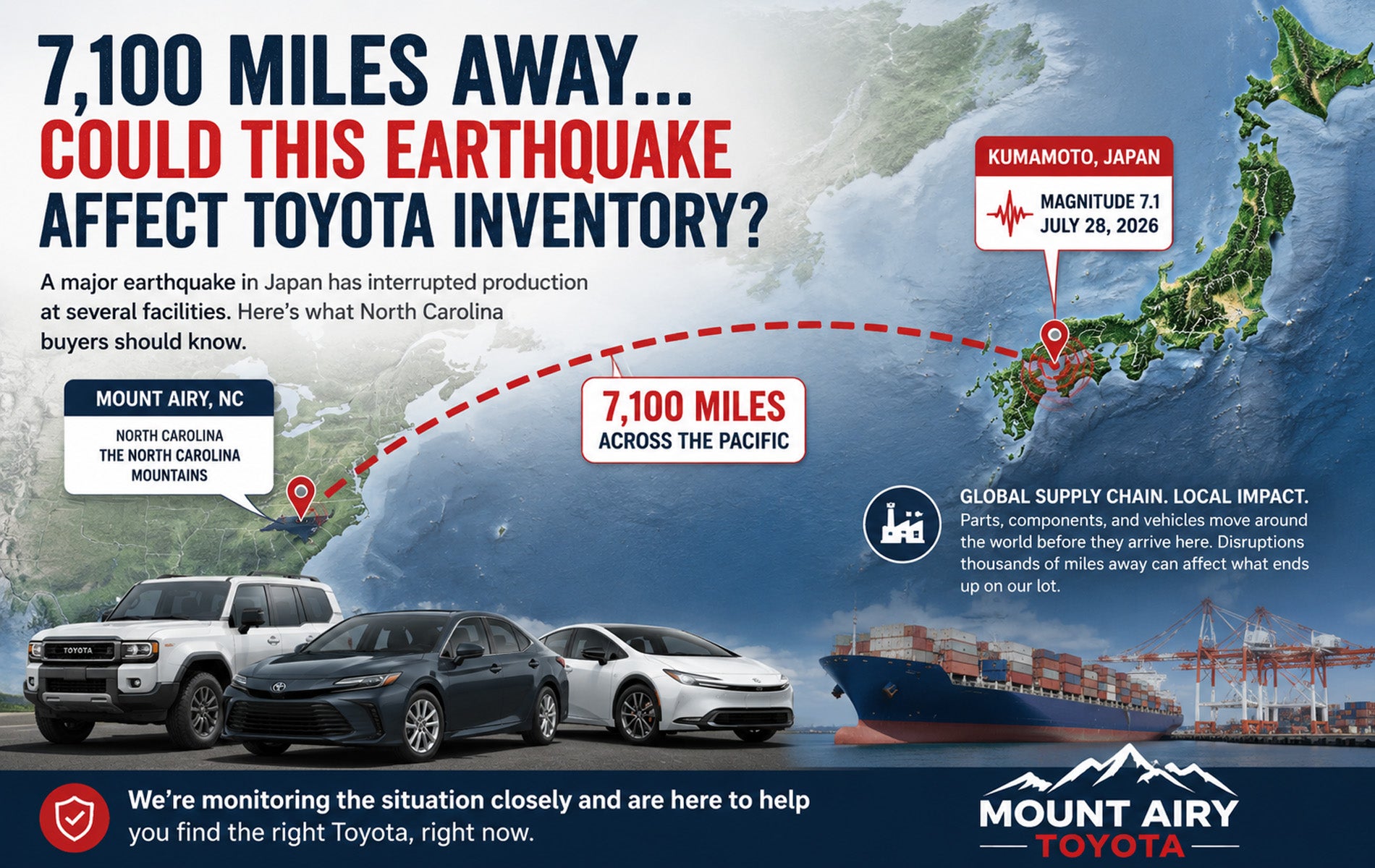
How could an earthquake more than 7,100 miles away from the North Carolina mountains impact your bottom line if you're car shopping? It's all about the supply chain. The truth is, no one has a crystal ball and knows for certain, but smart buyers are considering the possible impact. Toyota and several other Japanese manufacturers temporarily paused production at some facilities following the recent earthquake while engineers inspected plants, suppliers, and transportation infrastructure. That's a standard safety procedure after a significant seismic event and doesn't necessarily indicate long-term production problems. Still, the pandemic and the shortages it caused in our supply chain are still fresh enough in our memories to cause caution. It's a reminder that today's automotive supply chain stretches around the globe, and events thousands of miles away can eventually influence what shows up on dealership lots here in North Carolina. Which Toyota Models Could Be Affected? Industry analysts have identified a few models that could experience tighter inventory if production disruptions continue for an extended period. These include: Toyota Land Cruiser Toyota Prius Toyota Corolla It's important to emphasize that no widespread shortages have been announced. At this point, manufacturers are still evaluating facilities, suppliers, and logistics before determining whether production schedules will be affected over the coming weeks. We've Seen This Before This isn't the first time the automotive industry has faced unexpected challenges. Over the past fifteen years, manufacturers have dealt with: The 2011 earthquake and tsunami in Japan Global semiconductor shortages during the COVID-19 pandemic Shipping delays and port congestion Severe weather events affecting manufacturing plants Labor disruptions and transportation bottlenecks Each event affected inventory differently. Some caused only minor delays, while others created shortages that lasted months. The lesson is simple: the automotive industry has become very good at adapting, but unexpected events can still influence availability. Should You Buy Now? There's no reason to panic or rush into a purchase simply because of one news story. However, if you've already decided to purchase a specific Toyota—especially a particular trim level, color, or package—it may be worth beginning your search sooner rather than later. Limited-production models often have less flexibility than high-volume vehicles, and if inventories tighten, buyers may have fewer choices. If production returns to normal quickly, nothing changes. If disruptions last longer than expected, shoppers who waited may discover longer delivery times or fewer vehicles matching exactly what they wanted. What Mount Airy Toyota Is Watching Like dealerships across the country, Mount Airy Toyota closely monitors manufacturer updates and inventory availability. As information becomes available from Toyota, we'll continue helping customers find the right vehicle, whether it's already on our lot, arriving soon, or available through Toyota's dealer network. If you're considering a new Toyota and have questions about availability, our team is happy to discuss current inventory, incoming models, and your options. What's in Stock Now If you're interested in buying a Toyota right now, Mount Airy Toyota has 41 new vehicles in stock on our lot today. A Snapshot of Today’s New Car IN STOCK Inventory  at Mount Airy Toyota 1 Toyota 4Runner Limited – White 1 Toyota bZ XLE Plus – Black 1 Toyota bZ Woodland Premium – White 4 Toyota Camry XSE – Black SE – Black (2) SE – Gray 1 Toyota Corolla Hybrid LE – Gray 1 Toyota Crown Platinum – White 1 Toyota Grand Highlander Platinum – White 1 Toyota Highlander Hybrid Limited – Black 2 Toyota Prius Plug-In Hybrid XSE – Gray XSE Premium – White 2 Toyota RAV4 Plug-In Hybrid SE – White XSE – Black 3 Toyota Sequoia Platinum – Gray Capstone – Gray TRD Pro – White 1 Toyota Sienna XLE – Gray 11 Toyota Tacoma TRD Sport – Black (3) TRD Sport – White TRD Pro Hybrid – Black TRD Pro Hybrid – White Trailhunter Hybrid – Black TRD Off Road Hybrid – Blue TRD Off Road – Black TRD Off Road – Silver SR5 – Silver 11 Toyota Tundra Limited – Black (3) Limited – Gray (2) SR5 – Red (2) SR5 – Gray 1794 Edition Hybrid – Black TRD Pro Hybrid – White Capstone Hybrid – Gray We have an additional 36 vehicles that are in transit or in production. If you have any inclination to buy one of our vehicles listed as In Transit or In Production, reserve your preferred model as soon as possible. Whether you're shopping for a dependable Corolla, an efficient Prius, a capable Land Cruiser, or another Toyota model, Mount Airy Toyota is here to help you find the vehicle that best fits your needs.  Call for assistance in finding your dream car!  336-786-2118

Are hybrid batteries safe?

Thinking About Buying an Older Gas Camry to Avoid the Hybrid Battery? Read This First.

"Should You Buy a New Camry Hybrid or an Older Gas Camry? The Facts May Surprise You." For many Toyota shoppers, this is one of the biggest decisions they'll make. The good news is that today's Toyota hybrid technology has been on the road for more than two decades and has earned one of the strongest reliability records in the automotive industry. Still, that doesn't automatically make a new Camry Hybrid the right choice for every driver. For many shoppers, the decision isn't really about fuel economy. It's about the battery. Questions like these come up every day: How long does the hybrid battery last? What if it fails after the warranty expires? Will I be able to find someone to repair it? Are hybrid batteries safe? Should I avoid a hybrid altogether and buy an older gas-powered Camry instead? They're fair questions. The good news is that many of the stories you've heard probably refer to fully electric vehicles (EVs) rather than Toyota's proven hybrid technology. Before comparing ownership costs, let's clear up one of the biggest misconceptions. Hybrid vs. Electric Vehicle: They're Not the Same Thing Many people use the words hybrid and electric vehicle interchangeably.  They shouldn't.  Although both use batteries, they work very differently. A battery-electric vehicle (EV) relies entirely on a large battery pack that must be plugged into a charger. When the battery is depleted, you recharge before driving again. A Toyota Camry Hybrid never needs to be plugged in. Instead, it combines a gasoline engine with a much smaller high-voltage battery and electric motor. The battery automatically recharges while you drive using the gasoline engine and regenerative braking system. From the driver's seat, ownership feels exactly like a traditional gasoline vehicle.  You simply stop at a gas station, fill the tank, and drive away.Because of this, many concerns commonly associated with electric vehicles simply don't apply to the Camry Hybrid. For example: Concern EV Camry Hybrid Plug-in charging required ✔ ✘ Range anxiety ✔ ✘ Public charging stations ✔ ✘ Gasoline engine backup ✘ ✔ Regenerative braking ✔ ✔ Once shoppers understand this difference, many begin looking at hybrids very differently. Which Camry Costs Less to Drive? Let's compare a realistic ownership scenario. Assume a typical Mount Airy commuter drives: 15 miles each weekday (approximately 3,900 commuting miles annually) Plus shopping Weekend travel Family activities Vacations Total annual driving: 12,000 miles Using the average North Carolina gasoline price over the past several months (approximately $3.53 per gallon) and EPA combined fuel economy estimates: New Toyota Camry Hybrid vs 2022 Toyota Camry Gas Annual Miles 12,000 12,000 Combined MPG 51 MPG 32 MPG Fuel Used 235 gallons 375 gallons Annual Fuel Cost $830 $1,324 Estimated Annual Fuel Savings:  ~ $494 each year Five-year Savings:  $2,470 Unlike some hybrid comparisons where savings are relatively modest, the Camry Hybrid delivers meaningful fuel savings because of its excellent fuel economy. Fuel savings alone probably won't pay for the vehicle, but they're certainly enough to become part of the buying decision. Myth or Fact? "The Hybrid Battery Won't Last." The Concern Many shoppers picture the battery wearing out after 75,000 or 100,000 miles. The Facts Toyota has been building hybrid vehicles for more than 25 years.  Many original Prius and Camry Hybrid batteries remain on the road well beyond 200,000 miles, and some exceed 300,000 miles. Toyota carefully manages battery charging levels to reduce wear and maximize longevity.  Unlike your smartphone, the battery isn't constantly charged to 100% and completely discharged. Instead, it operates within a carefully controlled range designed to extend its useful life. Bottom Line - Mostly Myth Battery failures can occur, but they are far less common than many shoppers expect. "Replacing the Battery Will Cost a Fortune." The Concern This is probably the number one reason buyers avoid hybrids. The Facts Yes.  A hybrid battery replacement outside warranty can be expensive.  Depending on the model and repair option selected, replacement costs can range from a few thousand dollars to several thousand dollars. However...   Many owners never replace the battery while they own the vehicle.  In addition, today's buyers have more choices than they did fifteen years ago. Options now include: New Toyota batteries Factory remanufactured batteries Professionally rebuilt battery packs Independent hybrid repair specialists Bottom Line Partly Fact Replacement is expensive.  Replacement is also much less common than most shoppers believe. "Hybrid Vehicles Are Dangerous." The Concern News stories involving lithium batteries sometimes make shoppers nervous. The Facts Toyota hybrid systems include multiple safety features, including automatic high-voltage disconnects during many collision events and extensive crash testing.  It's also important to remember that a Camry Hybrid's battery pack is much smaller than the battery found in a fully electric vehicle.  Hybrid battery fires receive significant media attention because they're unusual—not because they're common. Bottom Line Mostly Myth Toyota hybrids have earned an excellent safety record. "North Carolina Summers Will Ruin the Battery." The Concern Heat damages batteries.  North Carolina gets hot.  Does that shorten battery life? The Facts Extreme temperatures can temporarily reduce battery efficiency.  However, Toyota designed its hybrid battery system with thermal management strategies intended to help protect long-term durability.  Like any vehicle, routine maintenance and keeping cooling systems functioning properly contribute to long battery life. Bottom Line Mostly Myth Hot weather may affect efficiency slightly on extremely hot days, but it typically does not significantly shorten battery life by itself. "Nobody Around Here Can Repair a Hybrid." Twenty years ago, this concern carried more weight.  Today, it's much less of an issue.  Toyota dealerships like Mount Airy Toyota service hybrid vehicles every day.  In addition, many independent repair facilities employ ASE-certified technicians trained to diagnose and repair hybrid systems.  Replacement parts are more widely available than ever before. For most owners, finding qualified service is no longer difficult. Bottom Line Myth "The Gas Camry Costs Less to Maintain." Many buyers assume hybrids are more expensive to maintain. In reality, both vehicles require: Oil changes Tire rotations Cabin air filters Coolant service Inspections However, the hybrid also benefits from regenerative braking, which often reduces brake wear.  Because the electric motor assists during acceleration, some drivetrain components experience less stress during everyday driving.  Routine maintenance costs are often surprisingly similar between the two vehicles. Bottom Line Mostly Myth "Hybrid Batteries Are Bad for the Environment." This is a more complicated discussion.  Hybrid batteries require materials such as lithium and nickel, and questions about mining and ethical sourcing are valid. At the same time, hybrids consume substantially less gasoline over their lifetime, produce fewer tailpipe emissions, and Toyota has invested heavily in battery recycling and responsible end-of-life management. Like nearly every modern technology, there are environmental trade-offs.  The question isn't whether hybrid batteries have an environmental impact—they do.  The better question is whether the lifetime reduction in fuel consumption and emissions outweighs those impacts.  Reasonable people can disagree, but it's important to understand the complete picture rather than focusing on only one side of the equation. Which Camry Is Right for You? Choose the used gas-powered Camry if: You want the lowest purchase price. You drive relatively few miles each year. You're comfortable buying a vehicle that's several years old. You prefer traditional automotive technology. Choose the new Camry Hybrid if: You commute regularly. You plan to keep the vehicle for many years. You want outstanding fuel economy. You value the latest Toyota Safety Sense technology. You appreciate lower operating costs over time. You want the peace of mind of a full factory warranty. The Bottom Line If you're considering an older gas-powered Camry simply because you're worried about hybrid batteries, today's Toyota hybrid technology deserves a closer look. Many of the concerns shoppers have—battery longevity, maintenance costs, safety, and repairability—were more understandable twenty years ago than they are today. Toyota has spent decades refining its hybrid system, and millions of owners have demonstrated that these vehicles can deliver outstanding reliability and low operating costs. That doesn't mean a new Camry Hybrid is automatically the right choice for everyone. An older gas-powered Camry remains one of the most dependable sedans on the road and may be the better fit for buyers focused on upfront affordability. The smartest decision isn't based on fear of a battery—it's based on understanding the facts, comparing the long-term costs, and choosing the Camry that best fits your driving habits, budget, and plans for the years ahead.