
Blog / Toyota History

How the 2021 Toyota Venza Limited Stacks Up Against the 2021 Volvo XC90
2021 Toyota Venza in Mounr Airy
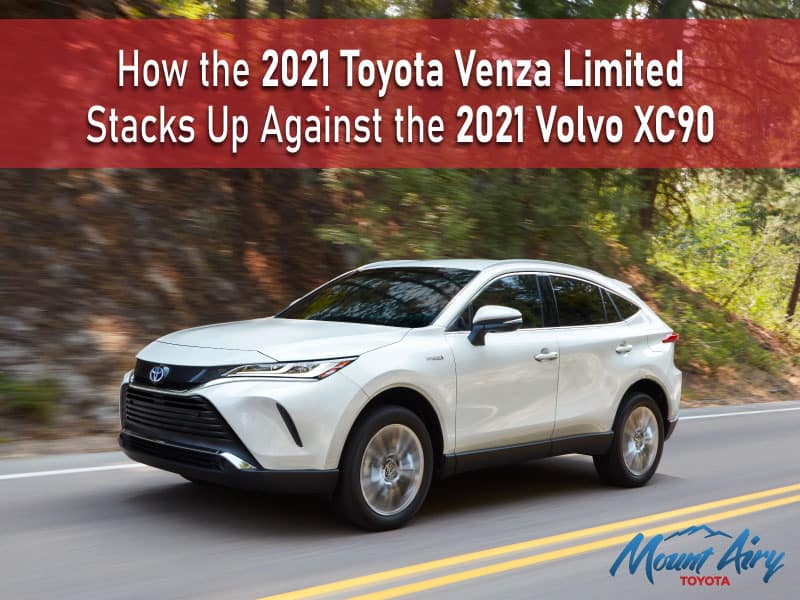
In 2015, Toyota discontinued the Venza. Now, it’s back and better than ever. Though the price doesn’t reflect it, the 2021 Venza Limited emits grandeur from the inside out. Toyota has coined the term “Elegance elevated” to sum up the reborn SUV, and we couldn’t agree more. In a segment that includes more than enough crossovers, the Venza shatters the competition in efficiency and reliability, and it holds its own in appearance, comfort, and technology.If you’re in the market for a midsize SUV, you’ll likely check out quite a few makes and models before making your decision. We’ve done some of the work for you. Below, we’ve compared the 2021 Toyota Venza Limited with the 2021 Volvo XC90—a vehicle considered to be one of the nicest luxury SUVs available. Let’s see how the Venza stacks up:   2021 Toyota Venza Limited The 2021 Venza Limited isn’t technically in the luxury segment, but someone forgot to tell Toyota that during the designing process. Here’s the skinny on this two-row beauty:   PerformanceAll Venza models are hybrids, which is something that can’t be said for any of the other automakers in the midsize SUV class. The powertrain consists of a 2.5-liter four-cylinder gas engine combined with three electric motors. Together, you get 219 horsepower. That may not sound like a lot of power, but the Venza gives you more oomph than expected, especially considering the impressive off-the-line acceleration from the electric motors. The engine setup is matched with a continuously variable automatic transmission, and all-wheel-drive is standard. All and all, the Venza provides a smooth and even ride that would rival any luxury SUV.   Fuel EconomyNo competitor comes close to the Venza when it comes to fuel efficiency. Rated at 40 mpg in the city, 37 mpg on the highway, and 39 mpg combined, the Venza even doubles many competitors.    Interior The interior of the Venza is something to behold, particularly the Limited grade. It will comfortably seat four adults, as it offers plenty of leg- and headroom in both rows. It technically seats five people, but there’s a drivetrain hump in the floor in front of the middle seat, which may compromise comfort for a six-footer. The cabin itself is exquisite. It’s clear that Toyota had no intentions of making the Venza Limited sporty; instead, it whispers luxury with its SofTex seats to go with soft-touch surfaces and woodlike trim on the center console. Brown piping runs along the doors and dash, which adds an upscale aesthetic.    TechnologyThe 2021 Venza Limited offers no shortage of the latest tech available to car buyers. Coming standard is a 12.3-inch touchscreen display to go with the Entune infotainment system and in-dash navigation. You will also get Apple CarPlay, Android Auto, and Amazon Alexa connectivity, Bluetooth, and SiriusXM satellite radio. The Venza Limited comes standard with Toyota’s Safety Sense 2.0, which is an industry-leading suite of safety technologies. A few of the many features include lane-departure warning with lane-keeping assist, automated braking with pedestrian detection, and adaptive cruise control.    2021 Volvo XC90 There’s no getting around the fact that the 2021 Volvo XC90 is a nice vehicle. Let’s discuss what it has to offer in terms of performance, fuel economy, interior, and technology:   PerformanceEvery XC90 model comes with a 2.0-liter turbo four-cylinder engine. The base Momentum pairs a 250-hp turbocharged engine with front-wheel-drive, while a 316-hp supercharged version with all-wheel-drive is available. An eight-speed automatic transmission comes with both engines.    Fuel EconomyThe 2021 XC90 achieves about the same fuel economy as most of its competitors. The turbo engine provides 21 mpg city and 30 mpg highway, while the supercharged version drops to 19 mpg city and 28 mpg highway.    InteriorThe interior is perhaps where the XC90 shines brightest. A clean, attractive design is matched with quality materials, and the three-row SUV provides seating for seven passengers unless you opt for captain’s chairs in the second row, which brings it to six passengers. A wide and boxy frame lends a considerable amount of cargo space.    TechnologyAll XC90 trims come standard with Volvo’s Sensus infotainment system and a nine-inch tablet like touchscreen that allows you to tap, pinch, and swipe for controls. Apple CarPlay and Android Auto capability is standard as well.Like Toyota, Volvo is known for prioritizing safety in the design of its vehicles. Not surprisingly, the XC90 provides many standard safety features, including forward-collision warning, lane-departure warning, and blind-spot monitoring.    The Bottom Line When it comes to value, this is no competition: The 2021 Venza Limited simply offers more for the money. Starting at $39,800, the Venza Limited looks and feels like it belongs in the luxury market, and drivers won’t be missing out on comfort, technology, or safety. Also, the Venza naturally comes with unparalleled efficiency and reliability. The XC90 is a respectable SUV with an attractive design, and it too offers plenty of safety features. If you need a larger SUV, the XC90 is a good choice, as long as you are willing to pay anywhere from $49,695 and $77,395 as a starting price. After a six-year absence, the Toyota Venza has returned. And Mount Airy Toyota is the place to come if you want to get your hands on one. Be sure to give us a call or come by our dealership to discuss details!
Posted in:

Related Posts

Toyota Supra 2019

The Super Supra - Race Classic Reimagined

The Supra is coming back. Everybody clap your hands. A Little History Toyota launched the Supra in 1978 and it had a good run until 2002. Its design was derived from Toyota’s Celica, but in 1986 the A70 Supra was launched and distinguished itself from the earlier Supra version. Toyota’s race car designs go all the way back to the 2000GT. We saw the first generation A40, from ‘78-’81, followed by the A60 second generation that ran until 1986. The A70 hit the roads from 1986-1993, and its final run, the A80 and its fourth generation, saw the streets from 1993-2002. That was the last we saw of the Supra—until now. The fifth generation is on its way, and it will be all we could hope for. The good news is, the new Supra will debut to the public in February 2019 in Daytona, where we will see what Toyota has landed on with its design, its capabilities, and its final look. We got a peek of the Supra at the Geneva Motor Show, but that was just that—a peek. NASCAR's Daytona race will show us what the Supra can really do. The racecar we will see at Daytona will translate into a driveable sports car for America in 2019. Let’s look at what’s coming. Supra Racing Unveiled at the Geneva Motor Show in March 2018, and in partnership with BMW, Toyota’s GR Supra Racing Concept racecar was modeled on the 2014 FT-1 concept. But what we can all drive (the 5th generation Supra, proper) will launch in its newest form in the Spring. The Supra still has as much mystery attached to it as what we do know. Details are going to be a surprise, but we can confirm that a four-cylinder will be available along with 6-cylinder, as one would expect for a sports car. And Toyota may offer a manual option on the Supra, in addition to automatic transmission. In Madrid, Road & Track along with the Australian Car Advice asked assistant chief engineer Masayuki Kai about a manual transmission model. Kai told them “It purely depends on the reaction of the market.” So for those stick-shift enthusiasts that really want to put that horsepower to good use, we can only hope that we get that manual transmission. Kai assured that “If, for example, U.S. customers are demanding strongly that Supra needs a manual-transmission car, then we will plan for it.” For those longing for the versatility and full control of a manual transmission, we can only hope that Toyota finds in the American market a solid demand for the stick. What’s Coming Next They’ve been teasing America with the possibility of a new Supra for a few years now, but we are going to see it, finally. And it’s going to be a sexy revision of what they had years ago. We will see a new model with sleek lines, a low-to-the-road ride, and 225 to 320 horsepower. It will have a tighter, smaller frame (length at 172.4 inches, 73 inches in width, and standing 50.8 inches high) with a low center of gravity. Lower, in fact, than most of the other sports cars on the market. As a matter of fact, its center of gravity is lower than the Lamborghini Aventador. The only thing out there lower that the upcoming Supra, for its CG, is the Porsche 911 GT3 RS. The Supra will weigh almost 3,300 pounds and have a 97.2 inch wheelbase. With a pronounced nose and a ducktail spoiler, the Supra will breeze through air resistance and make for a dynamic driving experience. It has a 50:50 weight distribution. All in the package of a stiff A90 chassis. It will have rear-wheel drive, a great bonus from the collaboration between BMW and Toyota. Since 2012, the two companies have worked together to work on things like rear-wheel drive in sports cars, lithium batteries, and revamped engines. And the Toyota Supra will come out blazing as a brilliant product of this collaboration. Those wheels will be driven by a turbocharged, 3.0 liter, inline-six engine. And the price? Around $40,000 for a smooth, zippy ride. They are taking the vintage Supra of the late 1990s and revamping it. To hype up our sneak peek, they camouflaged it in their test drive reveal. The 5th generation of the Supra, when first revealed at its test drive, looked to battleships of the First World War for its camouflage design inspiration. Dan Beckett, Head of Art at Toyota Europe, said: “During our research we looked at the dazzle camouflage applied to battle ships in the First World War. The effect of these bold, intersecting geometric patterns was not to hide the boat’s existence but disguise its shape and even the direction it was facing.” The trick that the camouflage played on the eyes hid from us all that the Supra’s shape and design will promise, but we will soon see it in its full glory. Beckett continues, “But we also drew inspiration from the Toyota Gazoo Racing livery, which uses large black-and-red trapezoidal shapes set on a white background. And the most recognizable visual cue in motorsport—the waving chequered flag.” The response on social media and among Supra fans has been to ask for a camouflage paint option, when the Supra becomes available in 2019 to the masses. And Supra enthusiasts, who have moaned the loss of the model in 2002, can only cheer at its return. The Supra, historically, has been a more affordable sportscar positioned in contrast to the more expensive Italian rivals. So, the Supra’s return fills in a gap missing in the car market—and its one that needs to be filled. And though it will debut to the public in 2019, it may not be available for purchase until 2020. Those few privileged enough to test drive the protoype in Madrid have issued glowing reports. Botchi Santos at motioncar.com reports, “The Supra felt divine on all these roads. A quick spring to 240 km/h was indeed jail-baiting, but to my defense, I was simply keeping up with the general speed of traffic on the highway.” Think of it: divine driving. Speed, ease of driving, a responsive wheel—all things we value in a sports car. Santos still owns as 1996 Supra—a targa-top, twin turbo 6-speed model 2JZ-GTE engine—so what he says next should make us all really take note: “Neither does it feel like my Supra, which is heavy and somewhat sluggish in comparison. It feels alert, responsive and playful, without being frisky, edgy and nervous. You know it has your back.” The fifth generation Supra will squeal past its predecessor with ease and speed. Santos wraps it up nicely when he offers: “If there’s one thing you should keep in mind when considering the MKV Supra, it’s that you shouldn’t think of it as a reboot. Instead, think of it as a reset.” Though they wrapped the Toyota Supra in camouflage when we first saw it, the reveal at Daytona in a few months is going to be worth the wait. At Mount Airy Toyota, we are ready.

The History of Toast in Mount Airy

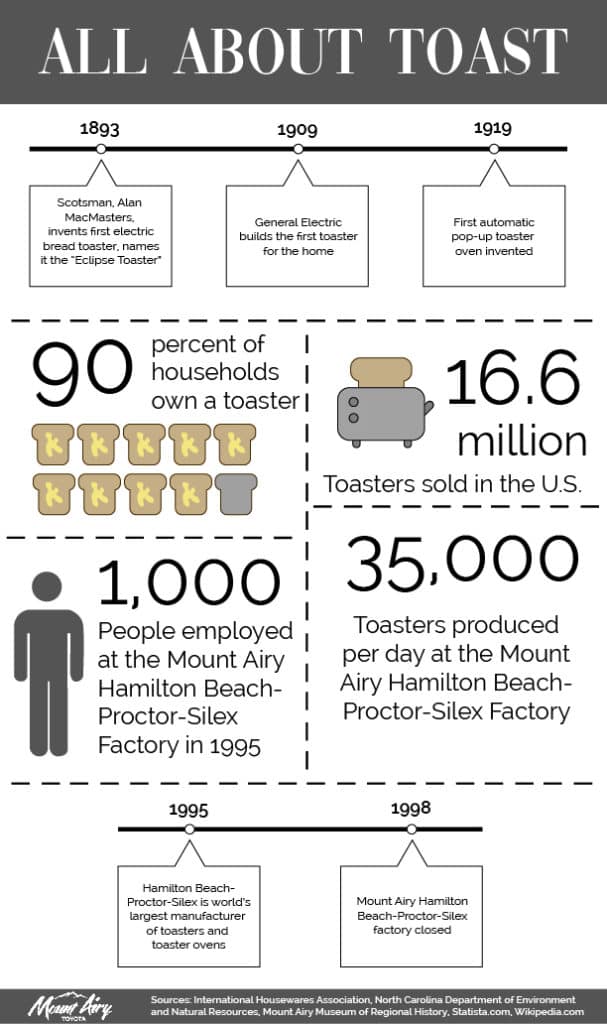
The next time you wake up in the morning, head into the kitchen, and pop a piece of bread in the toaster, you’re going to think of two things that might surprise you — Mount Airy and Toyotas. The small North Carolina town and the Japanese auto maker share an interesting connection when it comes to browned bread. As industrialism re-aligned the American food chain with sliced bread in every kitchen, Toyota exported its first automobile to the U.S. Twenty years later, Mount Airy — home to Mount Airy Toyota — became known as the Toaster Capital of the World. A Short History of Toast Toasters, first invented in Scotland in 1893, took quite a few years to catch on in domestic life. General Electric built the first toaster for the home in 1909, but toasters’ signature pop-up feature didn’t come along until 1909. What really turned up the heat on the toaster market was sliced bread. First sold in 1928 as “the greatest step forward in the baking industry since bread was wrapped,” the new-fangled, pre-sliced loaves gave way to the saying “greatest thing since sliced bread.” Wonder Bread took a big hunk out of the bread basket when the company started marketing pre-sliced bread nationwide in 1930. World War II marked a turning point for sliced bread. Officials banned sliced bread in 1943 as a wartime conservation measure. The ban coincided with a 10-percent increase in flour prices and a presumed shortage of wax paper, which was wrapped around sliced bread to keep it from drying out. Americans were distraught, and a letter that appeared in the New York Times drove the issue home: “I should like to let you know how important sliced bread is to the morale and saneness of a household. My husband and four children are all in a rush during and after breakfast. Without ready-sliced bread I must do the slicing for toast—two pieces for each one—that's ten. For their lunches I must cut by hand at least twenty slices, for two sandwiches apiece. Afterward I make my own toast. Twenty-two slices of bread to be cut in a hurry!” After the war, as rationing had passed and pre-made, pre-packaged foods were a sign of prosperity, bread boomed. “Most consumers happily ate six slices of industrial white bread a day during the 1950s,” according to a Salon article from 2012. Compare that to today’s gluten-free menus and burgers wrapped in lettuce! Six slices of bread a day gave way to a demand for mighty little toasters designed for each and every home, so in the late 1950s, the Proctor Electric Company served up a thoroughly modern plant built specifically to produce electric automatic toasters in a tiny town called Mount Airy. During the initial excavation phase of the plant, a large Native American burial ground was found on the site, according to the Mount Airy Museum of Regional History. Newspaper accounts of the day report that archeologists believed the graves to be between 300-600 years old. Sadly, there was no oversight to protect these grounds and an open invite to “hunt relics” was even issued to the community at large. Mount Airy’s toasters shipped out across the nation. Just two years after the plant opened, it produced its 1,000,000 toaster. Close to 50 models were manufactured at the site and sold under the brand names of Sears, Montgomery Ward and Universal. In 1960, Proctor Electric Company merged with the Silex Corporation, and later with Hamilton Beach. A case study issued by the North Carolina Department of Environment and Natural Resources in 1995 reported that Hamilton Beach-Proctor-Silex was the world’s largest manufacturer of toasters and toaster ovens. The company’s Mount Airy facility employed 1,000 people and produced 35,000 toasters per day. By 1998 the plant was closed. Not that toasters have fallen out of style. From early models with two slots, to four-slotted models with a variety of settings, to novelty toasters that brand an image of Hello Kitty or Darth Vader, toasters continue to be a kitchen staple. Whether for breakfast pastries or waffles, bagels or strudels, wheat bread or white, the toaster is a reliable friend. Toyota’s Toaster Connection Just as Wonder Bread began selling sliced bread in the 1930s, Toyota started producing cars. A division of the Toyoda Automatic Loom Works was devoted to manufacturing automobiles in 1993. Toyota Motor Co. was established as an independent and separate company in 1937. The changed economic and industrial landscape of the 1950s brought about the toaster craze and the first Toyota to be sold in the United States. There’s a saying in the automotive business — that certain cars look like “a toaster on wheels.” Toyota’s now defunct sister brand, Scion, was one of the champion makers of toaster cars with its Scion xB, introduced in 2004. “The original xB is perhaps the most gleefully rational car design to come out in the past decade, and somehow that basic, unassuming design manages to be fun as well,” wrote Jason Torchinsky in Jalopnik. In 2007 the second generation xB, rounded out the five-door hatchback’s boxy corners. Improvements earned the xB a Top Safety Pick from the Insurance Institute for Highway Safety for six years in a row. With a host of customizable looks and out-of-the-box boxy design, the xB appealed to a younger car buying market. Kia — a company with abysmal ratings in the mid-2000s — saw an opportunity. The Soul rolled out in 2009 complete with dancing hamsters who earned Nielsen’s most effective automotive ad award two years in a row. The term “toaster car” even has been attributed to Kia Motor’s chief designer’s 12-year-old daughter. The xB was discontinued in 2015 and, along with the Toyota Matrix, was replaced by the Scion iM. However, the Scion brand as a whole was scrapped and the iM turned into the Toyota Corolla iM for 2017. Toyota has plans to develop a new box on wheels. These “e-Palettes” are described as “fully-automated, next generation battery electric vehicle designed to be scalable and customizable for a range of Mobility as a Service businesses.” Or in other words, cute cargo containers. The e-Palettes conception includes partnerships with Amazon, Pizza Hut, and Uber. Might a roving, autonomous box deliver breakfast with a side of toast? We’ll see, as Toyota hopes to release the vehicles in time for the 2020 Olympics in Tokyo. Mount Airy and Toyota Today Though our town may no longer be the Toaster Capital of the World, we have other interesting claims to fame. Our address of 508 North Andy Griffith Parkway, Mount Airy, NC heralds the birthplace of Andy Griffith and his friendly town of Mayberry. Our dealership, Mount Airy Toyota, is Surry County’s flagship dealer with an award-winning sales team. In fact, you Mayberry well find our selection and service is even better than sliced bread.

Camden, NJ Drive-In Movie Theater Advertising

Headed to the Drive-In: How the Movies and Motoring Got Together

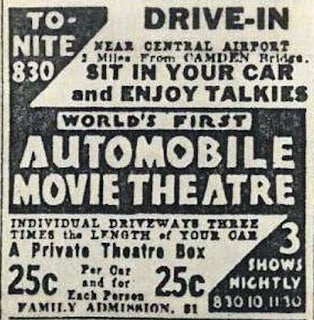
It was June 6, 1933 when the nation’s first drive-in movie theater opened. Originally called “park-in” theaters, the notion of moving going in an automobile came from Richard Hollingshead, a movie fan and a sales manager at his father’s company, Whiz Auto Products, in Camden, N.J. It was the worst year of the Great Depression and yet it was the first year for the Mount Airy Toyota car brand. According to the History Channel, Hollingshead's mother struggled to sit comfortably in traditional movie theater seats. He dreamed up the drive-in theater as a solution and tinkered with the concept in his home driveway, before earning a patent in May 1933 and opening Park-In Theaters, Inc. with an initial investment of $30,000. (As a sidenote: Toyota didn't release its first car until 1936.) Going to the movies was something at least relatively affordable for young folks and families. “Advertising it as entertainment for the whole family, Hollingshead charged 25 cents per car and 25 cents per person, with no group paying more than one dollar,” the History Channel writes on its blog. With the price of inflation, that single dollar amounts to about $18 today. Drive-in movie theaters may be responsible for helping drive the ability to listen to music in your car today. RCA developed the first in-car speaker in 1941. By 1949, Hollingshead’s patent was overturned, and drive-in theaters gained enormous popularity all over the country. “The popularity of the drive-in spiked after World War II and reached its heyday in the late 1950s to mid-60s, with some 5,000 theaters across the country,” writes the History Channel. “Drive-ins became an icon of American culture, and a typical weekend destination not just for parents and children but also for teenage couples seeking some privacy.” Two of the smallest drive-ins in the 1950s were Highway Drive-In in Bamberg, S.C., which had room for 50 cars, and Twilight Drive-In in Nakina, N.C., which had room for 60 cars. In comparison, theaters in Michigan and Texas held 3,000. Mount Airy once even had its own drive-in, the Bright Leaf, that opened in 1955 and held 300 cars. Today there aren’t many drive-in theaters left, but just about an hour away, in Eden, N.C. is one of the remaining few. The Eden Drive-In has been open since 1949. There’s parking for 200 cars, and visitors still pick up the movie’s audio on their FM radios. A little more than an hour in the opposite direction and across the Virginia border is Park Place Drive-In, which also features a miniature golf course and ice cream shop. We think that a trip to the drive-in is a great way to get the family together whether it’s in a 2018 Sienna or 4Runner, or perhaps just a trip for two in an all new, 86 or Tacoma. Can’t make it to the drive-in but still want a bit of cinema history? Mount Airy’s Earl Theatre was one of the premiere sites for Gone With the Wind in 1939 and Andy Griffith used to go to movies there as a child.