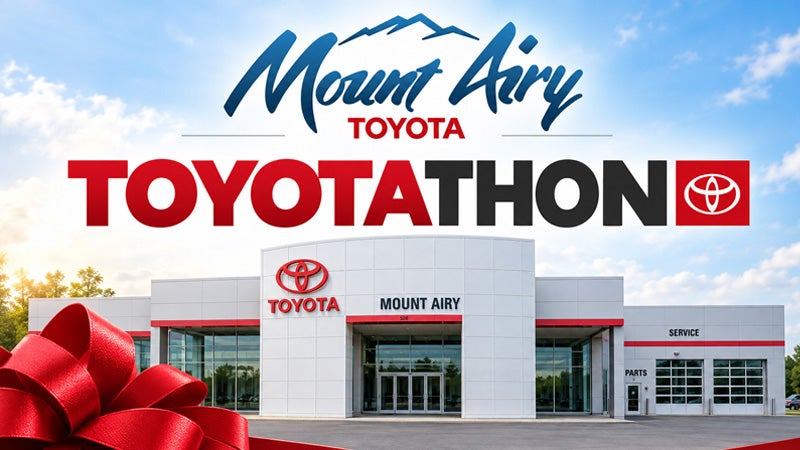
Mount Airy Toyotathon is Almost Here! Look for Big Savings in November! Why Toyota's Biggest Sales Event Is Different You have probably seen the commercials. The giant red bows appear. The holiday music starts. And suddenly, Toyotathon is back. But what exactly is Toyotathon? And is it really different from the countless holiday, year-end and clearance sales advertised by other automobile manufacturers? Actually, yes. Toyotathon is Toyota's annual year-end sales event, a tradition that dates back nearly 50 years. But to understand why Toyotathon is important, it helps to understand something else about Toyota: Toyota takes a very different approach to discounting its vehicles. That approach is also connected to something Toyota owners care about long after they drive away from the dealership: resale value. What Is Toyotathon? Toyotathon is Toyota's signature annual year-end sales event. During Toyotathon, Toyota traditionally makes special manufacturer-supported offers available on eligible vehicles. Depending on the year, model and market, those can include special financing rates, lease offers, customer incentives and other programs. Toyota itself has historically described Toyotathon offers as some of its best of the year. During its 2012 Toyotathon, for example, Toyota executives described the event as featuring some of the company's best offers of the year, including low interest rates and lease rates. That distinction is important. A dealership can call almost anything a "sale." Toyotathon is different because it is an actual Toyota manufacturer sales event, supported and promoted nationally by Toyota. And Toyota doesn't approach vehicle discounting quite like everyone else. Why Toyota Pricing Is Different Here's something many car shoppers don't know. Toyota closely controls the way its dealers advertise new Toyota vehicle pricing. Toyota uses Minimum Allowable Advertised Price guidelines, commonly called MAAP, as part of its dealer marketing program. In simple terms, Toyota establishes rules governing how low participating dealers can advertise new Toyota vehicles. Manufacturer incentives that are available to consumers can be reflected in those advertised prices. But a Toyota dealer generally can't simply decide to advertise a new Toyota thousands of dollars below the allowable advertised price just to undercut another Toyota dealer down the road. Why? One reason is to avoid the race to the bottom that can occur when dealerships compete primarily by advertising increasingly lower prices on the same new product. We've dealt with Toyota advertising compliance ourselves here at Mount Airy Toyota. If an advertised price falls outside Toyota's pricing guidelines, the dealership can receive a communication from Toyota's compliance team asking that it be corrected. In our experience, pricing discrepancies are often something simple, such as a database issue, incorrect incentive, feed problem or typo. They are generally easy to correct. Ignoring Toyota's advertising requirements, however, can eventually result in penalties under Toyota's dealer marketing program. But the important point for consumers isn't the technical compliance process. It's why Toyota cares about pricing in the first place. Why Would Toyota Want to Keep Prices Steady? Because the price of a new Toyota today can affect what that Toyota is worth tomorrow. Here's a simple example. Example: Suppose you buy a new vehicle for $40,000. Six months later, dealers are routinely advertising brand-new versions of the same vehicle for $34,000. Now imagine you're trying to trade your six-month-old vehicle. Your used vehicle can't be valued in a vacuum. It has to compete with what another shopper can pay for a brand-new one. If a brand-new version is readily available for $34,000, the market can't reasonably continue valuing your used vehicle as though the new one still costs $40,000. The discount on the new vehicle didn't just change the value of the one sitting on the dealer's lot. It potentially affected the value of every comparable used vehicle already on the road. Repeat that process year after year with large rebates and increasingly aggressive dealer discounts, and a manufacturer can gradually train the market to expect its vehicles to sell for considerably less than their sticker prices. That's the "race to the bottom" Toyota's pricing discipline is designed to help avoid. Instead of encouraging Toyota dealers to compete by continually advertising lower and lower prices on identical new vehicles, Toyota maintains standards around advertised pricing and takes a disciplined approach to manufacturer incentives. That helps establish greater consistency in new Toyota pricing. And consistent new-vehicle pricing can help protect used-vehicle values because Toyota isn't constantly resetting the market value of its own products downward. Does Toyota's Pricing Strategy Help Toyota Resale Value? There are many reasons Toyotas have historically maintained strong resale values. Reliability matters. Durability matters. Consumer demand matters. Product quality, inventory, reputation and the desirability of individual Toyota models all matter. But so does what Toyota doesn't do: continually discount the price of its new vehicles. And the connection between incentives and resale value isn't just our theory. It is something the automotive industry's residual-value experts specifically measure and discuss. J.D. Power's ALG division, one of the industry's leading authorities on residual values, has stated that manufacturer incentives can have a direct negative effect on the resale values of older models. That makes the relationship pretty straightforward. Large and repeated discounts can lower the effective market price of new vehicles. Lower new-vehicle prices put pressure on the value of comparable used vehicles. Avoiding excessive discounting can therefore help a manufacturer protect residual values. And Toyota's results are impressive. For 2026, J.D. Power named Toyota the top mass-market brand in its U.S. ALG Residual Value Awards. In explaining Toyota's performance, J.D. Power specifically pointed to Toyota's strong wholesale retention, brand value and its disciplined approach to incentives and rental fleets. That's an important connection. Toyota is disciplined about discounting new vehicles. Independent automotive experts identify disciplined incentives as a factor in Toyota's strong residual values. And Toyota owners ultimately benefit when their vehicles retain more of their value. Toyota also received more individual 2026 ALG model awards than any other manufacturer, with the Toyota GR Supra, GR86, Camry, Sequoia, Tundra and Tacoma each winning their respective categories. Kelley Blue Book tells a similar story. KBB named Toyota its 2026 Best Resale Value Brand, marking Toyota's sixth consecutive win and tenth overall win for the award. Toyota's projected average five-year resale value for 2026 is 53% of original MSRP. And five of the ten vehicles on KBB's 2026 Best Resale Value Top 10 are Toyotas: Toyota Tacoma: 63.0% Toyota Tundra: 59.9% Toyota 4Runner: 58.0% Toyota GR Supra: 56.0% Toyota Sienna: 54.3% The Toyota Tacoma actually holds the #1 position in the country on KBB's 2026 list. So Toyota's approach asks buyers to look beyond the size of today's advertised discount. A vehicle that is worth more when you're ready to trade it can ultimately be a better value than one that needed a huge discount to sell when it was new. The price you pay matters. The value you keep matters, too. And that's part of what makes Toyotathon different. So What Makes Toyotathon Different? Toyota's pricing philosophy is precisely what makes Toyotathon interesting. Throughout the year, Toyota maintains considerable discipline around advertised new-vehicle pricing and manufacturer incentives. Toyota dealers aren't simply encouraged to continually undercut one another with bigger and bigger advertised discounts. Then comes Toyotathon. During its signature year-end event, Toyota itself traditionally puts special promotional support behind eligible vehicles. In other words, the manufacturer that spends the year protecting pricing integrity is now the one creating the sales opportunity. That doesn't mean every Toyota suddenly has thousands of dollars knocked off the price. Depending on the vehicle and the year's Toyotathon program, the opportunity could take the form of special APR financing, lease offers, customer cash or another Toyota-supported incentive. Some models may have considerably stronger Toyotathon offers than others. But that's precisely why Toyotathon gets attention. When a manufacturer known for protecting vehicle values throughout the year decides it's time for its biggest sales event, Toyota shoppers have a reason to pay attention. Toyota's approach isn't simply about keeping today's new-vehicle price from falling. It's also about protecting the value of the Toyota product over time. If Toyota dealers continually competed by advertising identical vehicles for less and less, those lower new-car prices would eventually become part of the equation used to value used Toyotas. Toyota takes a different approach. It maintains disciplined advertised pricing. It controls the manufacturer incentives that can be incorporated into those advertised prices. And its vehicles consistently rank among the industry's leaders in retained value. Toyotathon History - Toyotathon Started as a 36-Hour Sales Experiment Toyotathon also has a much more interesting history than you might expect. The event dates to the 1970s. Toyota's own corporate history records a nationwide Toyotathon sales event in March 1977 that set a new-order record. The concept grew out of an extraordinarily successful regional promotion. Historical accounts describe an early Toyotathon as an intense 36-hour sales event, with participating dealerships staying open around the clock while customers were bombarded with television advertising. It worked. Approximately 3,000 vehicles were sold during the original 36-hour event, with hundreds more sold afterward. The idea spread. By the end of the 1970s, Toyotathon was evolving into the November and December year-end event Americans would eventually recognize from television. By 2011, Toyota was referring to its annual year-end Toyotathon as the 32nd edition. Toyota reported that year's event included low interest rates and special lease programs on most 2011 and 2012 models. In 2013, Toyota said its annual year-end Toyotathon would peak during the week between Christmas and New Year's and described the available financing and lease rates as providing some of its best deals of the year. What began as a frantic 36-hour experiment had become an American automotive holiday tradition. Why Is It Called "Toyotathon"? This may be our favorite part. The name Toyotathon combines Toyota with the suffix "-athon." We now attach "-athon" to all kinds of things, but the convention comes from the word marathon. Over time, "-athon" became shorthand for something unusually long, intensive or concentrated. Think: telethon. dance-a-thon. walk-a-thon. read-a-thon. hackathon. And, eventually, Toyotathon. Toyota certainly wasn't the last advertiser to have fun with it. Diet Pepsi MAX once created a "Yawn-a-Thon" as part of its "Wake Up, People!" advertising campaign, complete with a spoof telethon and celebrity wake-up calls. There have been Brand-a-thons in the advertising industry, where agencies participate in intensive branding competitions. "Snackathon" has even been registered as a trademark for an online snack retailer. And the "-athon" formula remains so recognizable that fundraising organizations routinely create Color-A-Thons, Run-a-Thons and similar events. Toyota, however, may have created one of advertising's most enduring branded versions of the idea. Nearly half a century later, people don't need anyone to explain that a Toyotathon involves selling Toyotas. Toyotathon Has Even Become Part of Pop Culture If you need evidence that Toyotathon has become bigger than an ordinary automotive promotion, consider what Toyota did recently. For Toyotathon 2025, Toyota and its advertising agency Saatchi & Saatchi teamed up with Sisqó to turn his famous "Thong Song" into "The 'Thon Song." Yes. Really. The campaign included a fully produced song and music video, streaming releases and a Christmas Day NFL debut on Netflix. The campaign went on to receive recognition at the 2026 Clio Awards. After nearly 50 years, Toyota wasn't simply advertising a sale anymore. It was poking fun at the fact that Americans already know what Toyotathon is. When Is Toyotathon 2026? Toyotathon traditionally begins around November and continues through the year-end holiday shopping season. As we get closer to Toyotathon 2026, we'll update our website with specific Toyota offers available at Mount Airy Toyota in Mount Airy, NC. Remember that Toyotathon offers can vary by model and may have specific eligibility requirements and expiration dates. Should You Wait for Toyotathon to Buy a Toyota? Not necessarily. If Mount Airy Toyota has the Toyota you want now, particularly if you're looking for a specific model, trim level, drivetrain, package or color combination, waiting for an incentive that may or may not apply to that vehicle doesn't always make sense. But if you're shopping for a new Toyota during the year-end period, Toyotathon is absolutely worth investigating. Ask us what Toyota is offering on the models you're considering. Ask whether the better opportunity is cash, financing or leasing. And don't evaluate a vehicle purchase based solely on the biggest advertised discount. Consider what you're buying, what you're paying and what that vehicle may still be worth several years from now. That's especially relevant with Toyota. When Toyota announces the offers for Toyotathon 2026, we'll let you know what's actually a great deal, which Toyota models qualify and what you need to know before you buy. Until then, stop by Mount Airy Toyota in Mount Airy, NC, and ask us about Toyotathon. After all, we've been doing this almost as long as Toyota has.