
Blog / Crossover

2022 Corolla Cross: The Newest Addition to Toyota’s Versatile Lineup
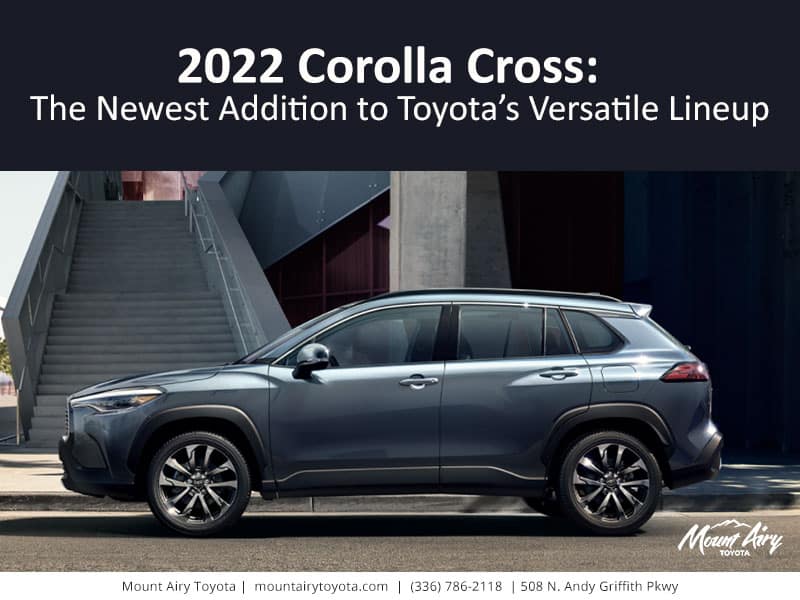
There’s no doubt about it: The American crossover segment is at war, and it has been for a while now. As the world’s leading automaker, Toyota has had some key players in this war, including the uber-successful compact RAV4 and subcompact C-HR. Seeing as how other automakers always seem to be playing catch-up, one would think that Toyota would be satisfied. It looks like they weren’t. Enter the 2022 Corolla Cross. This mini-SUV falls right between the RAV4 and C-HR in size, and it manages to strike a beautiful balance between novelty and familiarity—both of which are qualities eagerly sought after by consumers. As we’ve come to expect from all Toyota models, the Corolla Cross promises dependability, fuel efficiency, safety, and value. It looks bold yet approachable. And it just might be the most versatile vehicle ever produced by the automaker. Just in case you’re interested in learning more, we’ve provided some more details of the upcoming 2022 Toyota Corolla Cross: The Novelty Factor Toyota fans are no stranger to new model releases and drastic style upgrades to existing models. And the Cross seems to be about as natural an addition as there can be. Though it shares a platform (TNGA-C) and name with the Corolla, make no mistake—the Cross is not a variation of the Corolla sedan or hatchback. It is its own model through and through, and it offers drivers its own set of qualities and features. And it looks really good doing it too. Though it comes in only a slightly smaller size than its bigger brother, the RAV4, the Cross has a distinct appearance. Sure, it borrows certain design aspects from the RAV4 and Corolla, especially in the interior. But from the outside, it actually resembles the mid-size Highlander more than any other model. In short, the Cross comes in a unique package while still clearly belonging to the Toyota family. The Familiarity Factor While distinct, the 2022 Corolla Cross has an air of familiarity to it. This is first noticed when looking at the exterior. The front end will remind you of the RAV4 and Highlander; this is intentional by Toyota, given that both of those models are fierce competitors in their segments year after year. At the same time, the Cross cannot be mistaken for any other SUV, many thanks to the uniquely shaped LED headlamps and black plastic body cladding. There’s also a bold flare where the bumpers meet the wheel arches. Moreover, the taillights resemble those of the RAV4. But opposing arrows in the beltline produce a particularly wide and mature posture. The interior of the Corolla Cross feels wonderfully familiar as well. In essence, it borrows from the general interior of the Corolla sedan. This makes sense because the Corolla’s interior has often played a role in the sedan’s popularity (remember—it’s the best-selling passenger car of all time). Aside from the similarities in appearance, the interior of the Cross offers a similar infotainment setup, HVAC controls, storage compartments, and other features. Furthermore, the 2022 Corolla Cross provides a familiar powertrain, fuel economy, safety ratings, and many other characteristics that we will cover in more detail later. Competitors No question that the Toyota Corolla Cross’s segment is one of the most competitive in the market. Along with competing with its own sibling, the C-HR, the Cross faces strong rivalries with respectable subcompact SUVs in the Mazda CX-30, Honda HR-V, Hyundai Kona, Chevrolet Trailblazer, and Kia Seltos. It will also compete against the Nissan Kicks, Hyundai Venue, and Kia Soul, though it holds a distinct advantage over these models thanks to the all-wheel-drive option. Sounds just like the kind of tough competition Toyota relishes in, doesn’t it? Performance Performance is a key player in the overall success of Toyota models. And it doesn’t appear that the Corolla Cross will disappoint. Let’s talk about what we expect from the upcoming SUV in terms of powertrain, ride and handling, and fuel economy: Powertrain Every Corolla Cross model will come with a 2.0-liter inline-four engine that’s good for 169 horsepower and roughly 150 pound-feet of torque. Maximum towing capacity is expected at 1,500 pounds. This is the same engine that is optional on newer Corolla sedan models, and it’s paired with a continuously variable automatic transmission (CVT). One thing that sets the Corolla Cross apart here is that there’s a physical first gear, which enhances off-the-line performance. You can get the Cross in either front- or all-wheel drive. AWD models can send 50% of the engine’s torque to the rear wheels for optimized traction. When this grip isn’t needed, the back wheels remain disengaged, which boosts fuel efficiency. Ride and Handling The 2022 Corolla Cross boasts a MacPherson strut independent front suspension and four-wheel disc brakes. With front-wheel drive, you get a torsion-beam rear suspension that includes a stabilizer bar. AWD models provide an independent multi-link rear suspension. The wheel options range from 17-inch steel to 18-inch alloy, depending on the grade. Expect a smooth ride and responsive handling from the upcoming SUV. Fuel Economy The front-wheel-drive Corolla Cross is in line with the segment’s top competitors at 33 mpg on the highway, and it nudges out most other subcompact SUVs at 31 mpg in the city (32 mpg combined). You can expect a slight drop in efficiency when opting for AWD, which will produce 32 mpg city and 29 mpg highway (30 mpg combined). Interior As previously mentioned, the interior of the all-new Toyota Corolla Cross closely resembles that of the Corolla sedan, and it has plenty to offer in terms of features and cargo space. Design Do you like the interior design of the Corolla sedan? You know—that signature overall look that marries simplicity, practicality, and modernity? Well, you’re going to like the interior of the Corolla Cross because all of those qualities are present. In fact, much of the cabin has been lifted straight out of the Corolla sedan. All Corolla Cross models will seat up to five passengers. The L and LE models provide fabric upholstery, while the top-grade XLE comes with Toyota Softex synthetic leather seats. The two higher grades offer a leather-trimmed gear shifter and steering wheel. Features The Cross comes with either a 4.2-inch or seven-inch customizable display that sits in the analog instrument panel, depending on the grade. Power door locks, power windows, and heated side mirrors are standard on all models, while remote keyless entry, push-button start, and wireless charging come standard on the LE and XLE. Lower Corolla Cross grades provide either single-zone automatic climate control or a manual system. The XLE comes with dual-zone automatic climate control to go with a 10-way power-adjustable driver’s seat, heated front seats, and a rearview mirror that automatically dims. The steering wheel houses controls for the instrument panel, audio system, and advanced driver assistance features. Cargo Space The 2022 Corolla Cross shines when it comes to cargo carrying. It provides a sizeable hatch and a surprisingly accommodating cargo area; a power-opening hatch is also available. If you need even more space, you can easily fold down the 60/40 split seats. In front-wheel-drive versions, you get 25.5 cubic feet of space behind the second row, while AWD models offer 24.3 cubes (the different rear suspensions are what make the difference). Either configuration puts the Cross near the top of its class for cargo room, being bested only by the Kia Seltos at 26.6 cubic feet. Exterior Though it shares similarities with the Corolla sedan, the Corolla Cross is unmistakably a crossover. It offers higher ground clearance, a higher beltline, and more of an upright stance than the sedan. And it also distinguishes itself from the RAV4 by replacing an overall truck appearance with a sleekness that resembles the Highlander or even the Venza. LED lighting comes standard on all headlights and taillights, and the LE and XLE grades offer LED daytime running lights above the headlight cluster. The base (L) sports 17-inch steel wheels, while the LE and XLE ride on 17- and 18-inch alloy wheels. The 2022 Corolla Cross uses the same TNGA-C platform as the Corolla sedan, Corolla hatchback, and C-HR. The Cross is 175.6 inches long, which is three inches longer than the C-HR, but it matches the C-HR with a 103.9-inch wheelbase. The Cross is clearly more suited for driving in all-weather and rough pavement situations than the C-HR, as it’s three inches taller, one inch wider, and 5.1 inches higher off the ground. While larger overall than the C-HR, the Corolla Cross is smaller in every dimension than the RAV4. Its wheelbase is roughly two inches shorter, and it’s a couple of inches shorter overall than its bigger sibling. Moreover, the RAV4 is about an inch wider. Safety The 2022 Toyota Corolla Cross has yet to be tested by the Insurance Institute for Highway Safety (IIHS) or National Highway Traffic Safety Administration (NHTSA). But almost all Toyota models perform well in crash tests for each of these organizations—year after year. So, it would only make sense to expect stellar safety ratings to come soon. Like most Toyota models, every Corolla Cross version comes with Toyota Safety Sense 2.0. This suite of advanced driver assistance and safety technologies includes adaptive cruise control, automatic emergency braking, lane-keep assist, automatic high-beam headlights, and more. LE and XLE grades get rear cross-traffic alert and blind-spot monitoring, while the XLE throws in rear parking assist and automatic rear braking. In other words, this subcompact SUV is as safe for the family as it is fun. Infotainment/Connectivity All 2022 Corolla Cross models include a seven-inch touchscreen multimedia display with Apple CarPlay, Android Auto, and Amazon Alexa capabilities. You can also opt for an eight-inch touchscreen. All models come with a convenient USB port in the front, while LE and XLE grades provide two USB ports as well as wireless charging. You’ll get a six-speaker audio system unless you opt for the nine-speaker JBL package. Either way, you’ll receive a three-month trial subscription to SiriusXM radio. Grades and Prices The 2022 Toyota Corolla Cross offers three grades: L, LE, and XLE. As with any lineup, the higher you go, the more features you will get (such as the 18-inch alloy wheels, additional safety technologies, and extra storage space in the XLE). However, no matter which grade you choose, you’ll get modern, high-quality features with your crossover. The automaker has yet to release official pricing for the Cross models, but we expect a budget-friendly starting MSRP of about $24,000. Conclusion Amid an overall decline of sedans and hatchbacks, the 2022 Toyota Corolla Cross couldn’t have come at a better time. Positioned right between the C-HR and RAV4, this subcompact SUV is modern yet familiar. It offers all-wheel drive across all grades, as well as a slew of standard safety technologies. It’s among the top of the class in fuel economy, and it comes with all the useful and attractive interior features you would expect from Toyota. If you’re in the market for a fun and versatile crossover, look no further. Contact us at Mount Airy Toyota to find out when you can arrange a test drive of the all-new Corolla Cross!

Posted in:

Related Posts

How do oil markets and tariffs affect car prices?

Why Waiting To Buy Could Cost You: Rising Fuel Prices, Tariffs, and Smarter Car Buying in 2026

At Mount Airy Toyota, our sales team works hard to find discounts, coupons, promotions, and rebates whenever possible. That said, there are outside factors that can affect pricing. When we see an opportunity for our customers to save money, we make it a priority to pass that along. Right now, the oil market is creating one of those rare moments that make this an especially good time to buy. If you’ve been thinking about purchasing a vehicle and wondering whether to wait, the current market is sending a clear signal: waiting could cost you more, both upfront and over time. What does the Oil Market and the Strait of Hormuz have to do with your next vehicle purchase, and why should you care? More than most people realize. When that shipping lane slows down, fuel prices go up quickly. What follows is less obvious but more important. Even if everything reopened today, the effects would not disappear. Higher fuel and transportation costs are already working their way through the system, and that process usually takes three to six months to fully show up in the price of parts, goods, and vehicles. By the time it reaches the showroom, those increases are already built in. That is how this kind of economy works. It moves slowly, but once it starts, it is difficult to reverse. No matter how you feel about the reasons behind it, the outcome is the same. Costs rise, and they tend to stay elevated longer than expected. Here is the part most people miss. There is a window before the broader market reacts, before inventory tightens, before pricing fully adjusts. That window is where the advantage is. Most buyers will not connect the dots until months from now, when prices are already higher and options are more limited. If you are paying attention, this is your chance to move ahead of that curve. Locking in the vehicle you want now, especially one that helps manage fuel costs over time, is not about urgency. It is about seeing what is coming before it becomes obvious to everyone else and making a decision while you still have the upper hand. The Hidden Cost: Tariffs Add to the Pressure Fuel is only part of the story. Economists and automotive suppliers estimate tariffs could add around $3,000 per vehicle on average. That increase does not show up as a single line item. It builds gradually through: Higher material costs More expensive components Increased transportation expenses By the time vehicles arrive on the lot, those costs are already reflected in pricing. Why This Matters in Mount Airy and Surrounding Areas In Mount Airy and across northwest North Carolina and nearby Virginia communities, driving is part of daily life. Whether it is commuting, running errands, or traveling between towns, fuel is a constant expense. When fuel prices rise, it does not just affect what you pay at the pump. It increases the total cost of owning and operating your vehicle month after month. That is why timing your purchase and choosing the right vehicle matters more than most people think. The Smart Move: Buy Before Prices Rise and Drive Something Efficient Buying now gives you an opportunity to: Avoid incoming price increases tied to tariffs and fuel costs Lock in current inventory pricing Take advantage of today’s incentives before they change But timing alone is not enough. What you choose to drive matters just as much. A fuel-efficient vehicle helps protect you from rising costs long after the purchase is made. Best Toyota Options for Fuel Savings Right Now For drivers in the Mount Airy area looking to stay ahead of both pricing and fuel costs, Toyota offers some of the strongest options available: Toyota Camry Hybrid – Comfortable, proven, and delivers excellent real-world MPG Toyota RAV4 Hybrid – One of the most practical and efficient SUVs on the road today Toyota Corolla – Affordable, reliable, and consistently fuel-efficient Toyota Corolla Cross Hybrid – A smart crossover choice with strong everyday savings These vehicles are not just good on gas. They help reduce your total cost of ownership over time. Market changes like rising fuel costs and tariffs do not hit all at once, but once they begin, they tend to stay in motion.  Mount Airy drivers may find that rising fuel costs and tariffs could mean higher car prices soon. Buying now and choosing fuel efficiency is a smart move. Waiting may feel like the safer move, but in this environment it can mean: Paying more for the same vehicle later Facing higher fuel costs month after month Having fewer options to choose from If you are in Mount Airy or the surrounding North Carolina and Virginia area, now is the time to take a closer look at what is available while today’s pricing is still in place.

In Stock Toyota Tacoma, Toyota Tundra

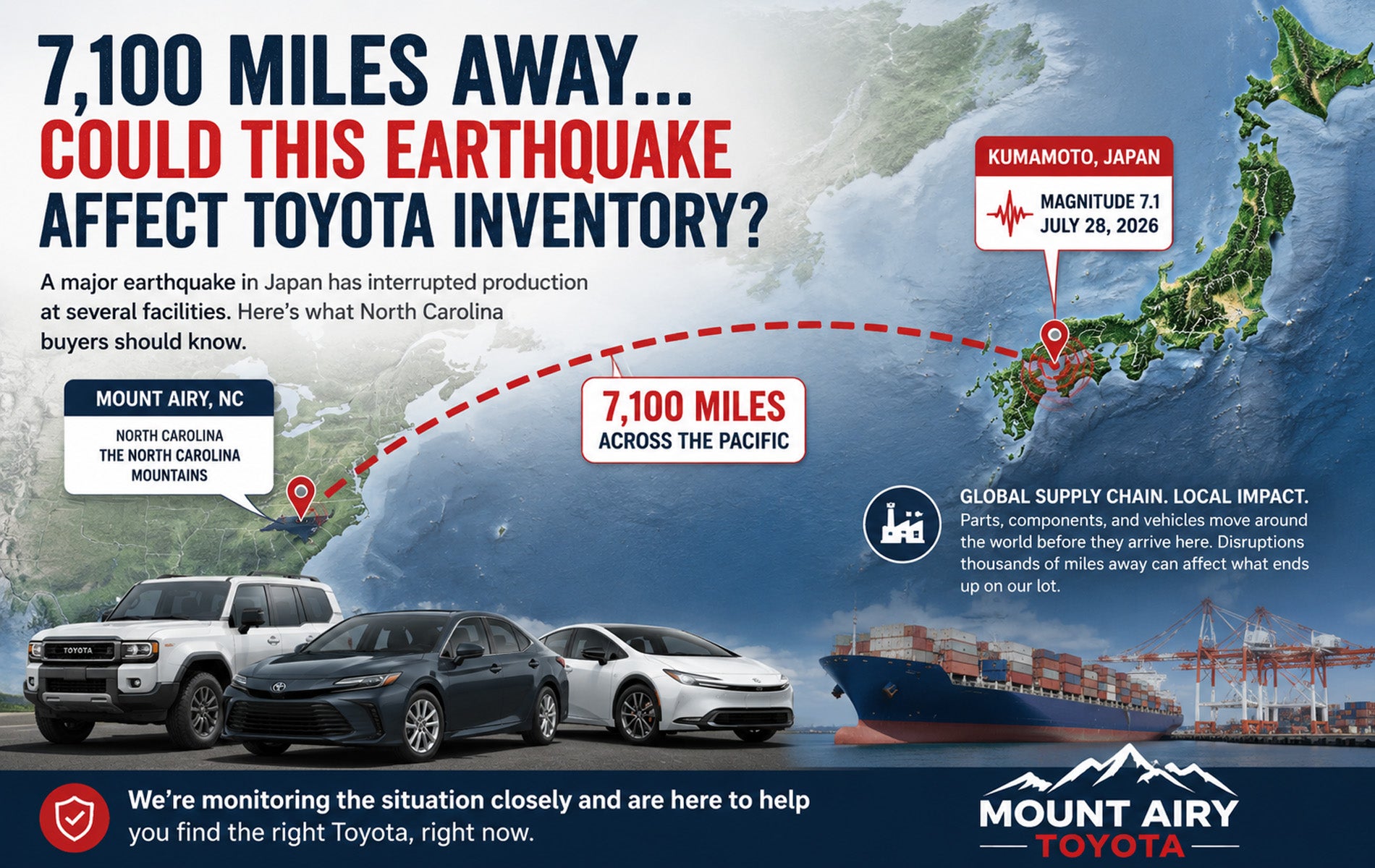
Could the Japan Earthquake Affect Toyota Buying in Mount Airy?

How could an earthquake more than 7,100 miles away from the North Carolina mountains impact your bottom line if you're car shopping? It's all about the supply chain. The truth is, no one has a crystal ball and knows for certain, but smart buyers are considering the possible impact. Toyota and several other Japanese manufacturers temporarily paused production at some facilities following the recent earthquake while engineers inspected plants, suppliers, and transportation infrastructure. That's a standard safety procedure after a significant seismic event and doesn't necessarily indicate long-term production problems. Still, the pandemic and the shortages it caused in our supply chain are still fresh enough in our memories to cause caution. It's a reminder that today's automotive supply chain stretches around the globe, and events thousands of miles away can eventually influence what shows up on dealership lots here in North Carolina. Which Toyota Models Could Be Affected? Industry analysts have identified a few models that could experience tighter inventory if production disruptions continue for an extended period. These include: Toyota Land Cruiser Toyota Prius Toyota Corolla It's important to emphasize that no widespread shortages have been announced. At this point, manufacturers are still evaluating facilities, suppliers, and logistics before determining whether production schedules will be affected over the coming weeks. We've Seen This Before This isn't the first time the automotive industry has faced unexpected challenges. Over the past fifteen years, manufacturers have dealt with: The 2011 earthquake and tsunami in Japan Global semiconductor shortages during the COVID-19 pandemic Shipping delays and port congestion Severe weather events affecting manufacturing plants Labor disruptions and transportation bottlenecks Each event affected inventory differently. Some caused only minor delays, while others created shortages that lasted months. The lesson is simple: the automotive industry has become very good at adapting, but unexpected events can still influence availability. Should You Buy Now? There's no reason to panic or rush into a purchase simply because of one news story. However, if you've already decided to purchase a specific Toyota—especially a particular trim level, color, or package—it may be worth beginning your search sooner rather than later. Limited-production models often have less flexibility than high-volume vehicles, and if inventories tighten, buyers may have fewer choices. If production returns to normal quickly, nothing changes. If disruptions last longer than expected, shoppers who waited may discover longer delivery times or fewer vehicles matching exactly what they wanted. What Mount Airy Toyota Is Watching Like dealerships across the country, Mount Airy Toyota closely monitors manufacturer updates and inventory availability. As information becomes available from Toyota, we'll continue helping customers find the right vehicle, whether it's already on our lot, arriving soon, or available through Toyota's dealer network. If you're considering a new Toyota and have questions about availability, our team is happy to discuss current inventory, incoming models, and your options. What's in Stock Now If you're interested in buying a Toyota right now, Mount Airy Toyota has 41 new vehicles in stock on our lot today. A Snapshot of Today’s New Car IN STOCK Inventory  at Mount Airy Toyota 1 Toyota 4Runner Limited – White 1 Toyota bZ XLE Plus – Black 1 Toyota bZ Woodland Premium – White 4 Toyota Camry XSE – Black SE – Black (2) SE – Gray 1 Toyota Corolla Hybrid LE – Gray 1 Toyota Crown Platinum – White 1 Toyota Grand Highlander Platinum – White 1 Toyota Highlander Hybrid Limited – Black 2 Toyota Prius Plug-In Hybrid XSE – Gray XSE Premium – White 2 Toyota RAV4 Plug-In Hybrid SE – White XSE – Black 3 Toyota Sequoia Platinum – Gray Capstone – Gray TRD Pro – White 1 Toyota Sienna XLE – Gray 11 Toyota Tacoma TRD Sport – Black (3) TRD Sport – White TRD Pro Hybrid – Black TRD Pro Hybrid – White Trailhunter Hybrid – Black TRD Off Road Hybrid – Blue TRD Off Road – Black TRD Off Road – Silver SR5 – Silver 11 Toyota Tundra Limited – Black (3) Limited – Gray (2) SR5 – Red (2) SR5 – Gray 1794 Edition Hybrid – Black TRD Pro Hybrid – White Capstone Hybrid – Gray We have an additional 36 vehicles that are in transit or in production. If you have any inclination to buy one of our vehicles listed as In Transit or In Production, reserve your preferred model as soon as possible. Whether you're shopping for a dependable Corolla, an efficient Prius, a capable Land Cruiser, or another Toyota model, Mount Airy Toyota is here to help you find the vehicle that best fits your needs.  Call for assistance in finding your dream car!  336-786-2118

Are hybrid batteries safe?

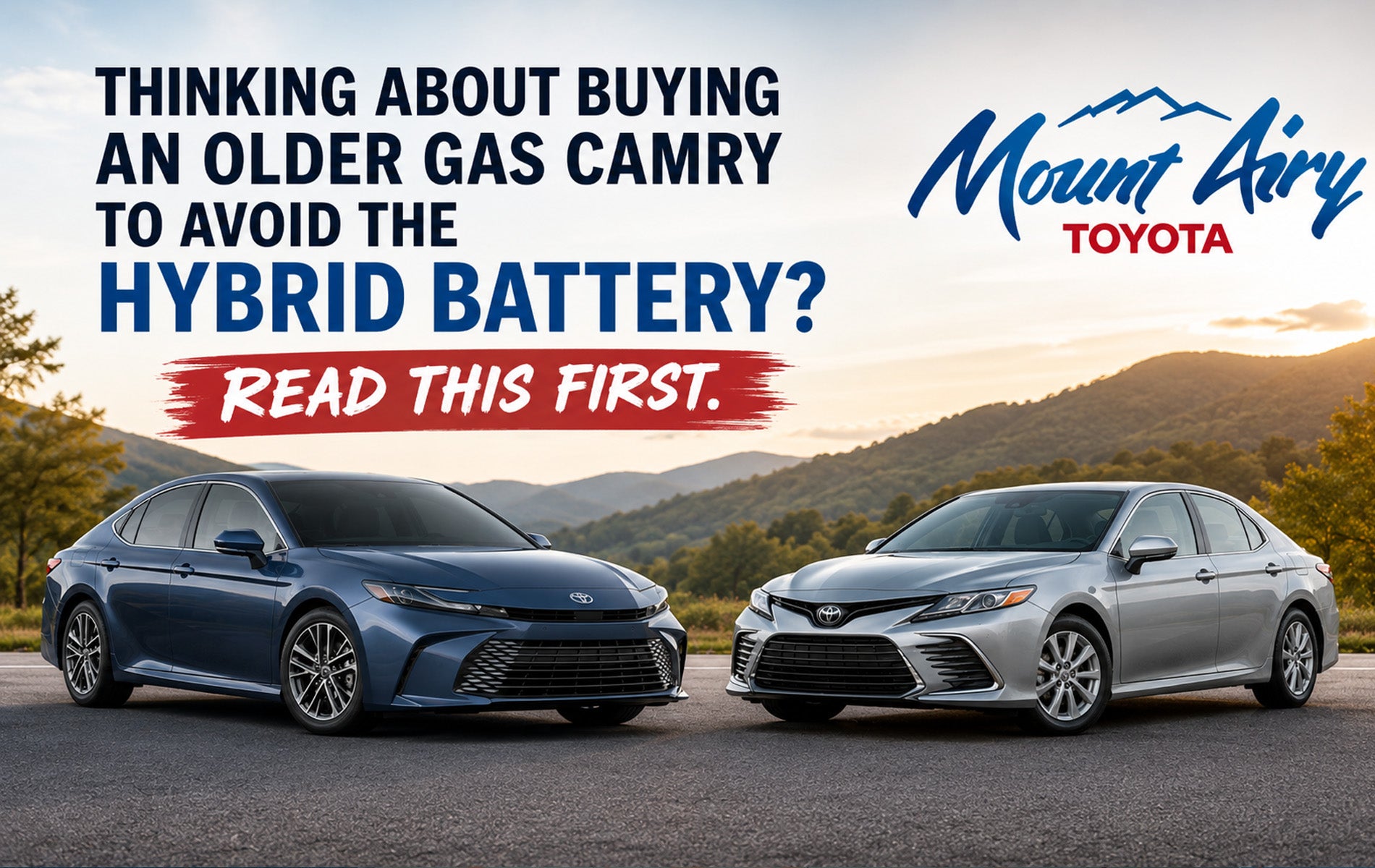
Thinking About Buying an Older Gas Camry to Avoid the Hybrid Battery? Read This First.

"Should You Buy a New Camry Hybrid or an Older Gas Camry? The Facts May Surprise You." For many Toyota shoppers, this is one of the biggest decisions they'll make. The good news is that today's Toyota hybrid technology has been on the road for more than two decades and has earned one of the strongest reliability records in the automotive industry. Still, that doesn't automatically make a new Camry Hybrid the right choice for every driver. For many shoppers, the decision isn't really about fuel economy. It's about the battery. Questions like these come up every day: How long does the hybrid battery last? What if it fails after the warranty expires? Will I be able to find someone to repair it? Are hybrid batteries safe? Should I avoid a hybrid altogether and buy an older gas-powered Camry instead? They're fair questions. The good news is that many of the stories you've heard probably refer to fully electric vehicles (EVs) rather than Toyota's proven hybrid technology. Before comparing ownership costs, let's clear up one of the biggest misconceptions. Hybrid vs. Electric Vehicle: They're Not the Same Thing Many people use the words hybrid and electric vehicle interchangeably.  They shouldn't.  Although both use batteries, they work very differently. A battery-electric vehicle (EV) relies entirely on a large battery pack that must be plugged into a charger. When the battery is depleted, you recharge before driving again. A Toyota Camry Hybrid never needs to be plugged in. Instead, it combines a gasoline engine with a much smaller high-voltage battery and electric motor. The battery automatically recharges while you drive using the gasoline engine and regenerative braking system. From the driver's seat, ownership feels exactly like a traditional gasoline vehicle.  You simply stop at a gas station, fill the tank, and drive away.Because of this, many concerns commonly associated with electric vehicles simply don't apply to the Camry Hybrid. For example: Concern EV Camry Hybrid Plug-in charging required ✔ ✘ Range anxiety ✔ ✘ Public charging stations ✔ ✘ Gasoline engine backup ✘ ✔ Regenerative braking ✔ ✔ Once shoppers understand this difference, many begin looking at hybrids very differently. Which Camry Costs Less to Drive? Let's compare a realistic ownership scenario. Assume a typical Mount Airy commuter drives: 15 miles each weekday (approximately 3,900 commuting miles annually) Plus shopping Weekend travel Family activities Vacations Total annual driving: 12,000 miles Using the average North Carolina gasoline price over the past several months (approximately $3.53 per gallon) and EPA combined fuel economy estimates: New Toyota Camry Hybrid vs 2022 Toyota Camry Gas Annual Miles 12,000 12,000 Combined MPG 51 MPG 32 MPG Fuel Used 235 gallons 375 gallons Annual Fuel Cost $830 $1,324 Estimated Annual Fuel Savings:  ~ $494 each year Five-year Savings:  $2,470 Unlike some hybrid comparisons where savings are relatively modest, the Camry Hybrid delivers meaningful fuel savings because of its excellent fuel economy. Fuel savings alone probably won't pay for the vehicle, but they're certainly enough to become part of the buying decision. Myth or Fact? "The Hybrid Battery Won't Last." The Concern Many shoppers picture the battery wearing out after 75,000 or 100,000 miles. The Facts Toyota has been building hybrid vehicles for more than 25 years.  Many original Prius and Camry Hybrid batteries remain on the road well beyond 200,000 miles, and some exceed 300,000 miles. Toyota carefully manages battery charging levels to reduce wear and maximize longevity.  Unlike your smartphone, the battery isn't constantly charged to 100% and completely discharged. Instead, it operates within a carefully controlled range designed to extend its useful life. Bottom Line - Mostly Myth Battery failures can occur, but they are far less common than many shoppers expect. "Replacing the Battery Will Cost a Fortune." The Concern This is probably the number one reason buyers avoid hybrids. The Facts Yes.  A hybrid battery replacement outside warranty can be expensive.  Depending on the model and repair option selected, replacement costs can range from a few thousand dollars to several thousand dollars. However...   Many owners never replace the battery while they own the vehicle.  In addition, today's buyers have more choices than they did fifteen years ago. Options now include: New Toyota batteries Factory remanufactured batteries Professionally rebuilt battery packs Independent hybrid repair specialists Bottom Line Partly Fact Replacement is expensive.  Replacement is also much less common than most shoppers believe. "Hybrid Vehicles Are Dangerous." The Concern News stories involving lithium batteries sometimes make shoppers nervous. The Facts Toyota hybrid systems include multiple safety features, including automatic high-voltage disconnects during many collision events and extensive crash testing.  It's also important to remember that a Camry Hybrid's battery pack is much smaller than the battery found in a fully electric vehicle.  Hybrid battery fires receive significant media attention because they're unusual—not because they're common. Bottom Line Mostly Myth Toyota hybrids have earned an excellent safety record. "North Carolina Summers Will Ruin the Battery." The Concern Heat damages batteries.  North Carolina gets hot.  Does that shorten battery life? The Facts Extreme temperatures can temporarily reduce battery efficiency.  However, Toyota designed its hybrid battery system with thermal management strategies intended to help protect long-term durability.  Like any vehicle, routine maintenance and keeping cooling systems functioning properly contribute to long battery life. Bottom Line Mostly Myth Hot weather may affect efficiency slightly on extremely hot days, but it typically does not significantly shorten battery life by itself. "Nobody Around Here Can Repair a Hybrid." Twenty years ago, this concern carried more weight.  Today, it's much less of an issue.  Toyota dealerships like Mount Airy Toyota service hybrid vehicles every day.  In addition, many independent repair facilities employ ASE-certified technicians trained to diagnose and repair hybrid systems.  Replacement parts are more widely available than ever before. For most owners, finding qualified service is no longer difficult. Bottom Line Myth "The Gas Camry Costs Less to Maintain." Many buyers assume hybrids are more expensive to maintain. In reality, both vehicles require: Oil changes Tire rotations Cabin air filters Coolant service Inspections However, the hybrid also benefits from regenerative braking, which often reduces brake wear.  Because the electric motor assists during acceleration, some drivetrain components experience less stress during everyday driving.  Routine maintenance costs are often surprisingly similar between the two vehicles. Bottom Line Mostly Myth "Hybrid Batteries Are Bad for the Environment." This is a more complicated discussion.  Hybrid batteries require materials such as lithium and nickel, and questions about mining and ethical sourcing are valid. At the same time, hybrids consume substantially less gasoline over their lifetime, produce fewer tailpipe emissions, and Toyota has invested heavily in battery recycling and responsible end-of-life management. Like nearly every modern technology, there are environmental trade-offs.  The question isn't whether hybrid batteries have an environmental impact—they do.  The better question is whether the lifetime reduction in fuel consumption and emissions outweighs those impacts.  Reasonable people can disagree, but it's important to understand the complete picture rather than focusing on only one side of the equation. Which Camry Is Right for You? Choose the used gas-powered Camry if: You want the lowest purchase price. You drive relatively few miles each year. You're comfortable buying a vehicle that's several years old. You prefer traditional automotive technology. Choose the new Camry Hybrid if: You commute regularly. You plan to keep the vehicle for many years. You want outstanding fuel economy. You value the latest Toyota Safety Sense technology. You appreciate lower operating costs over time. You want the peace of mind of a full factory warranty. The Bottom Line If you're considering an older gas-powered Camry simply because you're worried about hybrid batteries, today's Toyota hybrid technology deserves a closer look. Many of the concerns shoppers have—battery longevity, maintenance costs, safety, and repairability—were more understandable twenty years ago than they are today. Toyota has spent decades refining its hybrid system, and millions of owners have demonstrated that these vehicles can deliver outstanding reliability and low operating costs. That doesn't mean a new Camry Hybrid is automatically the right choice for everyone. An older gas-powered Camry remains one of the most dependable sedans on the road and may be the better fit for buyers focused on upfront affordability. The smartest decision isn't based on fear of a battery—it's based on understanding the facts, comparing the long-term costs, and choosing the Camry that best fits your driving habits, budget, and plans for the years ahead.